2

Can a TFT Resistive screen be made/used as a multitouch screen?

I have a Android 2.2 SuperPad III tablet which comes with a resistive screen and I am developing an app that needs a few features of a multitouch screen. When testing the tablet for multitouch it fails: it doesn't register 2 different points simultaneously. I know as a fact that Android OS has support for multitouch since I have performed the same tests on a capacitive screen and all tests were successful.

Would it be possible that Android OS disables the multitouch functionality on an resistive screen tablet or is it a hardware limitation? If needed, I don't mind modifying the Android kernel to reflect my needs however I would like to know that the hardware can handle it.

Greg
  • 155
  • 1
  • 7

2 Answers2

4

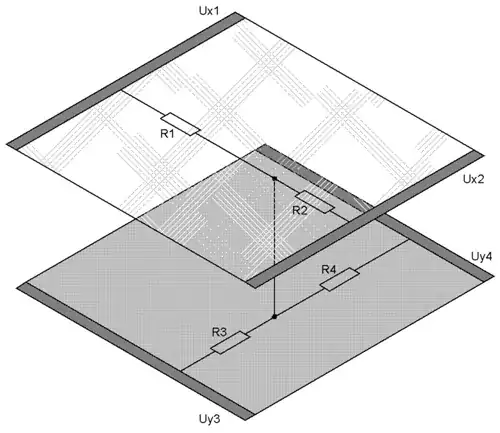
It's a hardware limitation. Resistive screens measure the resistance from the top and the left, and bottom and right of the pressed point, and derive X and Y coordinates from these.

Image portraying physical touchscreen and how the resistances are created

Pressing two points simultaneously can't give you multiple coordinates. It can confuse the controller, however, resulting in a complete irrelevant set of coordinates.
No matter what technology, to get multiple sets of coordinates you have to scan the grid, looking at one point at a time, which resistive doesn't.

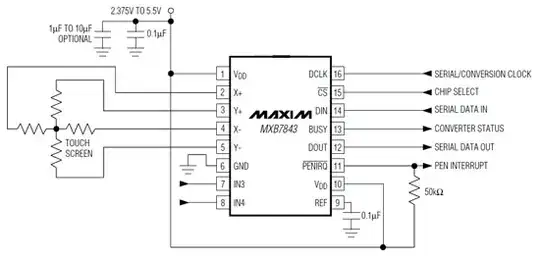
The application schematic for the MXB7843 touchscreen controller shows the electrical model of the touchscreen as the 4 resistors on the left.

example resistive screen reader application schematic

When you are looking at the image you can see that it only has physical inputs for one point so asking for two is just not there.

Kortuk
  • 13,412
  • 8
  • 62
  • 85
stevenvh
  • 145,832
  • 21
  • 457
  • 668
  • I edited your last sentence, telling someone it should be obvious might cause ignorance through a fear not understanding will cause them to look like an idiot. Second, I added text explaining what the images are. This means someone with a screen reader would be able to hear what the image was. Tell me if this edit changed your meaning too much for your taste. – Kortuk Jul 14 '11 at 15:56
  • 1
    It would seem that if there are two touches on an XY-resistive touch screen, the result would be a somewhat complicated resistor network defined by six parameters (XY of each touch, combined with strength). Measuring the resistance of of all combinations of terminals on the screen would also seem to yield six independent variables unless any combinations reades as a dead short. It would thus seem at least theoretically possible to determine something about the positions of two fingers if one had the right measurement circuitry connected to the screen. – supercat Jul 14 '11 at 16:44
  • @supercat - "the right measurement circuitry" will have to be a different technology. Currently when operating with two or more fingers there are too many variables to find their position unambiguously. – stevenvh Jul 14 '11 at 16:58
  • @stevenvh: I figure that with two fingers, there would be six unknowns, and the resistance measurements would yield six parameters. While it may well be that some combinations of resistances can be generated by more than one pair of touches, and others can't be generated by any, the space of possible measured combinations of resistance has the same cardinality as the space of possible pairs of touches. – supercat Jul 14 '11 at 19:15
  • @supercat - "some combinations of resistances can be generated by more than one pair of touches". This ambiguity means it won't work. It won't do if I press points A and B, and the computer makes it C and D. – stevenvh Jul 15 '11 at 05:26
  • @supercat and everybody - If you can convince me and others that it can work for two fingers (more is really impossible), feel free to add the method with formulas to my answer. I think this would be interesting to many. – stevenvh Jul 15 '11 at 05:28
  • @stevenvh: It won't work if the user interface would assign meaning to both possible gestures. It's not hard to imagine a user interface, though, where the only valid actions would be those that were unambiguous. As a simple example, a screen that has vertical sliders at the extreme left and right edge, and invites the user to slide a finger on each. Drive the top and bottom of the screen with VDD and ground, and the voltages read by the sides would be determined by the slider position. If there's only one finger, both side voltages would be identical, but... – supercat Jul 15 '11 at 15:11
  • @stevenvh: that case could be detected by connecting each side to a spare port pin (VDD, VSS, or float) through a resistor and seeing how much that changes the voltage. I don't know how to characterize all determinable combinations of finger positions, but at least some potentially-useful combinations could be detected. – supercat Jul 15 '11 at 15:13
3

Multitouch capable resistive screens do exist. I've had several LCD manufacturers in my office trying to sell me on them (plus, a simple Google search will provide many examples). But the screens need to be designed from the start with multitouch in mind. It's not something that a later software update can add.

Similarly, capacitive touch screens are the same way. They have to be designed with multitouch in mind, since it can't be added later. It's just coincidence and serendipity that most multitouch screens are cap-touch. Mostly it has to do with cap-touch being newer than res-touch.

Edit:

Here's some links about resistive multi-touch screens:

http://www.gizmag.com/getac-multi-touch/13078/

http://www.touchinternational.com/products/multi-touch-resistive-touch-screen.html

http://www.touchuserinterface.com/2009/06/how-stantums-resistive-multi-touch.html

It's really hard to find links about non-multitouch cap-touch screens. I guess nobody wants to advertise this "feature". The best that I came up with is this product page from Densitron: http://www.densitron.com/displays/Displays.aspx?nCategoryID=44

In the bullet list that page says that there are "Single and Multi Touch versions" of their projected cap-touch screens.

  • can you give us any links to material on this? – Kortuk Jul 14 '11 at 15:56
  • @Kortuk On which part? That there are multitouch res-touch screens? That there are non-multitouch cap-touch screens? That cap-touch is newer than res-touch? –  Jul 14 '11 at 16:09
  • if I picked, I would like links to more on all. More specifically the resistive touch because I had been taught resistive touch was never multi-touch and it seems another answerer was taught the same. – Kortuk Jul 14 '11 at 16:25
  • 1
    @Kortuk Done. Oh, wait, this comment isn't 15 characters long. Ahh, now it is. –  Jul 14 '11 at 16:48
  • 1
    @David - no it isn't. It's 78 long. – stevenvh Jul 14 '11 at 17:00