17

Radioactive element A radioactively decays into material B. If 75% of A and 25% of B are present, how many half-lives of material A have elapsed?

I was recently taught that the correct answer is "one half of a half-life has elapsed". However, due to the fact that the amount of radioactive material remaining scales exponentially (logarithmically) instead of in a linear fashion, wouldn't the answer be less than one half of a half-life?

Timtech
  • 381
  • 1
  • 4
  • 11
  • 3
    It doesn't scale quadratically, but rather exponentially (logarithmically). – gerrit May 08 '14 at 15:30
  • 2
    "I was taught that the correct answer is..." - you were taught badly (and you realize it which is good). Not only was the given answer wrong - the question was poorly phrased. In most instances element B would not be stable - and the only information you need is what percentage of A remains. Then again, determination of age often relies on ratios of isotopes present - but do realize you need to know the half life of the entire chain, not just the parent, in order to do the math correctly. – Floris May 10 '14 at 22:13
  • This is a math question. – Paul May 12 '14 at 21:47
  • For future visitors, this task can be facilitated on a TI-83 calculator or above using this program: http://tibasic.com/science/earth-science/ – Timtech Feb 01 '15 at 18:48

3 Answers3

25

@gerrit provided a formula, but without stating the reasoning behind it.

Radioactive decay is an exponential function. After $n$ half-lives, the amount of the original material remaining is

$$\textrm{amount remaining after}\ n\ \textrm{half-lives} = \left(\frac{1}{2}\right)^n$$

Therefore, you want to solve

$$\begin{align*} \left(\frac{1}{2}\right)^n &= \frac{3}{4}\\ \log_\frac{1}{2} \left(\frac{1}{2}\right)^n &= \log_\frac{1}{2} \frac{3}{4}\\ n &= \frac{\log \frac{3}{4}}{\log \frac{1}{2}} = \frac{\log \frac{3}{4}}{- \log 2} \approx 0.415 \end{align*}$$

200_success
  • 595
  • 4
  • 11
16

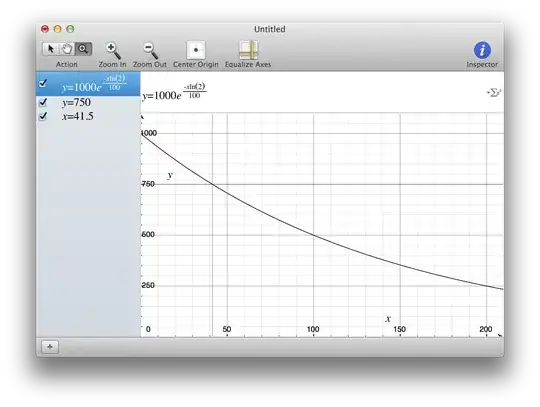
The other answers are entirely correct. But I like graphical representations.

From http://en.wikipedia.org/wiki/Radioactive_decay we see the decay formula is:

$$N(t) = N_0e^\frac{-t}{τ}$$

Where N0 is the starting number of nuclides and τ is the mean lifetime. We also see that the half-life is

$$t_{1/2} = τ ln(2)$$

Substituting for τ, we get:

$$N(t) = N_0e^\frac{-tln(2)}{t_{1/2}}$$

So for example if we have N0 = 1000 and t1/2 = 100 we can plot the following graph:

Exponential decay plot

Note that the horizontal axis is the t-axis.

We see the following:

  • At t=100 (one half life), N(t) is 500, half of 1000, as expected
  • At t=200 (two half lives), N(t) is 250, 1/4 of 1000, as expected
  • We intersect the curve with a line at N(t) = 750. Here we can see this occurs at about t=41.5 as predicted by the other answers.
200_success
  • 595
  • 4
  • 11
Digital Trauma
  • 261
  • 1
  • 6
  • 1
    Here we can see this occurs at about t=41.5 as predicted by the other answers. If you can see, that is. This site is overly-reliant on imagery. Good answers should be accessible to those who can't see / can't see very well. – David Hammen May 10 '14 at 00:50
15

You can use simple logarithms to calculate the answer. The number of half-lives that have elapsed can be calculated with

$$ - \frac{\log{f}}{\log{2}} $$

where $f$ is the fraction that remains.

So plugging in the numbers gives

$$ - \frac{\log(0.75)}{\log(2)} = 0.415 = 41.5\% $$

gerrit
  • 11,704
  • 2
  • 37
  • 87