19

Figure 1.12 from the IPCC AR5 WG1 report (reproduced below) illustrates the different instruments that have been used for weather forecasting.

Most of the methods have been in continuous use since their inception, except one: kites were used, but later disbanded.

Why is this so? This Monash university article from 1999 makes the point that they are superseded by radiosondes and aircraft. However, atmospheric measurements on aircraft are very expensive and mainly used for research as opposed to operational weather forecasting; and, unlike weather kites, they do not (normally) fly in the boundary layer¹. Radiosondes are only launched once or twice per 24 hours per location. Passive (operational) space-borne measurements have a lower vertical resolution, in particular near the boundary layer. I imagine that kites should provide a low-cost, high-resolution (both temporally and vertically) profile of the boundary layer. Why is it they are not really used operationally anymore?
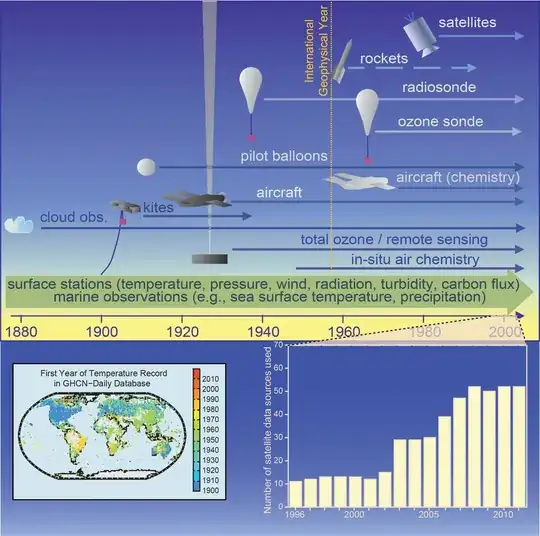
IPCC AR5 WG1 Figure 1.12
Figure 1.12 | Development of capabilities of observations. Top: Changes in the mix and increasing diversity of observations over time create challenges for a consistent climate record (adapted from Brönnimann et al., 2008). Bottom left: First year of temperature data in Global Historical Climatology Network (GHCN) daily database (available at http://www.ncdc.noaa.gov/oa/climate/ghcn-daily/; Menne et al., 2012). Bottom right: Number of satellite instruments from which data have been assimilated in the European Centre for Medium-Range Weather Forecasts production streams for each year from 1996 to 2010. This figure is used as an example to demonstrate the fivefold increase in the usage of satellite data over this time period. Figure reference: Cubasch, U., D. Wuebbles, D. Chen, M.C. Facchini, D. Frame, N. Mahowald and J.-G. Winther, 2013: Introduction. In: Climate Change 2013: The Physical Science Basis. Contribution of Working Group I to the Fifth Assessment Report of the Intergovernmental Panel on Climate Change [Stocker, T.F., D. Qin, G.-K. Plattner, M. Tignor, S.K. Allen, J. Boschung, A. Nauels, Y. Xia, V. Bex and P.M. Midgley (eds.)]. Cambridge University Press, Cambridge, United Kingdom and New York, NY, USA.


¹Research aircraft sometimes do. Flying in a full-sized jet 20 metre above the ocean surface is an interesting experience!

gerrit
  • 11,704
  • 2
  • 37
  • 87
  • 1
    were they not merely replaced with tall buildings, guyed masts, etc... being fixed structures from which reliable wind data could be recorded from. – Siv Apr 21 '14 at 19:31
  • 1
    Wind data from sensors on buildings are strongly disturbed by the flow modifications induced by the buildings. – BHF Apr 21 '14 at 19:53
  • solid structures, fixed structures, then perhaps – Siv Apr 21 '14 at 19:55
  • Think you need to rethink your assumptions, or at least state them. For example, your chart appears to show they haven't been used since roughly 1940, are you asking why they're not used now, or for the past 70+ years? Where would the sensors be, how much would they weight, etc? Where is wind data most needed and what if any risks are related to using kites in those locations? Would the kite be manned or unmanned? Honestly, question seems way to open ended to me as it is currently; though maybe I'm wrong, or have misunderstood the intent of your question. – blunders May 08 '14 at 02:35
  • Also, in my opinion, tethered balloons are not comparable to kites. – blunders May 08 '14 at 03:12
  • @blunders I'm not really making any assumptions in this question. I'm asking "why are they not used anymore". Is that unclear in any way? As for your other questions, do you think I should describe the properties of weather kites in more detail for this question to be answerable? – gerrit May 08 '14 at 13:41
  • By anymore, you mean why are they not used anymore right now, not why back in around 1940 they stopped being used, correct? (For example, unmanned kites were not around back in 1940.) And yes, I believe you should define what you expect them to be, since I was unable to find any modern reference to their use; that said, I was able to find semi-like uses of kites like Kite Aerial Photography. – blunders May 08 '14 at 14:00
  • Lastly, as stated above, it's my position tethered balloons are not comparable, and should be removed. If you believe they're comparable, believe you should explain why, and honestly, to do so would likely greatly expand the scope of the question. All that said, just to be clear, in my opinion, it's a valid question and of value too. – blunders May 08 '14 at 14:03
  • If you're "very" interesting in the topic, this book "Airborne Wind Energy (Green Energy and Technology)" appears to cover the topic in detail; here's the table of contents. – blunders May 08 '14 at 14:33
  • Was going to say that it could be dangerous with aircraft... but then again, we launch all these weather balloons too. Which got me wondering about the dangers of that. http://weatherjackwilliams.com/answers-weather-balloons-and-airplanes/ seems to think it's not impossible. Wonder if it could wrap in a propeller or melt after ingestion and cause engine issues. – JeopardyTempest Jul 14 '16 at 07:49

1 Answers1

12

Most data we collect about weather is done regularly and for all altitudes of the troposphere. Kites, though, are at the mercy of the weather and do not fly high enough. So when there is ice or snow or other meteorological conditions that don't allow a kite to fly, you get no data. We now use methods to measure the weather that don't break in bad weather. The answer to your question is succinctly put in this NOAA webpage where they state these difficulties with kites:

  • The average altitude reached was only about 3 km.
  • Data could not be evaluated until after the kite was reeled in...
  • Observations could only be taken in good weather with winds neither too light or too strong.
  • There was danger of the kite breaking away and endangering lives and property.

In the 1940s, weather balloons were being released and could gather an entire profile of data in all weather conditions. This is far superior to a kite. That being said, some people do still use kites: High-Flying Science, with Strings Attached.

Ken Graham
  • 277
  • 1
  • 3
  • 10
f.thorpe
  • 13,583
  • 2
  • 46
  • 89