0

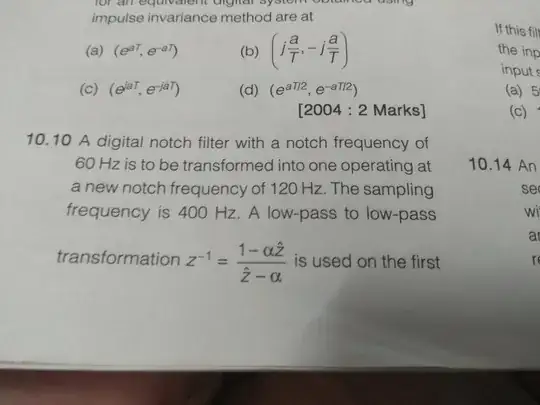
I am unable to solve this question, 10.10 from GATE IN 2004 (a previous year question paper for an exam targeted at engineering graduates in India.)
10.10 part 1 10.10 part 2

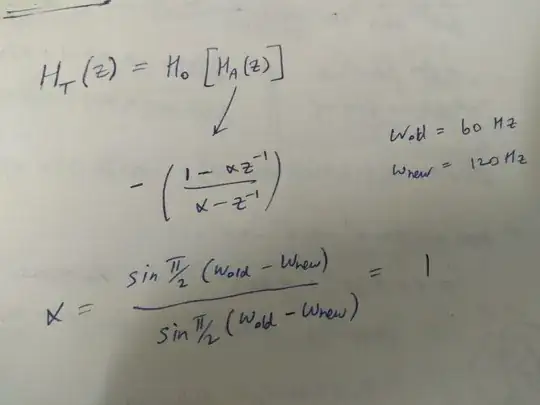
So I tried to solve the 10.10 by considering the real frequency shift transformation's general form,
My attempt

I am not getting any answer close to the options! I wonder what I am doing wrong.

So 1) what is the answer to the question 10.10 shown above?

2) how is this formula for the coefficient derived?

Aditya P
  • 171
  • 3
  • 9

1 Answers1

2

This is an allpass transformation, i.e., the unit circle is mapped to itself. On the unit circle we have

$$e^{-j\omega_0}=\frac{1-\alpha e^{j\hat{\omega}_0}}{e^{j\hat{\omega}_0}-\alpha}\tag{1}$$

For given values of $\omega_0$ and $\hat{\omega}_0$ you can compute $\alpha$ from $(1)$:

$$\begin{align}\alpha&=\frac{1-e^{-j(\omega_0-\hat{\omega}_0)}}{e^{j\hat{\omega}_0}-e^{-j\omega_0}}\\&=\frac{e^{-j(\omega_0-\hat{\omega}_0)/2}}{e^{-j(\omega_0-\hat{\omega}_0)/2}}\cdot \frac{e^{j(\omega_0-\hat{\omega}_0)/2}-e^{-j(\omega_0-\hat{\omega}_0)/2}}{e^{j(\omega_0+\hat{\omega}_0)/2}-e^{-j(\omega_0+\hat{\omega}_0)/2}}\\&=\frac{\sin\left(\frac{\omega_0-\hat{\omega}_0}{2}\right)}{\sin\left(\frac{\omega_0+\hat{\omega}_0}{2}\right)}\tag{2}\end{align}$$

With $\omega_0=2\pi\cdot 60/400$ and $\hat{\omega}_0=2\pi\cdot 120/400$ we get from $(2)$ the value $\alpha=-0.45965$.

Matt L.
  • 89,963
  • 9
  • 79
  • 179