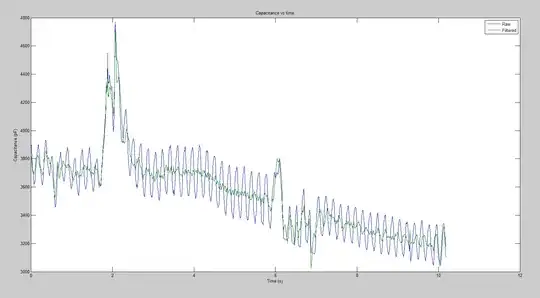
As already noted in two other answers a notch filter is often a sensible option to remove a specific tonal noise component from a measured signal.
There is however a trade off between the width of the notch filter and the suppression that can be achieved: narrow notch filters are deep and therefore have high suppression, while wide notch filters are relatively shallow and will have significantly less suppression. Effectively suppressing a strong tonal noise component requires high suppression and therefore accurate knowledge of the disturbance frequency.
This knowledge might not always be available or there might be significant variation in the disturbance frequency making the application of a notch filter ineffective. As mentioned by @Stanley Pawlukiewicz this uncertainty can be tackled by applying an adaptive notch filter. Although this can be made to work very well it might be overkill in specific applications.
Alternatively, assuming that frequency domain content below the disturbance frequency is not of interest, applying a high pass filter might also be an option. This however depends on the filter order you can get away with (e.g. due to acceptable phase distortion) and the ratio between the filter corner frequency and the disturbance frequency (which together with the slope of the filter determines the suppression at the disturbance frequency).