13

I'm gathering temperature data from a refrigerator. The data looks like a wave. I would like to determine the period and frequency of the wave (so that I can measure if modifications to the refrigerator have any effect).

I'm using R, and I think I need to use an FFT on the data, but I'm not sure where to go from there. I'm very new to R and signal analysis, so any help would be greatly appreciated!

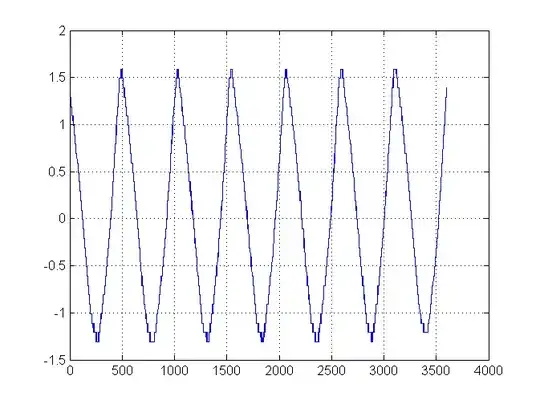
Here is the wave I'm producing:

My wave

Here is my R code so far:

require(graphics)
library(DBI)
library(RSQLite)

drv <- dbDriver("SQLite")
conn <- dbConnect(drv, dbname = "s.sqlite3")

query <- function(con, query) {
  rs <- dbSendQuery(con, query)
  data <- fetch(rs, n = -1)
  dbClearResult(rs)
  data
}

box <- query(conn, "
SELECT id,
       humidity / 10.0 as humidity,
       temp / 10.0 as temp,
       ambient_temp / 10.0 as ambient_temp,
       ambient_humidity / 10.0 as ambient_humidity,
       created_at
FROM measurements ORDER BY id DESC LIMIT 3600
")

box$x <- as.POSIXct(box$created_at, tz = "UTC")

box$x_n <- box$temp - mean(box$temp)
png(filename = "normalized.png", height = 750, width = 1000, bg = "white")
plot(box$x, box$x_n, type="l")

# Pad the de-meaned signal so the length is 10 * 3600
N_fft  <- 3600 * 10
padded <- c(box$x_n, seq(0, 0, length= (N_fft - length(box$x_n))))
X_f    <- fft(padded)
PSD    <- 10 * log10(abs(X_f) ** 2)

png(filename = "PSD.png", height = 750, width = 1000, bg = "white")
plot(PSD, type="line")

zoom <- PSD[1:300]

png(filename = "zoom.png", height = 750, width = 1000, bg = "white")
plot(zoom, type="l")

# Find the index with the highest point on the left half
index <- which(PSD == max(PSD[1:length(PSD) / 2]))

# Mark it in green on the zoomed in graph
abline(v = index, col="green")

f_s     <- 0.5 # sample rate in Hz
wave_hz <- index * (f_s / N_fft)
print(1 / (wave_hz * 60))

I've posted the R code along with the SQLite database here.

Here is a plot of the normalized graph (with the mean removed):

normalized graph

So far, so good. Here is the spectral density plot:

spectral density

Then we zoom in on the left side of the plot and mark the highest index (which is 70) with a green line:

zoom in on spectral plot

Finally we calculate the frequency of the wave. This wave is very slow, so we convert it to minutes per cycle, and print out that value which is 17.14286.

Here is my data in tab delimited format if anyone else wants to try.

Thanks for the help! This problem was hard (for me) but I had a great time!

Aaron Patterson
  • 233
  • 2
  • 6
  • Aaron, I think the best thing here is for you to put a link to your data file (as a text or something) on a dropbox, so that I can download it and give you the answer. Otherwise there is going to be a lot of going back and forth. I cannot make out the numbers on the far left end. :-) (Also give you sample rate - that is, how often you are taking a temperature reading). – Spacey Jun 02 '12 at 22:14
  • Ah, sorry. The data contains temperature in degrees C, I converted to degrees F for the graph. It is the correct data though (it's the "temp" column). – Aaron Patterson Jun 02 '12 at 23:19
  • The problem with measuring frequency that way is that if you get considerable variability from cycle to cycle then it will be much harder to determine the average frequency -- the peaks will smear together -- whereas simply counting time between excursions will let you average things nicely (and also compute std dev, etc). Using the FFT approach would be more called for if there were a lot of noise, but that doesn't seem to be the case here. – Daniel R Hicks Jun 03 '12 at 12:12
  • +1 for posting, code, data, plots, and a link to github. – nibot Jun 03 '12 at 13:15
  • @DanielRHicks In this particular case, I do not think it matters, but yes, the FFT will give you the average of all of them, whereas if we did something like a zero-crossing, we would measure each cycles duration (frequency), and then we can determine if we want to take mean, median, mode, etc. Good point! – Spacey Jun 03 '12 at 17:02

3 Answers3

8

Interesting project you have going on there! :-)

From a signal analysis POV, this is actually a simple question - and yes, you are right that you would utilize the FFT for this frequency estimation problem.

I am not familiar with R, but what you essentially want to do is take the FFT of your temperature signal. Since your signal is real, you will get a complex result as the output of your FFT. You can now take the absolute magnitude squared of your complex FFT result, (since we dont care about phase). That is, $real^2 + imag^2$. This is your power spectral density.

Then, very simply, find the max of where your PSD sits. The abscissa of that max will correspond to your frequency.

Caveat Emptor, I am giving you a general outlook, and I suspect the result of the FFT in R will be normalized frequency, in which case you would have to know your sample rate, (which you do), in order to convert it back into Hz. There are many other important details that I am leaving out, such as your frequency resolution, FFT size, and the fact that you probably want to de-mean your signal first, but it will be good to see a plot first.

EDIT:

Let us take your signal into account. After I de-mean it, it looks like this:

enter image description here

You want to de-mean because the DC bias is a frequency of 0 Hz technically, and you do not want it to drown out other frequencies of interest. Let us call this de-meaned signal $x[n]$.

Now, when you take the FFT, you must take heed of some details. I use an FFT length of 10 times the length of the signal, so we can say that $N_{fft} = 10 * 3600 = 36000.$ Any FFT size set greater than the size of the original signal has the effect of interpolating your FFT result in the frequency domain. While this doesnt add any information for you from an information theory POV, it does help you better discern where exactly your true peak lies, especially in cases where it lies between two frequency bins. To get true better frequency resolution, you want to get more data. (i.e, let the sensor run for a longer period of time).

Moving along, from the text file, I see that your sensor is taking temperature readings every 2 seconds. This means that your sampling rate, or $f_s = 0.5 Hz$

Thus, let us take an FFT of $x[n]$, and call that result $X(f)$. This result will be complex, and in fact, it is conjugate symmetric, but thats not important here. (It just means for your purposes, half of it is redundant). Now if we take $10log_{10}(|X(f)|^{2})$, this is the power spectral density (in log scale). The result looks like so:

enter image description here

You can see how it is symmetric. If you ignore the last half, and just look at the first half and zoom in you, can see this:

enter image description here

So you have a peak at index 70! But what is index 70 in real frequency terms? Here is where you want your frequency resolution. To compute that, we simply take $\frac{F_s}{N_{fft}} = 1.3889e-005 Hz$. This simply means that every index represents a frequency that is a multiple of this number. Index 0 is $0 * 1.3889e-005 = 0 Hz$. Index 1 is $1 * 1.3889e-005 = 1.3889e-005 Hz$. Index 70 is $70 * 1.3889e-005 = 9.7222e-004 Hz$.

We are almost done. Now that you have this figure, we can convert it to something more palatable. This figure is just saying that your signal completes 9.7222e-004 cycles every second. So we can ask, how many minutes does it take to compute one cycle? Thus, $\frac{1}{(9.7222e-004)*60} = 17.14$ minutes per cycle.

Spacey
  • 9,817
  • 8
  • 43
  • 79
  • @AaronPatterson I have edited the post, please see. Also, you may add your pictures directly to your original post. :-). Please add an image of the PSD result that you get. – Spacey Jun 02 '12 at 19:18
  • 1
    Not exactly correct if the frequency turns out to be between FFT result bins. – hotpaw2 Jun 02 '12 at 21:15
  • @hotpaw2 That is why I warned OP that I am giving general outlook, and why I need to see the plot. All the same, I have edited to add the extra caveats. – Spacey Jun 02 '12 at 21:35
  • Hi @Mohammad, I tried to reproduce your results in R, but I'm having a bit of trouble. Would you mind taking a look at my updated post? For some reason when I zoom in on the spectral density plot, I don't see a peak at index 70. I'm not sure if this is something R is doing, or if I messed up one of the equations. – Aaron Patterson Jun 03 '12 at 04:39
  • @AaronPatterson Not that it should matter too much, but to reproduce my results, remember I used an FFT size of 10*3600. Here, it looks like you used an FFT size of 3600. (The original size). (You want to use a bigger size to get some good frequency interpolation for the peak picking process.) – Spacey Jun 03 '12 at 04:44
  • I'm really sorry, I don't really understand what you mean by 103600. I understand that 3600 is my original sample size, how do I increase the size by 10x? Are you just using the same data over and over 10 times? The fft function in R doesn't allow me to enter a factor, so I'm not sure exactly what to do with the 10. Thank you for being patient with me! – Aaron Patterson Jun 03 '12 at 05:02
  • @AaronPatterson Ah, it appears R doesnt do the automatic zero-padding for you. No worries. All you need to do is append 36000-3600 = 32400 zeros to the end of your original vector before you FFT it in R. I think that should do it. – Spacey Jun 03 '12 at 05:36
  • Sorry I missed you on the chat thing. I was able to pad my vector with 0s, and now I'm getting the same values as you! I will finish updating my R program to include the final calculations. Thank you very much for this help! If you have time, I'd really appreciate book recommendations for getting started with DSP! Thank you! – Aaron Patterson Jun 03 '12 at 06:23
  • 1
    @AaronPatterson No problem, glad to help. As far as books, look at Richard Lyons "Understanding DSP" - that is a fastastic book to get started on. – Spacey Jun 04 '12 at 20:57
  • @Mohammad What is "005"? I'm trying to learn from this answer and apply it to a problem I'm working on, and I want to make sure I understand. Is it the sampling rate (i.e. 0.5 Hz)? – Jota Jan 20 '14 at 01:46
  • 1
    @Frank That is just an exponential. $1.3 \text{x} 10^{-5}$, for example. – Spacey Jan 20 '14 at 12:54
  • @Mohammad Ah, OK, thanks. I guess I've not encountered that style, and it seems a bit weird to me with the "e" in there and the seemingly superfluous zeros. For anyone else as slow as me: Fs/Nfft = 0.5 / 36000 = 1.3889e - 005 – Jota Jan 20 '14 at 19:39
  • @Frank I was defaulting to how it is written in MATLAB. (We would write "1.3e-5" in MATLAB for example). Sorry for that! :-) – Spacey Jan 20 '14 at 20:00
4

There is no need to do anything complicated: just measure the duration between peaks of the waveform. This is the period. The frequency is just 1 divided by the period.

With about 8 cycles over 2 hours, the frequency is 4 cycles per hour, or about 1 mHz.

nibot
  • 3,803
  • 5
  • 29
  • 40
4

For a waveform this smooth and stationary, counting sample points between positive going crossings of some average threshold value will give you a period estimate. Look at several threshold crossing periods to get a more average estimate or detect any trend.

hotpaw2
  • 35,346
  • 9
  • 47
  • 90