Short question
How to plot the magnitude of frequency response of the delay line canceller with non constant period using GNU Octave? Or more directly: how to plot magnitude of frequency response of staggered PRF (pulse repetition frequency) MTI (moving target indicator) processors?
Full question
I try to plot magnitude of frequency response of the MTI delay line canceller (some kind of FIR) which has the following structure using GNU Octave:

With tips in my related post I can plot frequency response for constant period:
close all;
clear all;

T   = 1e-3;
f   = linspace (0, 2 / T, 1000);
w   = 2 .* pi .* f;
z   = exp (-j .* w .* T);
H_z = 1 - z .^ -1;

plot (f, abs (H_z), 'r', "linewidth", 2);
hold on;
grid on;
title ("Magnitude of the frequency response of the delay line canceler.");
xlabel ("Frequency.");
ylabel ("Magnitude.");
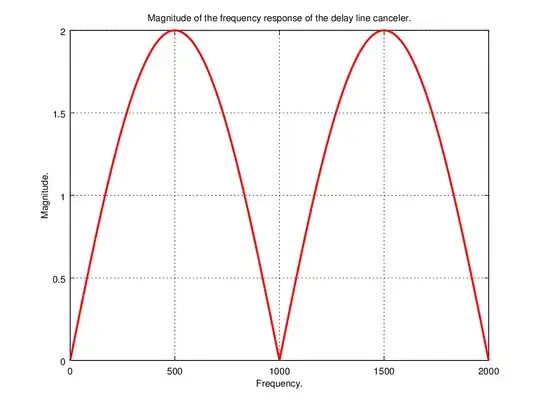
But now I am interesting in frequency response for non constant period:
- determinate values of period;
- random values of period.
I try to do in the following way:
close all;
clear all;

T_1   = 0.001;
T_2   = 0.0012;
f     = linspace (0, 2 / min (T_1, T_2), 1000);
w     = 2 .* pi .* f;
z_1   = exp (-j .* w .* T_1);
z_2   = exp (-j .* w .* T_2);
H_z_1 = 1 - z_1 .^ -1;
H_z_2 = 1 - z_2 .^ -1;
k     = 1 / 2;
H_z   = k .* (H_z_1 + H_z_2);

plot (f, abs (H_z), 'r', "linewidth", 2);
hold on;
grid on;
title ("Magnitude of the frequency response of the delay line canceler for alternate values of period T1 and T2.");
xlabel ("Frequency.");
ylabel ("Magnitude.");

Another words, I mean that: common frequency response is the normalized sum of the frequency response for each value of the period.
Am I right? If yes, is this approach will be correct for random values of period?
Notes
Here is some related papers, when mentioned frequency response of staggered PRF MTI processors:


