Why do electricians prefer not to use the back-stab or quick connect holes on switches and receptacles? If these were unreliable do you think they would be allowed by the NFPA and NEC?
Asked
Active
Viewed 5.7k times
14


-
3I abhor back-stab and yet I permit myself to use push-in wire nuts... – Mazura Nov 28 '14 at 10:55
-
3@Mazura LOL Isn't it funny how we all individually chose what's acceptable and what's not? I know many who just hold the wires together and put the wire nut on. I ALWAYS twist them with my linemens before nutting them. – Dave B Nov 28 '14 at 21:05
-
1From all I've heard (and one experience 30-35 years ago) the "back stab" connections are unreliable (and, as a result, I don't think they've been made for 20 years or so). The newer style where you just push the wire in and then tighten the screw, however, are probably MORE reliable (and less likely to short to adjacent wires) than the traditional wrap-around-the-screw scheme. – Hot Licks Nov 29 '14 at 13:15
-
1No fires but unreliable, stabs are still out there. The stabs are a no tool required cheap connection 14 awg. Some are getting confused with back & side that require a torque of 9-16 inch lb to be installed properly these are much better. – Ed Beal Oct 12 '17 at 01:49
-
I've seen 2 device failures recently, a broken switch and an overheating receptacle. Both had backstabs. On the receptacle, someone just jammed #12 stranded into the #14-only hole on all 4 connections, resulting in half the strands refusing to go into the hole. – Harper - Reinstate Monica Apr 25 '19 at 23:23
7 Answers
26
The sockets I've been using for the last 15 years have standard screw connection, holes behind that location where the screw pulls a plate against straight stripped wires and the push-in holes.
After you've encountered a few burnt sockets from using the push-in connection in the first couple outlets in a daisy chain, you start to realize something.
The straight connections behind the screw are mechanically sound and require only a wire stripper and a screwdriver. You don't really save much time using the push-in.
Hoping and wishing that brass retains its spring pressure to maintain a tight, low resistance connection on the push-in connector after many heat cycles anneal it, doesn't make the connection mechanically sound.
When the spring pressure relaxes as the metal loses its work hardening, you are left with a loose connection which heats, further anneals the brass spring and then proceeds to get hot enough to melt the supporting plastic shell.
Afraid to burn a house down during its lifetime? --OR-- Proud of sturdy craftsmanship that only takes a wire stripper and a screwdriver to make a solid, permanent connection?
Take your pick on how you word it, I'd rather err on the side of wearing the socket out from use, not having to replace it due to burning and melting from a loose connection.
Further observations:
On the mechanical connections: Brass has a similar coefficient of expansion as copper so is slower to loosen if tightened properly. This is one of the reasons why the old copper wire only sockets would fail with aluminum wire.
Due to daisy-chain failure, I once sectioned the side out of a new socket to verify "spring-loading" in the push-in contact. As copper wire is flexed, it work hardens. This allows the wire to put side pressure against the spring contact as the socket is pushed back into the box for mounting which can slightly unseat the connection. The lessened contact pressure causes resistance. Heat eventually anneals the spring causing it to lose its "tightening" ability leading to enough heat to melt the plastic supporting the contact. That observation is from disassembling a failed socket and the closeness that the hot conductor came to the others after burning/melting the support plastic was not good.
If you look up the receptacle specifications, the push-in is rated for 14 gauge wire. If your circuit breaker is 20 amp, you will be using 12 gauge wire and have to use screw head or straight in mechanical connections.

wallyk
- 12,339
- 3
- 23
- 50

Fiasco Labs
- 11,340
- 1
- 27
- 44
-
2You should be more explicit on the why. Push-in connections create an unreliable contact. It can have resistance. Current in a resistance produces heat. It can overheat to the point of burning the socket or the whole house. – Florian F Nov 28 '14 at 09:05
-
-
1I'm having trouble with the logic here. Screw terminals have no way to tighten up with age and cycling. The spring-loaded pushin however would tighten as the connection loosened. – DocSalvager Dec 01 '14 at 20:19
-
1Bad answer. Most outlets don't have "straight connections behind the screw." You have to bend the wire around the screw. The push-in connections are UL rated; they aren't fire hazards, and they don't pull out. Finally, why would you even suggest putting 20A into an outlet rated for 15A? – Sophit Dec 08 '14 at 20:08
-
2Because it's common practice in the US to use multiple 15A sockets on a 20A breaker with 12GA wiring. – Fiasco Labs Dec 09 '14 at 02:22
6
It's not that we are afraid of anything. It's that it makes poor business sense to use such a failure prone connection. Thing is, they are just unreliable. It's not that they are unsafe.

Speedy Petey
- 16,413
- 2
- 28
- 50
-
5If they were unreliable, they would be unsafe. It's an electrical connection. You can't have one or the other. It's either a reliable connection or a fire hazard. – Sophit Dec 08 '14 at 20:10
-
4I wholly disagree. They certainly CAN be unreliable and also safe. If the connection opens and things stop working it can still be safe. If the connection opens and every time it bursts into flames it is unsafe. – Speedy Petey Dec 08 '14 at 22:09
-
1If the connection "opens" and things "stop working", that means your wire has come out of the outlet. That means increased resistance while it's slightly loose, and possible sparks/shorts as it pulls out further. Either of those can cause fires. I honestly don't know what you're thinking here. – Sophit Dec 08 '14 at 23:14
-
Have you ever worked on these things? I get the impression you haven't. – Speedy Petey Dec 08 '14 at 23:29
-
1Yes, and I've also seen wires pull out. When wires pull out, it's a fire hazard. You need to revisit your training; safety is the primary concern when wiring outlets. – Sophit Dec 11 '14 at 00:17
-
2Oh please with the covert insults. Now you're just looking for an argument. Work in the field for 25 years and you'll see what I mean. I stand by my assertion: Just because these connections are known to be unreliable does not automatically mean they are all unsafe. – Speedy Petey Dec 11 '14 at 01:25
-
Profesional electrician here also + for unreliable but safe. I think back stabs should be outlawed! I have replaced hundreds of failed BS outlets and switches since the 70's. Speedy Petey's answer & comments are dead on, I hate charging 100-150$ to replace a bad outlet but travel time and tracking down the outlet can take time even with scanners that detect the problem through walls. Failed electrical looks bad on all electricians. I have never seen more than a little melted insulation from these failures. Next they cause arc fault breakers to trip. All this to save a few seconds install time – Ed Beal Oct 12 '17 at 01:07
3
Push-in's (i.e. back-stab terminals) were popular in the 70's and a failure as most of the comments refer to. However, as I like to say, The new push-ins are not your fathers push in. You will be hard pressed to even find a screw in connector in Europe. Schneider, a large electric manufacturer who also owns Square D, does not make screw type connectors in their outlets or panels in the European market. A infrared camera picture of the screw in vs the new push in showed a substantial heat source (can you say "loose connection?") on screw-in vs the new-style push-in. We are hard to change but current technology every place other than the US supports the new-style push in terminals.

ThreePhaseEel
- 83,293
- 29
- 137
- 230

Ametty
- 39
- 1
-
Interesting info, can you cite codes from EU nations or catalog references? – Freiheit Dec 06 '16 at 15:52
-
I've seen my fair share of European installations. The push-in is not as universal as you claim. The top-of-the-line products feature it, but they also assume top of line in the rest of the installation... which is often not the case. Push-in connectors easily break old household wire, especially when you try to remove the wire. Legrand makes plenty of screw based products, especially in their low and mid range (Niloe etc.) – the gods from engineering Oct 11 '17 at 20:37
-
Most of the EU equipment I have worked on used screw clamps for terminals instead of wirenuts, in 1 case a company came here to remove all the spring loaded terminals because they kept failing on these the wires actually vibrated out. The only place I will use a wego or spring terminal is in a fluorescent light because the very low current they hold but anything more than 50w I go to wire nuts or crimps. – Ed Beal Oct 12 '17 at 01:31
-
I just had a thought that the reason push connectors are used more in the UK may be because of the higher voltage lower current, as I have said I have no problem with the push in connectors in Flouresent fixtures where the current is low usually less than 5 amps. But have replaced hundreds of failed dasiy chained outlets and even some switches. With lighting loads becoming less due to Flouresent and LED I could see using wego connectors in the lighting circuits but still think the outlets should be more of the back and side (clamp style). – Ed Beal Feb 28 '18 at 14:45
-
Whaat! here (Italy, hence EU) backstabs are never found on switches or sockets, are very rarely found on ultra-cheap chinese lamps of the mid '00. I think this is also because here all wiring is done with 'flexible' wire: the single core wire was de facto abandoned in the 80s. Try to see all our manufacturers (BTicino, Vimar, Gewiss) and tell me how many "backstabs" you're able to find. – DDS Apr 21 '20 at 10:12
3
Yes, unreliable devices are allowed by electrical codes. Further than that, unreliable devices are sometimes MANDATED by the electrical codes: AFCI circuit breakers, for instance. The fact that the manufacturers of these devices have a great deal of influence in the bodies that create the codes may explain this situation.

kreemoweet
- 3,529
- 13
- 13
-
-
I agree GFCI's were really crappy when I was an apprentice but they were code, now AFCI'S they don't work well with full loads of modern electronics when I say full loads close to 80% when running lighting that is dimmed, or the mandated electronic ballasts that do not last. Most don't realize the warranty on these devices is only 2 years on the best quality AFCI'S & GFCI'S and getting a waranty replacement? They do not last and they do not do the job for the circuits mandated. I am lucky my state will allow AFCI not to be used if a known problem and no GFCI'S behind fridges required. – Ed Beal Oct 12 '17 at 01:23
2
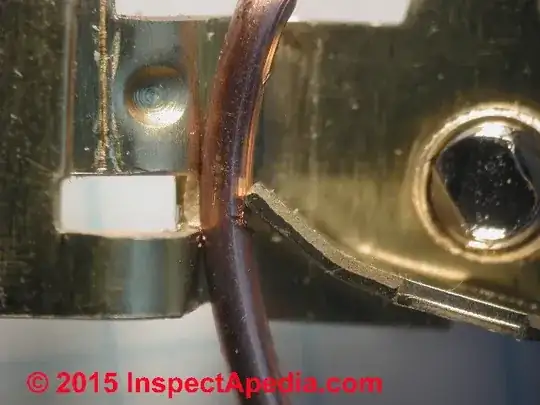
Do you see the connection? Two thin edges and and one of them where there is damaged wire. This can create hot spots that are invisible outside of the device. As the metal heats and cools over its life time the connection and become weaker making it get hotter.
Compare this to wrapping a the wire around a screw, which tightens up as you tighten the screw. Anyone can visually inspect the latter while the above picture you would never see. I myself use pigtails when connecting devices whenever I can. This way if there is device failure it is localized instead of taking out the rest of the circuit.
Some people choose to use the cheapest, fastest and sloppiest work they can to complete a job. Yes it might be OK 1,000 times but that 1,001th time when it fails it could not be their fault, oh no it must be a manufacturing defect or some such. When these types of connections fail it is usually immediately or years down the road. Which means fixed then or it is past their warranties. Small condolence when someones house burns down.

Machavity
- 24,720
- 7
- 42
- 93

William Bowen
- 21
- 1
-
The spring itself is part of the current path. Brass is not an ideal spring material. So as it heats up from current passage, it loses spring strength. – Harper - Reinstate Monica Apr 25 '19 at 23:24
1
The biggest problem in services is the client. Imagine you've wired whole house with push-ins but then the client decides he/she wants the light switch on the other side of the door, or the sockets in different color. With screw connections, you can disassemble and reassemble the installation. Without screws - you're screwed.

Agent_L
- 1,670
- 11
- 13
-
4
-
2
-
Sorry. Didn't realize this would touch such a nerve with so many. Just always wondered. Some answers seem plausible just don't agree with the manufacturer's having influence with the NFPA and NEC. Not sure what they would have to gain by adding this option. Maybe contractor's. – Dave B Nov 28 '14 at 19:44
-
1
-
@Agent_L, devices with only push-in connections were only found in a short time frame, I believe in the early 70's. All other devices had/have both push-in and side screws, so doesn't that make your point relatively moot? – Speedy Petey Nov 28 '14 at 20:35
-
2@SpeedyPetey It makes my point even stronger. It means every electrician with every socket have a choice: save 3 seconds and use the option that may cause problems in the future or spend 3 seconds tightening the screw and save yourself shitload of work if something goes wrong. Seems like a no-brainer to me. – Agent_L Nov 28 '14 at 21:25
-
@SpeedyPetey, your comment makes sense to me. Agent_L, I'm pretty sure his point was simply that you can pull the wires out of the backstab sockets, clean 'em up and screw them down to the posts that exist on the same device, except for devices produced during a short period of time in the 1970's which only had the backstab sockets. Meaning (belt and suspenders here) that disassembly doesn't ruin the device. Right? – Craig Tullis Nov 29 '14 at 00:21
-
3@Craig ahh, my mistake. You're thinking the socket is valuable, but it's not. Socket is expendable. You can always go to Home Depot and buy a new socket for a few bucks. It's the wire that's the expensive part. The wire is permanently damaged by a one-time connector, so you need to trim it and re-strip. Do this too many times and it's too short to reach the socket anymore. Now you have to replace wires in the wall, which often means tearing down part of wall and rebuilding it anew. And that cost is simply not comparable to time spent tightening all screws in the house. – Agent_L Nov 29 '14 at 08:20
-
Well... sure. No, the device is cheap. Of course, the cheaper the more likely you'll end up replacing it, probably. And for the record I prefer the screw down terminals, the exception being the newer backstab sockets where tightening the screws clamps the wire in. But either way, the original "electrician" did leave at least 6" or 8" of wire sticking out of the box for this very reason, right? How many sockets are you planning to replace? :-) And even if you've had to replace 5 or 6 of them, before you get to that point, you've pigtailed the wires in the box so this is all a non-issue. – Craig Tullis Nov 29 '14 at 11:46
-
Dunno about US push-in terminals, but the ones sold in EU all have levers that allow the wires to be unplugged. They often require pulling more of the device out the wall though, compared to screw terminals. – the gods from engineering Oct 11 '17 at 23:23
-
1The outlets that clamp the wire entering from the back and require torquing are not back stabs , these outlets are called back & side the screw clamps a pair of jaws or the wire can be wrapped around the screw. When we reference stabs we are talking a no tool 14 awg wire connector built into the outlet that requires no tools, just stab and the wire is locked. If stabs were so good why did they not allow 12 awg wire? Answer they don't hold up to the higher load. – Ed Beal Oct 12 '17 at 01:42
0
Not only that, but a 5% drop in voltage at any point from the panel is "recommended" as the maximum voltage drop. When I had my previous house built in 1996, the apprentice ran so much wire up and down the walls, that i hat a 15% drop in my bedroom. I threatened to call the state wiring inspector if it wasn't fixed. It was. Push in contacts can also lead to more voltage drop through contact resistance.

sborsher
- 746
- 5
- 6