27

In a farm setting, my brother asked me what could cause him to get a shock from an outdoor hose bib at the pump house? He was prepping for freezing weather and disconnecting hoses from hose bibs. There was a ground wire attached (poorly) to the galvanized pipe that was going into the the buried pipe. He also mentioned that he noticed arcing (as in SPARKS!!!!) at the piping when the pump started.

What could cause me to get shocked by a hose bib?

FreeMan
  • 47,262
  • 25
  • 88
  • 193
George Anderson
  • 23,214
  • 3
  • 40
  • 81
  • 3
    Self-answered questions are 100% great! Don't make a big deal out of it, just do it. ;) – FreeMan Feb 01 '23 at 17:03
  • I'm assuming you're not shuffling around outside with your fuzzy slippers? – Huesmann Feb 02 '23 at 19:19
  • @Huesmann Yeah my PFBS (pink fuzzy bunny slippers) are soooo comfy when when wet and out side and working on a ground fault, get a nice tickle at times! LOL (just kidding of course). I was very careful. My bros are fish farmers, usually in wet waders, wet hands...good conductors, so it wasn't surprising that they would feel it first. – George Anderson Feb 02 '23 at 20:55

2 Answers2

37

When my bros called for help, I took a few tools and meters with me. Took a couple of measurements from the pipe to actual ground...very low voltage....OK....now what? Fiddled with the ground wire attached to the piping and it started arcing due to the poor connection! I thought Oh H E double hockey sticks this is really bad. I have 2 amp clamp type DMM and both said, even though the readings where varying the both read between 5-10 amps on a EGC (equipment grounding conductor) which is a ridiculous amount of current for and EGC. I told them not to touch any metal pipes , call the PoCo and tell them 3 words to get immediate attention: potential lost neutral and that would get their attention.

The PoCo showed up quickly and determined they didn't have a problem but the tech noticed a splice in the triplex going to the farm building and because he had a bucket truck, he volunteered to inspect the splice. Sure enough, it was a damaged / lost neutral. They fixed it at no charge even though it was on the customer side of the meter.

FreeMan
  • 47,262
  • 25
  • 88
  • 193
George Anderson
  • 23,214
  • 3
  • 40
  • 81
  • 4
    Unusual result of a lost neutral, so most people might not expect shocks from piping to be the cause. – crip659 Jan 31 '23 at 20:02
  • only happens when the water pipes are not in soil, or have pvc section – Traveler Jan 31 '23 at 20:25
  • There's nothing particularly unusual about that amount of current on the grounding system. That system is a parallel path back to the supplying transformer, and the relative resistances of service neutral path and ground path will determine how the "return" current is divided between the two. I've seen as much as 40% of all 120V unbalanced load current show up on the grounding electrode conductor, though that would be rare. – kreemoweet Jan 31 '23 at 21:59
  • 1
    @Ruskes nope, galvanized steel the whole way and buried. – George Anderson Feb 01 '23 at 04:00
  • @crip659 this is a farm that runs a lot of pumps constantly, some 240 some 120. The 240v ones worked fine the 120v were wonky , like if they turned on a 120v space heater , the pump would quit. I just said this a classic example of a lost neutral. The thing that surprised me was there was so much current flowing thru the EGC that the ground (steel pipe) and still returned enough voltage to shock someone. – George Anderson Feb 01 '23 at 04:05
  • 5
    @GeorgeAnderson In a farm context you have another issue, especially if dealing with cattle or horses... The potential gradient in the ground close to that earth can easily be great enough to (worst case) kill a horse or cow, and more commonly will significantly reduce milk production in cattle if that is your thing. Combined earth/neutral once past the suppliers demarc are a bad idea anyway, and a horrible idea where quadrupeds are concerned. There is plenty of literature around this in dairy farms. – Dan Mills Feb 01 '23 at 15:13
  • @DanMills Is there a reason this would be specific to quadrupeds? Is it just because of the distance between their front and back legs? E.g. if you did a wide split with your 2 legs, could it cause the same problem? – Darrel Hoffman Feb 01 '23 at 15:48
  • 1
    @DarrelHoffman Yea, just a distance thing, and it tends to put the current thru places that matter to the critters continued functioning. You doing it is not mostly going to dump the current across your ticker. – Dan Mills Feb 01 '23 at 16:15
  • The hardest part of this fix was probably wading through all the automated systems to get to a real human who could understand "lost neutral" and get a truck rolling ASAP. – FreeMan Feb 01 '23 at 17:05
  • 1
    @FreeMan actually they got thru to a human pretty quickly...must have been a slow day! But once we said "potential lost neutral" there were out there pretty quickly. – George Anderson Feb 01 '23 at 18:25
  • @DanMills Thanks for the resp. In this case, it's a fish farm running many aerators. – George Anderson Feb 01 '23 at 18:33
  • @DanMills Have heard of this with horses--they get shocked when they try to drink so they stop drinking and get sick. Worse, they still remember being shocked even after you've fixed it. If you're really unlucky you might have to move the whole trough. – user3067860 Feb 02 '23 at 16:56
  • 1
    @user3067860 they had an incident at a race course over here with a disused (but still live) cable under the paddock, it killed two race horses (Whoops, got to figure the insurance companies had fun with that!). With cattle there have been very expensive lawsuits from dairy farms supplied by that US perversion that is SWER due to reduced production, sometimes over decades. – Dan Mills Feb 02 '23 at 22:40
17

That's what happens when you combine neutral and ground

... and why it was outlawed as of NEC 1999 or 2008 for sub panel feeders. And 1996 for ranges and dryers. And 1966 (pre-moonshot) for everything else and as early as 1955 for some things.

I'm using the big font in the hopes that they can hear me across the pond :)

"I don't need separate neutral and ground! They're the same thing!" Actually, they're not. Neutral is the normal current return. Ground is the safety shield. When you mix them it's not ground anymore. It's neutral and you don't have a ground.

In fact, as we stamp it out in the USA it's resurfacing in the UK. They don't have local ground rods on their dwellings, they take ground from the utility. (called TN-S in their scheme). And of late, the utilities are treating N and G as the same thing and combining them, in a single PEN (Protective Earth and Neutral) wire. This scheme is called TN-C-S. This may be done silently without notice in the course of maintenance on supply lines. And when the PEN wire breaks, it does the same thing as you experienced - energizing all the "grounds" which aren't really grounds, since PEN isn't ground.)

But even worse, it breaks the GFCI protection. John Ward has a lovely video on the topic.
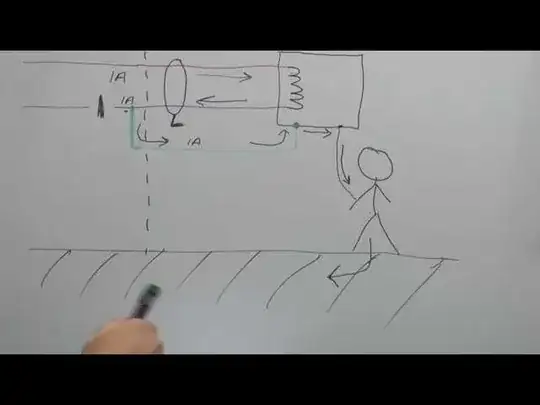
enter image description here

(not a perfect metaphor because the British only have one "hot" wire. Imagine a second hot.)

And all that would be something UKers mostly live with, as people call when the power goes out, and with the high-density housing there, only a minority of people have electrical tools in their hands while in contact with actual dirt. However, the UK is starting to charge electric cars, and that has pushed the problem to the forefront and demanded positively byzantine schemes to protect you from "protective earth".

4-wire feeders are your friend. Run quadplex.

Here's the important part: when you run 4-wire feeder to a subpanel, you separate neutral and ground at the subpanel. (and bond your local ground rods to the ground, not the neutral).

The trick with this is... most people with any experience installing overhead lines do most of their work for the power company. Who follows different rules, as you may have noticed. So when you ask for an overhead line feeder, they will automatically reach for the triplex. You will need to jump all over them and say "no no, quadplex. REALLY." Best to just fib and tell them you have a 3-phase converter in one building and want to distribute 3-phase to the other building. Fix it after they're gone lol.

I suppose you could obtain an XHHW wire and furl it onto the existing overhead line.

Harper - Reinstate Monica
  • 300,628
  • 26
  • 286
  • 734
  • That's a great video explanation. Thanks for sharing – raddevus Feb 01 '23 at 14:15
  • 1
    I'm not quite following what you are saying about running quad plex? Here in the US residential service is typically serviced by a transformer that supplies 240v across the two hots and 120v via a center tap (GNC: Grounded neutral conductor) on the transformer. So if someone wanted to do the quad, where would the 2nd ground wire be connected? Both would be bonded in the main panel, so it would be a double run back to the transformer...neutral and ground, what's the point? – George Anderson Feb 01 '23 at 14:37
  • @GeorgeAnderson I don't quite understand the question but there is only one ground, not a separate ground for each hot. Same for neutral, there is only one. – user253751 Feb 01 '23 at 16:59
  • @user253751 agreed....I just don't understand the benefit of quad-plex and where to connect it to the transformer since the transformer only 2 hots for 240v and a center tap for 120v, which is also grounded. – George Anderson Feb 01 '23 at 18:22
  • @GeorgeAnderson because neutral and ground should only be connected to each other at one point. Yes, it's not necessary in theory if everything is normal. But if something goes wrong, the outcomes are a lot better if neutral and ground are kept separate. That's why they have to be kept separate. For example, if the neutral wire gets accidentally broken it can become live and shock you, so if you used the same wire for neutral and ground, now ground is disconnected too, and ground is live too, and that's bad. – user253751 Feb 01 '23 at 18:24
  • @GeorgeAnderson I forgot to mention you separate neutral and ground at the subpanel, and bond local ground rods to the ground not the neutral. Now if the neutral breaks, OK, you get funny voltages on appliances, but ground is still good and everything's still grounded. If both break, neutral is still separated from ground so you don't get hot faucets. – Harper - Reinstate Monica Feb 01 '23 at 19:16
  • @Harper-ReinstateMonica Yes, I meant to double check that, clearly I know in subs that the neutral and ground need to be isolated, as I've mentioned many times here before. I think my bros installed the sub in the pump house and I'm pretty sure they were not aware of this requirement. ... Been thinking thru the scenario I first posted and believe the only way this could happen is if the neutral and ground are bonded in the sub. Once I get back to the farm (I don't live there), I'll check and let you know. – George Anderson Feb 01 '23 at 23:59
  • From what I can tell, the only difference between TN-C-S and what the US does is that the US has a sperate grounding rod at the building, and not all TN-C-S implementations do that. Lacking a local ground rod is what makes some versions of TN-C-S especially problematic. – Kevin Cathcart Feb 02 '23 at 21:33
  • @Kevin that's right. However it's an imperfect metaphor because British services are typically several services per multi-unit building, whereas American services are often one service to several buildings e.g. any single-family home with an outbuilding. This is where the inter-building ground wire becomes extra important. – Harper - Reinstate Monica Feb 03 '23 at 02:53