I am currently working with Spiking Neural Networks and multi-(meta)-stable attractor states.
What I observe in my simulations are 'bump' attractors that appear, disappear, and may wander around. Here is a screen shot from a simulation:
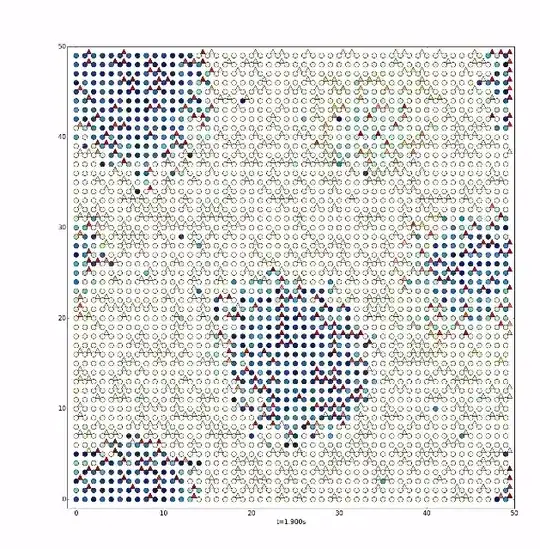
Dark blue dots represent excitatory neurons' spikes (fading into white to leave a trace), and dark red triangles representing inhibitory neurons' spikes.
If neurons are currently part of a 'bump' cluster, they exhibit a high firing rate, otherwise the rate is much lower.
The neurons are arranged on a 2D torus map (periodic boundary conditions). Thus, for every neuron I have its respective x and y coordinate plus the timing of the spikes.
What I want and need is a algorithm that
- can detect and distinguish neurons within the bump state from non-bump states
- measure the average size of a bump
- the average number of bumps per unit time and unit map size
- the average lifetime of bump (as I said they are meta-stable)
- In case the bumps are "wandering" the average speed or drift of a bump
What might be a suitable clustering algorithm in order to perform these steps? Would it be more useful to convolve the spike times with a filter in order to get some rate representation?


