20

I'm interested if there are studies dealing with text understanding and POS (part of speech) coloring, or coloring syntactic/semantic information. The studies should solve the questions like:

  • Which combination of colors improve/deteriorate understanding and reading of texts?

  • How many colors should be in the scheme for positive/negative effects on reading and understanding of text? Which POSs should be preferably colored?

  • Are there types of people who are more efficient with/without coloring?

I believe that a few colors with good combination could be beneficial. Has somebody conducted research to test the effect of highlighting on reading comprehension?


An example:
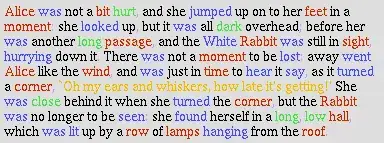
sytactically colored text

On this text you can see that many colors that don't go together can make the reading process even worse and distracting. Can this be changed to improve the reading process, instead?

A few events inspired me in the following order:

  1. I started learning Chinese and their characters seem to have positive effect on my comprehension.
  2. I've read a NL (natural language) article in English in a programming editor. I was used to colors for various programming languages.
  3. I searched the Internet and found the article A case against syntax highlighting but don't agree with all the author's arguments or opinions. When you have only a few carefully chosen colors it's beneficial for programming so maybe could be for NL comprehension as well. A few colors could underline the basic thought and help to draw attention of the reader. When I read a scientific text for which I have not passion I'm often bored because don't know where it directs and colors and images help me a lot to concentrate and skimming over the basic thoughts could help with decision if it has sense to read it at all. This does not hold for fiction and poetry where we read for pleasure rather than getting information.
Ben Brocka
  • 9,836
  • 5
  • 53
  • 89
xralf
  • 373
  • 7
  • 16
  • 3
    Just curious, can you give me a little background about this question? What makes you ask it? I've never heard of any research addressing the topic. – Andy DeSoto Apr 03 '12 at 21:37
  • I'd like to know as well. I've heard of some syntax highlighting in educational context but nothing nearly as significant as in this example – Ben Brocka Apr 03 '12 at 23:32
  • I've heard of syntax highlighting for IDEs, that seems to help a lot for programmers (at least for me), I would not be surprised if similar things would help for general reading. – Artem Kaznatcheev Apr 04 '12 at 00:03
  • The way I set up Visual Studio, every color has an associated semantic. E.g. yellowish for const and value types, ... I feel it helps me a lot to understand the code quicker at a glance. @xralf, thank you for the link on which you based your question. Please include that from the start next time. You have to reference that image you added either way. I for one don't agree with the article and don't see it backs itself up in any way. – Steven Jeuris Apr 04 '12 at 09:24
  • "Semantics are more important than syntax". So my counter-argument is syntax and colors can (and probably usually do) express semantics. – Steven Jeuris Apr 04 '12 at 09:27
  • @StevenJeuris Note that my original title was not with "syntax" word. I have the same opinion. The highlighting should in some way (e.g. via POSs to show noun-verb connection quickly) reflect the semantics. I can figure out semantics more quickly when reading in Chinese, so think that colors for alphabetical writing systems can play similar role. – xralf Apr 04 '12 at 09:48
  • Thank you for pointing that out. Don't forget you can always revert edits if you don't feel they improve the question, or the question you intended to ask. – Steven Jeuris Apr 04 '12 at 09:56
  • @xralf thank you for improving the question! +1 now. How is you having started learning Chinese relevant? Does your reference material for learning Chinese color different characters differently? – Artem Kaznatcheev Apr 05 '12 at 07:27
  • @ArtemKaznatcheev It's related because it's visual representation of concepts underlying meaning (semantics) and improves reading comprehension (at least I think) and I wrote ideas that inspired me because Andy DeSoto asked for it in the first comment. – xralf Apr 05 '12 at 08:23
  • 2

2 Answers2

17

I can speak to this question somewhat from a cognitive psychology standpoint. We memory researchers would think of text highlighting like this in terms of distinctiveness. (An article by McDaniel and Bugg (2008) may shed some light.) Simply put, highlighting a word in a different color than the rest of the text draws what we call item-specific processing towards that word. You'll have a better memory for it, for sure -- and maybe this ties into goals more relevant when writing code.

Increasing item-specific processing, however, comes with a cost: It detracts from organizational processing, which is involved with interrelating sentence (or code) elements, memory for order, and so forth.

Also note that the more items that are made distinctive, the less of a benefit making an additional item distinctive provides (e.g., if words are multicolored already, making a new word red or green doesn't really do anything to the distinctiveness of that word).

So when you use a lot of different highlighting colors, like in the example image, two things are happening: (1) too much distinctiveness is being used, washing out benefits from distinctiveness; and (2) increasing item-specific processing for individual items damages memory and processing for the structure. In essence, the example given is the worst of both worlds.

To answer your question, it might make sense to only use highlighting (or colors, fonts, etc.) to highlight key points, etc.; much like what we already do in writing for the web. Like anyone who highlights a textbook knows, it doesn't do any good to highlight an entire chapter.

Andy DeSoto
  • 2,776
  • 15
  • 25
4

According to this study, layout and color can be used to improve text readability. You can take a look online at text formatted in this manner here.

Dan
  • 141
  • 2