To answer your question, we must first understand what you mean with "read". Since you ask in the context of speed reading, you appear to be interested in extracting meaning from written text. So we can rephrase your question as:
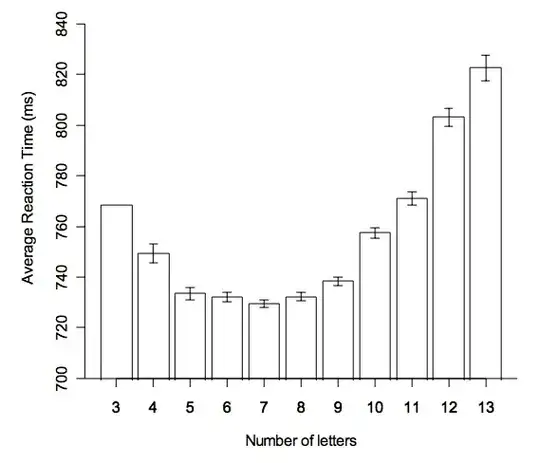
Does the time to recognize and understand a word increase with word length?
The effect of word length has been studied for two tasks, lexical decision and naming. In a lexical decision task participants are presented with words or nonwords (e.g. "dftrpg") and have to quickly press one specific key for words, and another for nonwords, on the keyboard. The time between the presentation of the stimulus and the key press (the reaction time) is registered. Since you are reading a text in which there are no nonwords, lexical decision is irrelevant in the context of your question.
A naming task is similar to a lexical decision task, with the exception that participants read the words aloud, and their responses trigger the computer via a microphone ("voice key"). Again, the reaction times between the presentation of the stimulus and the spoken word are registered. Since we cannot directly measure understanding, we assume that naming reflects understanding. (Of course you can speak words that you do not know, and even nonwords, but the reactions times would be significantly longer, so we would notice the difference. As long as RT is reasonably short, we may probably assume that the participant knows that word and has understood it.)
Not every time a participant names a word will he or she do so in the exact same time. Sometimes someone will be a bit slower to react, sometimes a bit faster. So we calculate the average reaction time for each word. What we note is that these average reactions times are not the same for different words, that is: the reaction times vary. Now, what we want to do, is explain this variance. Is it in some way related to word length? Or does it correlate to other characteristics of the words, such as number of syllables, word type (noun, verb, adjective), word frequency (how often a word is actually used in everyday spoken language), and so on.
After a number of calculations on the data, we find that all these aspects explain a part of the variance in reaction times (Baayen, Feldman & Schreuder, 2006). Here is a table of the different word characteristics (the predictors), and how much of the variance in naming speed they predict. Only those predictors are listed that had a significant effect. The numbers are adjusted R2 × 100, i.e. the percentage of variance uniquely accounted for by each predictor over and above all other predictors. You don't have to understand the meaning of these numbers, but they show the relative strength of the effect each predictor has on naming speed.
Lower bounds for the percentage of variance (adjusted R2 × 100)
explained by the significant predictors in word naming

Frequency                           6.08
Initial diphone 2                   4.33
Initial diphone (syllable-based)    3.88
Frication/Length first phoneme      2.24
Voicedness first phoneme            1.73
PC2 Consistency                     1.28
Length                              1.14
PC1 Consistency                     0.91
Written-to-spoken ratio             0.59
Neighborhood density                0.36
PC3 Consistency                     0.36
Inflectional entropy                0.34
Residual familiarity                0.31
In all, the results are:
- The overall variance in reaction times is small. In young adults they range from around 300 to around 700 ms, with about two thirds of the RTs falling into a narrow slot of only 100 ms.
- All the predictors together explain only half of the variance in reaction time (R2 = 0.4999), the rest of the variance must be attributed to unknown predictors or, more likely, are artifacts of the testing situation (distraction, boredom, etc.).
- The single strongest predictor of naming speed is word frequency.
- The contribution of each of the other single predictors is tiny (a few microseconds each).
- Word length predicts only a few microseconds in variance.
- There is a word length effect only if words are presented individually, not in a text context (Meyer, Roelofs & Levelt, 2003).
To answer your question, we can say that the length of the words has probably no noticeable effect on your text reading speed.
Sources:
- Baayen, R. H., Feldman, L. B., & Schreuder, R. (2006). Morphological influences on the recognition of monosyllabic monomorphemic words. Journal of Memory and Language, 55(2), 290-313.
- Balota, D. A., Cortese, M. J., Sergent-Marshall, S. D., Spieler, D. H., & Yap, M. (2004). Visual word recognition of single-syllable words. Journal of Experimental Psychology: General, 133(2), 283.
- Meyer, A. S., Roelofs, A., & Levelt, W. J. (2003). Word length effects in object naming: The role of a response criterion. Journal of Memory and Language, 48(1), 131-147.