8

The Two-Stream Hypothesis, where object properties are processed independently from spatial information, remains the most well established theory of visual processing. However, it concerns me that most models that reference this theory stop at the end of the two streams (as per the cartoon model in the image below); they never say how the mind translates those sources of information into action (i.e. the two arrows in the picture never meet).

  • Are there models and/or theories out there that try and situate the Two Streams of information into a full perception action cycle?
  • And if not, then why not (e.g. complexity, better theories, different level of analysis, etc.)?
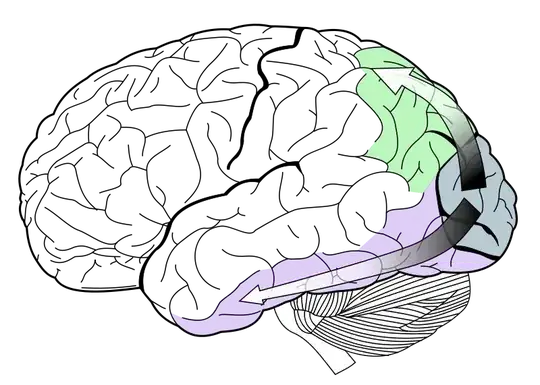
twoStreams

zergylord
  • 2,404
  • 19
  • 34

2 Answers2

4

Mario Liotti and Don M. Tucker (Brain Asymmetry, MIT, 1996) attempt to explain that the 'corticolimbic architecture is not left/right, but dorsal/ventral". In their opinion, the reason for hemispheric asymmetries can be found in the asymmetries of the dorsal and ventral systems. They proposed that emotional behavior could be interpreted by analyzing the vertical circuits (dorsal/ventral).

Dana Sugu
  • 511
  • 4
  • 15
  • Thanks for the input! However, perhaps I'm misreading this, but I don't quite see how this answers my question. I'm interested in how we solve tasks where both dorsal and ventral stream information is needed. How are hemispheric asymmetries related to this? – zergylord Aug 03 '13 at 07:29
  • You wanted to understand how "the Two Streams of information [turn] into a full perception action cycle". Liotti and Tucker (1996) proposed a model of how the two pathways of information processing lead to behavior, i.e. 'perception action cycle' in my understanding. Have you read the article? Do not bother about the hemispheric asymmetries. – Dana Sugu Aug 03 '13 at 07:42
  • An interesting point they make: "Analyzing the complex relations among vertically integrated circuits, and interpreting their function in relation to human emotional behavior, is likely to be a difficult and controversial process." Liotti and Tucker (1996:415) – Dana Sugu Aug 03 '13 at 07:49
  • I've tried reading the chapter you linked, but several pages aren't available since its only a google books preview, so its hard to get a sense of what their model is. Could you briefly summarize their model in your answer? Self contained answers are generally encouraged here anyways. Thanks again for your time! – zergylord Aug 03 '13 at 08:07
  • "Self contained answers are generally encouraged here anyways." I tend to think that if I have a question and read an article I would somehow try to link its content to my question. However, your question would be differently linked with the content/ideas of the article. As for my experience in this forum, I have always got answers referring to some articles, never a self contained answer. Try this: http://psycnet.apa.org/psycinfo/1995-97461-014 – Dana Sugu Aug 03 '13 at 08:47
  • Perhaps my comment was too strongly worded, as I too see links as a vital part of a good answer. But the problem here is that your answer text doesn't give any indication as to how the link helps to answer my question. – zergylord Aug 03 '13 at 09:13
  • "Are there models and/or theories out there that try and situate the Two Streams of information into a full perception action cycle?" Yes, I came across this model that explains emotion information processing and behavioral output as related to the dual visual pathways. – Dana Sugu Aug 03 '13 at 09:43
  • "The view that the dual visual system leads away from the primary sensory cortices toward association areas and limbic areas viewed as a route whereby incoming sensory information is processed sequentially through adjoining areas before reaching the limbic systems challenged by the finding that all intrinsic corticocortical connections are in fact reciprocal. – Dana Sugu Aug 03 '13 at 09:44
  • "Backward," that is, from limbic to cortical, projections are particularly important, since they link areas of increasing laminar differentiation, and their functional value has to be considered with respect to the fact that they parallel the stages of architectonic development. This opposite pathway, leading away from proisocortex, may be viewed as a feedback system whereby limbic information on the internal state of the organism is relayed to cytoarchitectonically more differentiated areas. – Dana Sugu Aug 03 '13 at 09:44
  • This reverted direction may provide critical clues to the way in which motivational and emotional states mediated by limbic regions exert regulatory and adaptive functions determining which representations will dominate the information processing and behavior of the whole brain (Derryberry and Tucker, 1991). (Liotti and Tucker, 1996:410) References: Derryberry, D., and Tucker, D. M. (1991). The adaptive base of the neural hierarchy: Elementary motivational controls on network function. – Dana Sugu Aug 03 '13 at 09:45
4

You may be interested in the FARS model from Fagg and Arbib (1999) that describes the interaction of the two visual streams in the primate brain during object grasping.

The article What Puts the How in Where? Tool Use and the Divided Visual Streams Hypothesis (2007) makes use of the dorsal/ventral streams to explain our ability to use complex tool. As Frey argues, "the ability of the dorsal stream alone to account for one of the most common forms of human action, tool use, is limited. While experience-dependent modifications to existing dorsal stream representations may explain simple tool use behaviors (e.g., using sticks to extend reach) found among a variety of species, skillful use of manipulable artifacts (e.g., cups, hammers, pencils) requires in addition access to semantic representations of objects' functions and uses."

Apart from these two domains, I can not see one that would benefit from the "full perception action cycle": one stream is usually sufficient to describe a phenomenon.

marsei
  • 1,294
  • 7
  • 14