Video is often presented at different sizes. On the Internet, many websites provide quite a few size settings. In the store, you can buy TVs of many different sizes. In both cases, it's the same resolution video being stretched to a various sizes. To the technically savvy, making the same pixel occupy a larger physical space does not increase the quality of the video. But to the average consumer, he may think bigger is better.
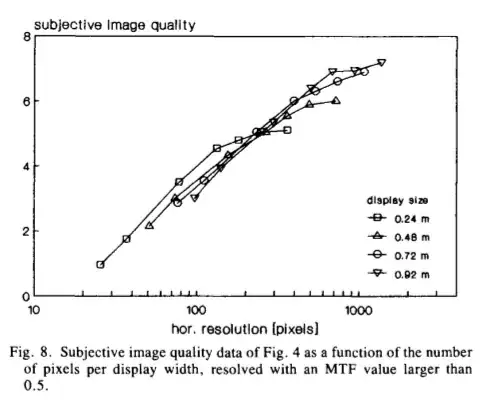
What does the graph of perceived quality VS physical size look like? Is it linear, that is bigger is always better. Or is it parabolic? That is, there is a perfect ratio of pixel to size and any deviation from this ratio will result in a worse perceived quality. Or is it some other shape?