3

I have read that fluorine has a lower electron affinity than chlorine despite its lower atomic radius because its electron cloud is extremely dense. If this is the case, shouldn't the ionization energy of fluorine be lower than that of chlorine, since fluorine's dense electron cloud should eagerly repel its electrons?

Even more confusing is that electron affinity can also be defined as the ionization energy of the singly charged anion form of an atom, i.e. the ionization energy of $\ce{Cl-}$ is equal in magnitude to the electron affinity of $\ce{Cl}$. Therefore, it seems that the trends for ionization energy and electron affinity should always match, which is not the case with fluorine and chlorine.

1 Answers1

5

To quote chemguide:

The first ionisation energy is the energy required to remove the most loosely held electron from one mole of gaseous atoms to produce 1 mole of gaseous ions each with a charge of 1+.

That means, the ionization energy of fluorine is the energy of the following reaction:

$$\ce{F -> F+ + e-}$$

The ionization energy of chlorine is the energy of the following reaction:

$$\ce{Cl -> Cl+ + e-}$$

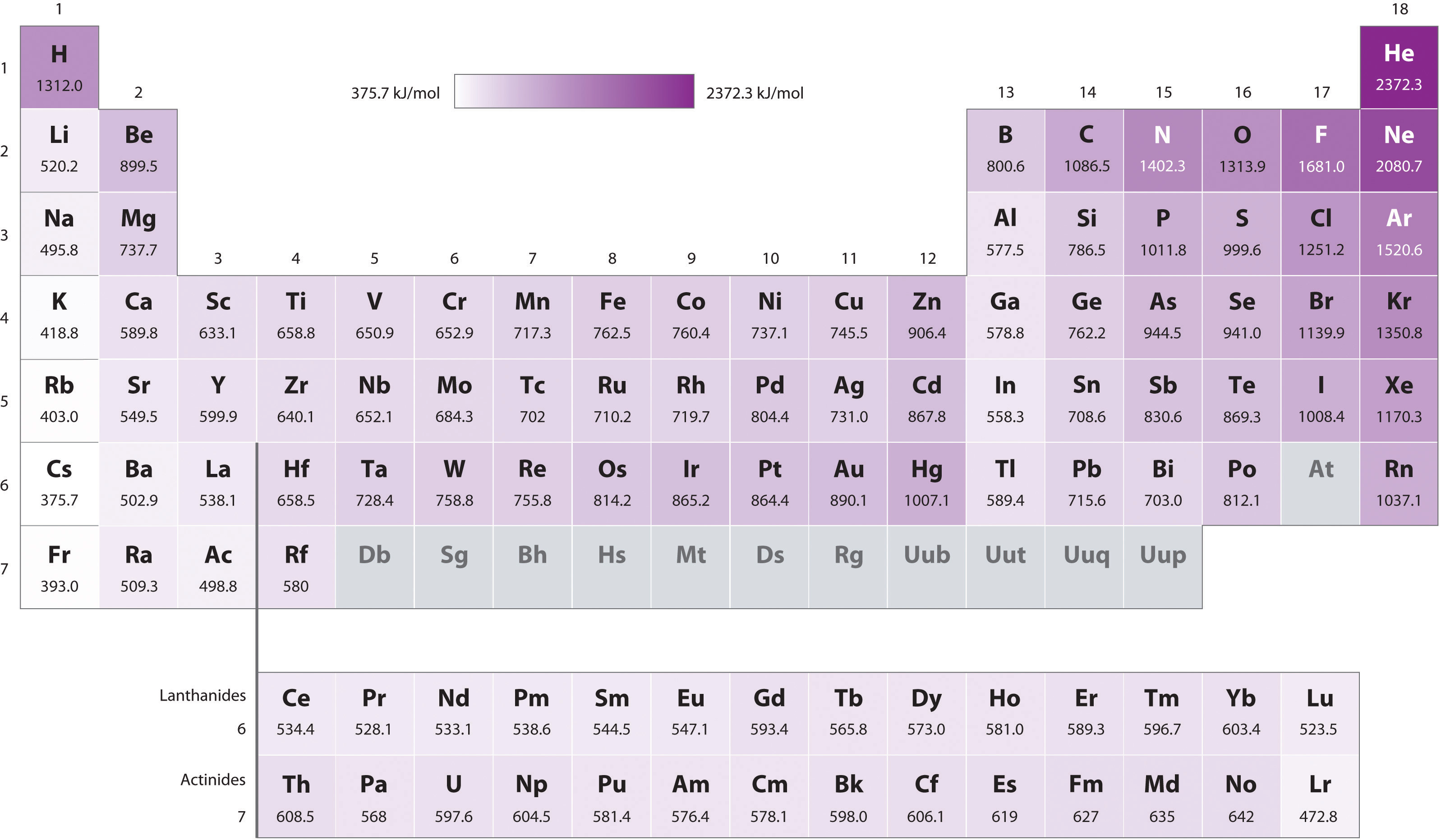
Since the most loosely held electron in fluorine is closer to the nucleus than chlorine, it takes more energy to remove the electron from fluorine than in chlorine.


The ionization energy of chloride ion ($\ce{Cl-}$) is the energy of the following reaction:

$$\ce{Cl- -> Cl + e-}$$

The electron affinity of $\ce{Cl}$ is the energy of the following reaction:

$$\ce{Cl + e- -> Cl-}$$

As a result, their energies are equal in magnitude but opposite in sign.


Why does chlorine have a higher electron affinity than fluorine?

To quote this answer:

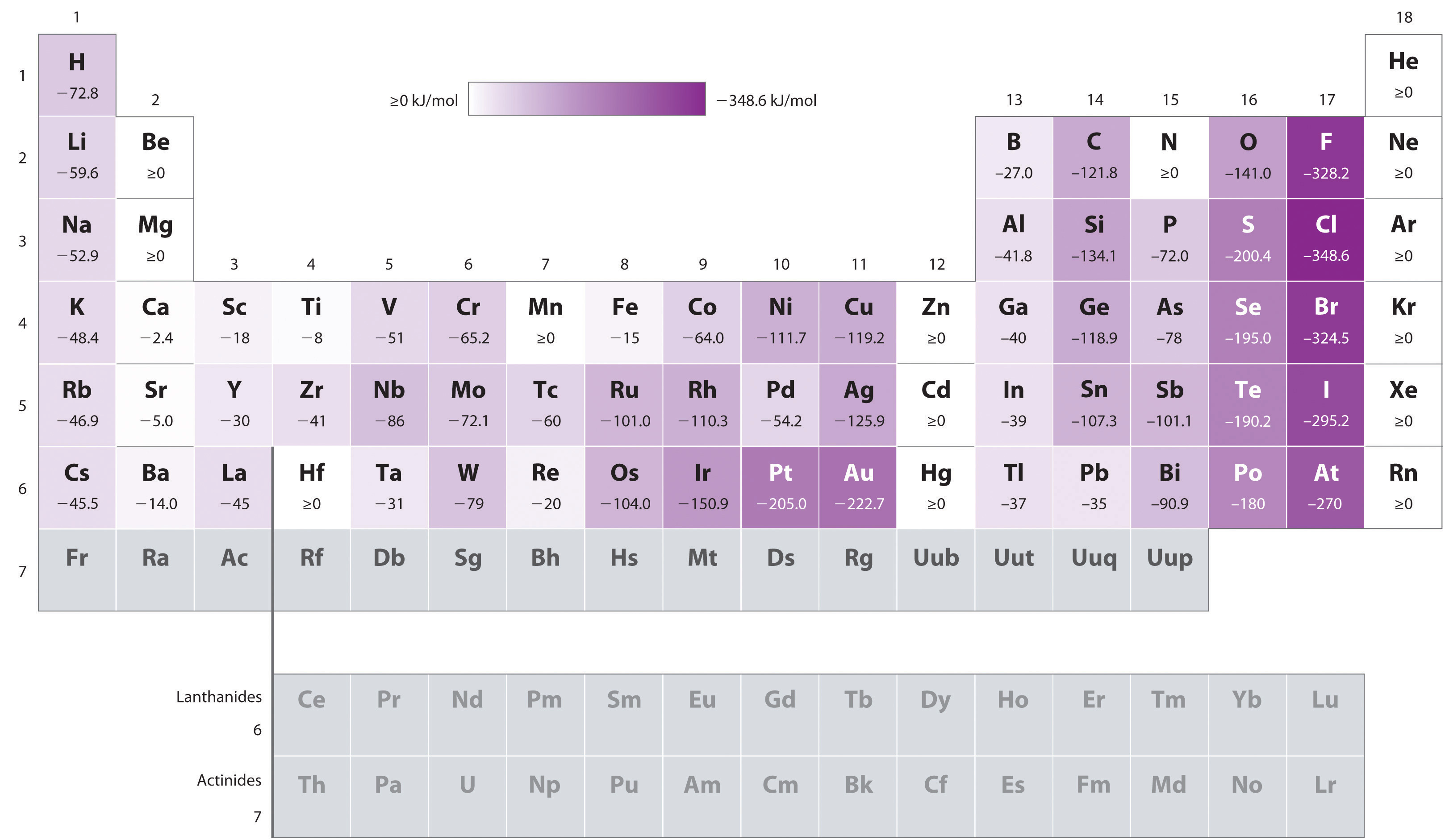
Fluorine, though higher than chlorine in the periodic table, has a very small atomic size. This makes the fluoride anion so formed unstable (highly reactive) due to a very high charge/mass ratio. Also, fluorine has no d-orbitals, which limits its atomic size. As a result, fluorine has an electron affinity less than that of chlorine.

As can be seen in the second photo, this effect seems to be true for Period 2 elements.


(source: lardbucket.org)
(source: lardbucket.org)

Glorfindel
  • 2,075
  • 4
  • 20
  • 28
DHMO
  • 5,035
  • 2
  • 23
  • 52
  • In that case, why is it that Cl has a lower ionization energy than F, but Cl- has a higher ionization energy than F-? (This is what I was trying to get at in the 2nd part of my question.) –  Sep 17 '16 at 09:30
  • @jt2000 That is answered here. – DHMO Sep 17 '16 at 09:53
  • 1
    This is half an answer at best, as it doesn’t compare fluorine’s and chlorine’s electron affinity. – Jan Sep 17 '16 at 16:25
  • @Jan See the comment just above you. – DHMO Sep 17 '16 at 16:26
  • @user34388 An answer should be self-containing and not rely on comments or other answers to be understood. Please edit in the relevant parts. (I’m very inclined to upvote this answer but it’s just not complete enough for me yet.) – Jan Sep 17 '16 at 16:56
  • @Jan I didn't want to include it because that part would be a duplicate. I included it notwithstanding. – DHMO Sep 17 '16 at 17:00
  • @jt2000 The link I provided explains why Cl has a higher electron affinity than F, which is the same as why Cl- has a higher ionization energy than F-. – DHMO Sep 17 '16 at 17:44
  • @user34388 The link you provided doesn't explain why Cl has a lower ionization energy than F, it only explains why Cl- has a higher ionization energy than F.- Also, I do understand why Cl has a higher electron affinity than F, but I'm wondering why the logic used to explain this (small atomic size) does not apply to why the ionization energy of Cl is less than that of F. It seems to me that because F has a lower electron affinity because of its small atomic size, it should also attract its own electrons less, resulting in a lower ionization energy than Cl as opposed to higher. –  Sep 17 '16 at 17:55
  • @jt2000 As Jan said, "Notice that ionisation energy and electron affinity are two only very weakly connected physical constants. " – DHMO Sep 17 '16 at 18:30
  • @user34388 Is there a particular reason why this is true, considering that they seem closely related in physical terms, their only difference being that one relates to the singly charged anion while the other relates to the uncharged form? –  Sep 17 '16 at 18:42