2

Will it still etch glass when very dilute? Will the reaction still proceed slowly? At what pH will the reaction stop completely?

From Wikipedia on hydrogen fluoride: "Although hydrofluoric acid is regarded as a weak acid, it is very corrosive, even attacking glass when hydrated."

On hydrofuoric acid: It etches glass "by reacting with silicon dioxide to form gaseous or water-soluble silicon fluorides. "

It seems fishtank glass can be etched even when the water is kept at a pH of 7.0. "You might try a razor scraper, to see if that will remove any of it. If not, there is a very high chance they are due to etching. Etching is caused by the action of water, especially acidic water, over a long period of time. "
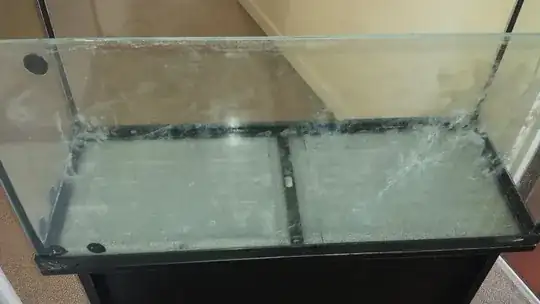
enter image description here

user1491819
  • 256
  • 1
  • 3
  • 9
  • 1
    Your reference [3] is talking nonsense. HF is the only acid that will ever etch glass. And highly diluted, you won't see it in this century or the next. – Karl May 15 '16 at 14:44
  • Karl, HF is one of the compounds formed in fluoridated water. – user1491819 May 16 '16 at 10:05
  • 1
    In extremely low amounts, that are not able to etch glass. The subject of fluorinated water is full of conspiracy therories, you fell for one of them. – Karl May 16 '16 at 10:30

2 Answers2

5

In $\ce{SiO2}$ etching, there are two active fluorine-containing species, $\ce{HF}$ and $\ce{HF2-}$.

The rate of etching at 25 degrees C in Angstroms per second is:

$$9.66[\ce{HF2-}] + 2.50 [\ce{HF}] -0.14$$

according to A Study of the Dissolution of SiO2 in Acidic Fluoride Solutions J. Electrochem. Soc. vol. 118, pp. 1772-1775.

The relavent equilibrium constants at 25 degrees C and ionic strength of 1M are

$$\frac{[\ce{H+}][\ce{F-}]}{[\ce{HF}]} = 0.0013M $$

$$\frac{[\ce{HF}][\ce{F-}]}{[\ce{HF2-}]} = 0.104M $$

Because of the -0.14 term in the rate equation, only at enormously high F- concentration would there be etching at pH 7 (such as in this situation).

This study was concerning high (~1M) concentrations of fluorine species, so it might not be completely relevant for low concentrations or very long time periods.

DavePhD
  • 40,570
  • 2
  • 85
  • 181
  • Thanks, but there was no mention of whether the reaction can continue at a pH of 7.0, as in the case of the fishtank. Does the following from the abstract mean that as long as the temp is above 23 degrees C, the reaction will still proceed, though at a slow rate?

    "the rate of dissolution is linearly dependent on the concentration of Formula and HF in relatively dilute fluoride solutions. Both reactions have a similar temperature dependence characterized by an activation energy of 9.1 and 8.1 kcal/mole, respectively."

    – user1491819 May 15 '16 at 11:46
  • What units is the rate of etching expressed in? m/s? mm/year? – Level River St May 15 '16 at 13:21
  • 2
    It appears to be in Å/s. – f'' May 15 '16 at 18:28
  • DavePhD - What would be the rate given a fluoride concentration of 1ppm? How does HF keep reacting with SiO2 at a pH of 7.0? Is this a unique property of HF, or do all acids keep reacting at a pH of 7.0? – user1491819 May 16 '16 at 10:14
  • 1
    @user1491819 Accord to the article, the rate would be zero if the concentration is that low, although they aren't really studying concentrations that low. – DavePhD May 16 '16 at 11:24
  • @DavePhD can you think of any other plausible ways the fishtank glass could have been etched - (if indeed it actually is)? – user1491819 May 17 '16 at 11:01
  • 2
    What you observe is, unless you kept your fish at pH > 10 for a prolonged period, widely known as "limescale". – Karl May 20 '16 at 04:59
-1

Certain acids are corrosive at a pH of 7.0. These compounds do not involve H or OH, so are not neutralised when diluted in water to a pH of 7.0.

"SiFW (silicofluoride treated water) is associated with serious corrosion of lead-bearing brass plumbing, producing elevated water lead (PbW) at the faucet."

"Silicofluorides (SiFs), fluosilicic acid (FSA) and sodium fluosilicate (NaFSA), are used to fluoridate over 90% of US fluoridated municipal water supplies. ...New data refute the long-prevailing belief that PbW contributes little to children's blood lead (PbB), it is likely to contribute 50% or more."[1]

[1]: Journal of Neurotoxicology(2007): Confirmation of and explanations for elevated blood lead and other disorders in children exposed to water disinfection and fluoridation chemicals http://www.ncbi.nlm.nih.gov/pubmed/17420053

user1491819
  • 256
  • 1
  • 3
  • 9