16

I have been messing around with making Indigo dye while waiting for bacteria to grow. I have been following the Baeyer-Drewson method. Basically, you mix nitrobenzaldehyde with an acetone water mix and slowly add NaOH. The solution turns black and you get a dark sludge. I have been separating the sludge from the liquid by centrifugation. I have noticed that the supernatent has a dark reddish brown color.

  1. I was wondering if anyone knew what the red byproduct was?
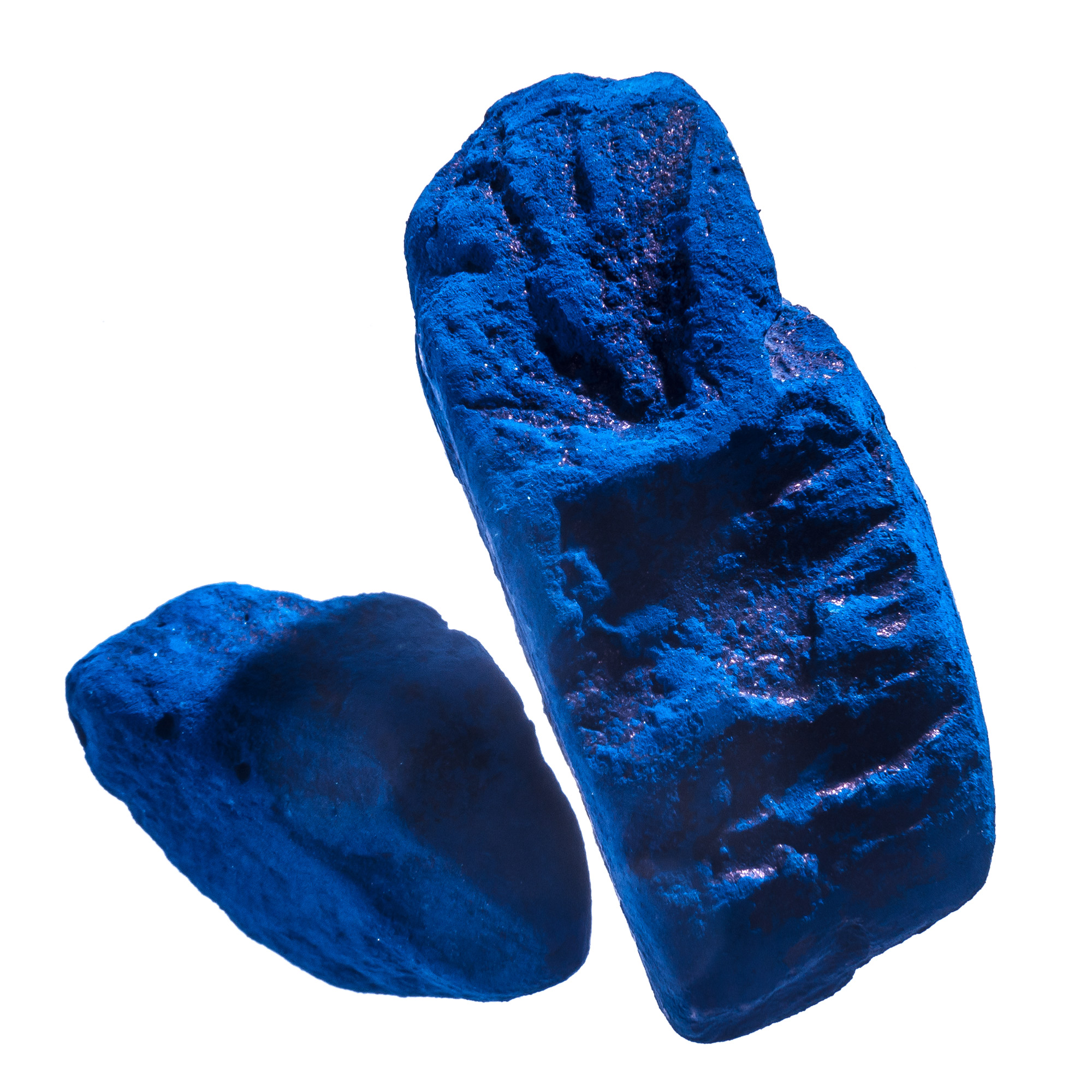
  2. My indigo is black when dried, wikipedia shows nice bright blue chunks. What could be causing this color difference? Maybe the red byproduct?
  3. Does indigo dissolve in anything without needing to be reduced first? I have had no luck with the organic solvents available in our lab.
bon
  • 15,369
  • 13
  • 62
  • 91
user137
  • 2,228
  • 12
  • 21
  • 3
    I would love to know the answer to this question myself (and likely will provide a bounty). I do this synthesis with my students as a lab experiment, and the yields are dismal. Knowledge about what else is being formed may help me tweak the procedure to improve yields. – Ben Norris Jul 12 '15 at 20:59
  • 1
    As a side note, I can make solutions that are dilute enough for spectroscopy by dispersing about 80 mg of indigo in the smallest amount of methanol possible and then diluting to 100 mL with acetone. Indigo is soluble in neither by itself, but this method produces (dilute) solutions. – Ben Norris Jul 12 '15 at 21:01
  • My first guess is that some self-condensation of acetone occurs. It should give various conjugated polyenones, that should have yellow to red color mostly, up to black for longer chains. While acetone is usually condensed in acidic media, a proper base should work too. Phorone synthesis: http://www.youtube.com/watch?v=ll8FLbJpR14 . If this is the case, it should be possible to steam-distill away most of the colored byproducts, however the remaining black residues of aceton resin should be insoluble and undistillible. – permeakra Jul 14 '15 at 21:12
  • For your question 3: I have no idea if it actually works, but based on structure and my own fevered imagination, I'd guess that a mixture of Dowtherm A (which is a eutectic mixture of biphenyl and diphenyl ether) and an amide such as N,N-dimethylacetamide would be a good solvent for indigo. – Curt F. Jul 15 '15 at 03:37
  • 1
    @CurtF. - That is an interesting idea on the solubility. I wonder what the OP wants to do with the indigo. For my use (optical spectroscopy, the arenes in Dowtherm A are a deal breaker). – Ben Norris Jul 15 '15 at 12:10
  • @BenNorris I just want to dye stuff. Right now I have dye in several containers and have been having trouble pooling it all together. I might try to disperse it in ethanol, combine them and centrifuge them. This might remove some of the byproduct as well. – user137 Jul 15 '15 at 15:51
  • @user137 You might not want to try Curt's suggestion of solvent either since all three compounds have very low volatility. If you are interested in dyeing, why not just buy indigo, which is cheaper than 2-nitrobenzaldehyde? – Ben Norris Jul 15 '15 at 17:08
  • @BenNorris Because then I'd be taking the easy route. Solubility probably wouldn't be good for dying anyway, since indigo only sticks to fabric by being so insoluble, a good solvent would carry the dye away from the fabric. If there was a good solvent that was also volatile, I would be interested because then I could easily combine all my reactions and remove the solvent. – user137 Jul 15 '15 at 17:22
  • @permeakra I tried to mix acetone, water, and NaOH to mimic conditions in the reaction and did not observe any color change. Could the nitrobenzaldehyde or indigo interacting with the acetone and promoting condensation? – user137 Jul 15 '15 at 22:08
  • @BenNorris I tried to suspend a very small of my indigo sludge in 500 uL of acetone or acetone-water mix. In the acetone water mix, the solvent turned kind of yellow and I could see tiny particles. In acetone, it turned green and I could not see particles. Do your solutions have a visible color? I suspect the green is caused by a more soluble yellow contaminant and the blue indigo. – user137 Jul 15 '15 at 22:11
  • @user137 Yellow (and to lesser extent red) color is typical for moderately large conjugated systems. For example, o-aminobenzaldehide is pale yellow. (and, for that matter, dibenzilidenacetone and phorone) The conditions of the synthesis are typical for aldol condensation, so most likely we have some secondary condensation, but which one I have no idea. – permeakra Jul 16 '15 at 06:20

1 Answers1

5

After looking further into indigo production, I came across a related structure called indirubin.

Indirubin:
indirubin
Indigo:
indigo

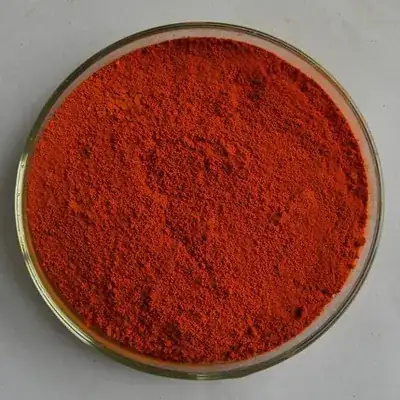
Indirubin is a byproduct of indigo synthesis and has a reddish color. It may also be more soluble than indigo, and indirubin derivatives have some anticancer activity. If you trust this supplier, you can buy indirubin for pretty cheap to compare with your lab's indigo reactions.

enter image description here

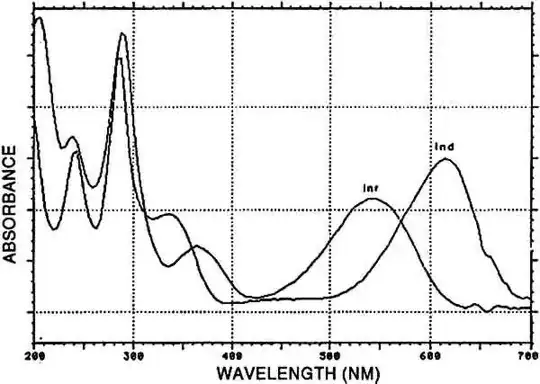
I also found a study done on old native american dyes that studied indigo and indirubin in fabric fibers, among other dyes. They provide a UV-VIS spectrum of both compounds, with Ind = indigo and Inr = indirubin. We can see that indigo has an absorption peak in the red region, so blue is reflected. Indirubin has a peak at around 540 nm, which is yellow-green, allowing some blue and red to reflect, but probably more red than blue. This paper also references a 1910 paper** studying indirubin levels in commercially available indigo samples, but I can't find that article. They suggest that higher levels of indirubin are produced when more indoxyl is converted to isatin. If you can find this 1910 article, it may provide some insight into reducing isatin and indirubin levels.

enter image description here

** William Popplewell Bloxam and A. G. Perkin, J. Chem. Soc., Trans., 1910, 97, 1460-1475.

Martin - マーチン
  • 44,013
  • 13
  • 159
  • 319
user137
  • 2,228
  • 12
  • 21
  • 1
    Not sure if the labels are better this way, I wanted to resize them but imgur has troubles scaling png so they are just black squares... I included the link to the digital version of the linked article, It's behind a paywall for me so I can't read :( – Martin - マーチン Jul 21 '15 at 09:14