9

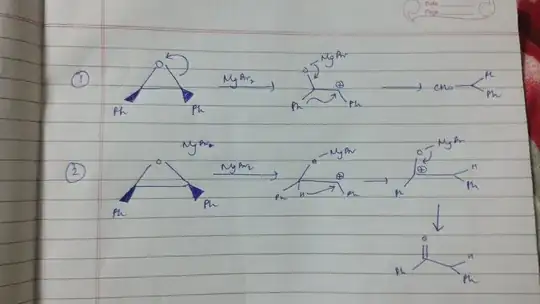
I just read about the Pinacol rearrangement and the following reaction was presented just after it. The book (Clayden) shows path 1 being taken.

My question is why is the second path not taken? I know that migratory aptitude of $\ce{Ph>H}$ but all we want is stability, so why can't the $\ce{H}$ migrate?

enter image description here

ron
  • 84,691
  • 13
  • 231
  • 320
Karan Singh
  • 3,795
  • 9
  • 37
  • 50

2 Answers2

11

why is the second path not taken?

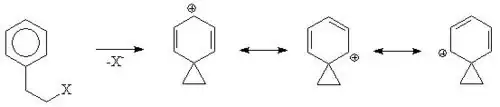
$\ce{H}$ can migrate, it is just that phenyl migrates better. The reason that phenyl migrates better is because it is much better able to stabilize the developing carbocation center. The phenyl group participates by what is termed neighboring group participation (see the "NGP by an aromatic ring" section). It forms a phenonium ion. Note the geometry of this ion, the former aromatic ring is perpendicular to the plane of the screen while the former $\ce{C-C}$ bond is contained in the plane of the screen.

enter image description here

(image source)

We can draw several resonance structures to describe the phenonium ion, this leads to it being especially stable.

enter image description here

(image source)

Such extra stabilization is not possible with a migrating hydrogen atom. Therefore the pathway involving the phenonium ion is lower energy (faster) than the pathway involving hydrogen migration.

ron
  • 84,691
  • 13
  • 231
  • 320
  • 1
    Is there a way to compare migratory apptitudes of different alkyl/aryl groups with H and among themselves? – user223679 May 18 '15 at 04:31
  • @user223679 Yes, many reactions (pinacol) have been used for this. Using the present example, just make several epoxides with different substituents and use the product ratios to assign relative migratory aptitudes. Make sure the reaction is being run under conditions to insure kinetic control. – ron May 18 '15 at 17:12
  • Has someone generalized an order? Is something like this been found out yet? – user223679 May 18 '15 at 17:32
  • @user223679 Yes. If you search "migratory aptitude here on Chem SE you'll find some useful information. Otherwise just ask a question. – ron May 18 '15 at 17:41
  • Coming back to this post, you said here that one can't judge between H and Ph and I feel this question is similar to the pinacol one. And another answer out there suggests H>Ph (though I can't trust that source). – user223679 May 18 '15 at 18:06
  • @user223679 There are general trends regarding migratory aptitudes, but no rules. The migratory aptitudes are influenced by factors such as solvent, geometric alignment of the migrating group and carbocation p orbital, early vs. late transition state (e.g. how much positive charge has been developed in the TS), etc. Dunno what else to say. – ron May 18 '15 at 18:22
  • Thank you for bearing with me. I apologize for being so nitpicky. Was just confused between two things said by you in similar reactions. – user223679 May 18 '15 at 18:28
  • 1
    @user223679 Absolutely no problem. Confusion is often a good sign, it indicates that you're really digging in to a problem. – ron May 18 '15 at 18:36
6

In both the cases that you mentioned, the lone pair of oxygen is finally going to stabilize the carbocation by donating towards the positively charged carbon atom.

Hence stability of the carbocation may not be a very good criteria of comparing the mechanism. The migratory apptitude then plays a major role in deciding the faster mechanism.

Stability is just the thermodynamic aspect while migratory apptitude is the kinetic aspect.

Both need to be considered. Since the stability brought about by the oxygen is similar in both cases, we chose the kinetic aspect as the determining criteria.

And ron's answer clearly outlines the kinetic aspect.
Del Pate
  • 2,175
  • 2
  • 19
  • 33