3

molecule

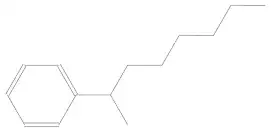
What is this compound's IUPAC name?

1) 2-phenyloctane.
2) octan-2-ylbenzene.

Is using phenyl correct or is taking benzene as the base correct?

pikachu
  • 801
  • 2
  • 11
  • 21
  • I did the following searches to find that if aliphatic chain has more than 6 carbon atoms then it prefers using phenyl : http://m.wolframalpha.com/input/?i=2-phenylpentane&x=0&y=0 & http://m.wolframalpha.com/input/?i=2-phenylhexane&x=0&y=0 . Also this says so too. So is it correct ? – pikachu Mar 09 '15 at 12:51
  • I cant add more than 2 links , hence the comments . Can someone add it in the question ? – pikachu Mar 09 '15 at 12:52
  • Welcome to chemistry.SE! If you had any questions about the policies of our community, you can ‎visit the help center or take a ‎‎tour of the website.‎ Let me get this straight: You can't add links?! And, [tag:iupac] is used for the IUPAC org itself, not nomenclature. – M.A.R. Mar 09 '15 at 12:54
  • @Loong So both of them are correct ? – pikachu Mar 09 '15 at 12:58
  • 1
    @MARamezani Not more than two links – pikachu Mar 09 '15 at 12:58
  • 1
    @pikachu Yes, both ‘octan-2-ylbenzene’ and ‘2-phenyloctane’ are correct; ‘octan-2-ylbenzene’ is the preferred IUPAC name. –  Mar 09 '15 at 13:02
  • @Loong But this says While compounds like these are usually named by simple benzene type naming (chlorobenzene and bromobenzene), the phenyl group naming is usually applied to benzene rings where a substituent with six or more carbons is attached, such as in the diagram below. – pikachu Mar 09 '15 at 13:07
  • @Loong Please have a look at my previous comment . thanks. – pikachu Mar 20 '15 at 10:45
  • 2
    @pikachu That site is not necessarily wrong, since according to current IUPAC recommendations (2013), “the context may favor (…) the chain, so that (…) an unsaturated acyclic structure may be recognized, or the one chosen has the greater number of skeletal atoms (…) in the principal chain of the acyclic structure.” However, the approach for the preferred IUPAC name (PIN) prefers the choice of a ring over a chain in systems composed of cyclic and acyclic hydrocarbons. –  Mar 20 '15 at 17:22
  • 3
    @pikachu The old IUPAC rule (from 1979) actually was: “Choice between these methods is made according to the more appropriate of the following principles: (…) (b) treatment of a smaller of structure as a substituent into a larger. (…) In accordance with the principle (b) (…), a hydrocarbon containing a small cyclic nucleus attached to a long chain is generally named as a derivative of the acyclic hydrocarbon; (…)” –  Mar 20 '15 at 17:23
  • @Loong Okay . Thanks !!! So the site goes with the 1979 rule . – pikachu Mar 23 '15 at 06:38

0 Answers0