28

I never thought that modern American nickels actually contained nickel anymore. However, according to this wiki article, the coins actually do contain 25% nickel, the rest being copper. And yet, no US coin produced today is officially magnetic. Why is this alloy of nickel not attracted to a magnet?

(and yes, I tried time and again to find and answer elsewhere online.)

Mathew Mahindaratne
  • 39,943
  • 27
  • 55
  • 107
mpprogram6771
  • 1,298
  • 1
  • 8
  • 29
  • 4
    Be aware that even chrome-nickel stainless steel ( typically 16-20% Cr, 8_12% Ni, rest mostly iron ) is not ferromagnetic ( magnetic in common terms ), even if it contains mostly ferromagnetic metals as Fe and Ni. Because Ni keeps iron in the austenitic non ferromagnetic form. – Poutnik Apr 02 '20 at 02:44
  • 1
    @Poutnik So why are other Fe-Ni alloys, such as permalloy (which have ~45 - 85% Ni), ferromagnetic? Is it becauses the Fe is not austenitic in permalloy? Or because there's enough Ni to overcome the austentic Fe? – theorist Apr 02 '20 at 05:26
  • @theorist Probably the latter. But I am not expert in metallurgy, relying on googled info and I do as well remember typical CrNi steel is not ferromagnetic. – Poutnik Apr 02 '20 at 05:30
  • @Poutnik I think it is indeed the latter -- through my own googling, I just found that permalloy has an FCC (i.e., austenitic) crystal structure. Interestingly, I also found that austenitic alloys can be partly converted to ferromagnetic forms (martensitic and ferritic) using cold working (the austentic crystal structure -- which Fe favors in the presence of Ni -- can be restored by melting and recooling). – theorist Apr 02 '20 at 05:41
  • RE: "... And yet, No US coin is officially magnetic. ..." The 1943 Lincoln penny was steel coated zinc due to a copper shortage during WWII. It is ferromagnetic. There were a few copper blanks that got pressed in 1943 and these specimens are very valuable. A common scam was to plate a steel/zinc penny with copper. Such an altered coin is easily detected with a magnet. – MaxW Apr 02 '20 at 00:46
  • Back in the day, I worked at Duracell. We spot-welded Nickel tabs to cells and then attached them to our testing computers. Needless to say, we had a lot of scrap tabs after testing 1000's of cells. When we took the scrap to a dealer, he refused to believe it was (almost pure) nickel because it was magnetic. No amount of arguing could get him to change his mind ! – Bruce C. Apr 16 '20 at 16:49

3 Answers3

57

There are many types of magnetic properties, including ferromagnetism, paramagnetism, diamagnetism, antiferromagnetism, ferrimagnetism, superparamagnetism, metamagnetism, spin glasses, and helimagnetism. Many of these are too weak to cause any noticeable interaction with a magnet. The type of everyday magnetism you're thinking of, which nickel has, is ferromagnetism.

While nickel is ferromagnetic, copper is not. As you said, the American nickel is currently 25% nickel and 75% copper. According to this paper (from 1931!), in order for a nickel-copper alloy to be ferrogmagnetic, it must contain at least 56% nickel:

... 56 percent nickel is required before the alloy shows ferromagnetic properties at ordinary temperatures.

https://journals.aps.org/pr/abstract/10.1103/PhysRev.38.828

E. H. Williams, Magnetic Properties of Copper-Nickel Alloys. Phys. Rev. 38, 828 (1931).

theorist
  • 12,135
  • 1
  • 35
  • 53
25

None of the US coins are magnetic (ferromagnetic), except for the 1943 Lincoln penny (Steel Cents, made in steel and zinc to save copper for ammunition during wartime), which are considered magnetic. Almost all of those coins other than Steel Cents are made with higher percentage of copper ($\ce{Cu}$) and lower percentages of other metals such as nickel ($\ce{Ni}$), zinc ($\ce{Zn}$), etc. (mostly $\ce{Ni}$). For example, current 5-Cent US coin (US Nickel) is made of 75% $\ce{Cu}$ and 25% $\ce{Ni}$, as OP noted in the question. You can find some percentages in US coins in this AZO Materials Article.

Pure $\ce{Ni}$ is magnetic at room temperature while $\ce{Cu}$ is not. Yet, why US Nickel is not magnetic?

The magnetic properties of $\ce{Cu/Ni}$ alloys have been studied by several researchers (e.g., Ref.1 and 2), perhaps because their use in alloys goes back at least two thousand years, at the time, the knowledge of the composition of alloy was unknown (Note: the elemental nickel was only discovered relatively late on). According to this research, pure $\ce{Ni}$ is magnetic with its Curie temperature being around $\pu{527 K}$ (Curie temperature or Curie point is where a metal loses its ferromagnetism with elevating temperature). When $\ce{Ni}$ mixes with $\ce{Cu}$ to make an alloy, this Curie temperature decreases with increasing amount of $\ce{Cu}$ (Ref.3):
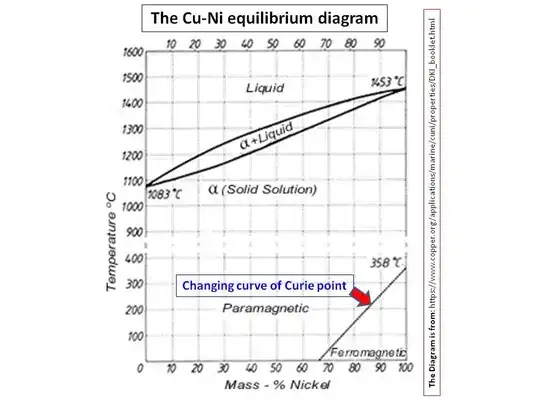
The Cu-Ni equilibrium diagram

Apparently, the Curie point has become $\pu{0 ^\circ C}$ or lower for $\ce{Cu/Ni}$ alloys with compositions 67:33 or lower $\ce{Ni}$ amount. Thus, it is safe to say alloys with less than 65% $\ce{Ni}$ in $\ce{Cu/Ni}$ alloys do not show magnetic properties at room temperature. Therefore, the US Nickel with 25% $\ce{Ni}$ would not act on permanent magnets.

However, Kaufmann and Starr (Ref.2) have shown that these alloys with less amount of $\ce{Ni}$ would gain their their magnetism at way lower temperatures (about $\pu{14-77 K}$).

References:

  1. E. H. Williams, "Magnetic Properties of Copper-Nickel Alloys," Phys. Rev. 1931, 38(4), 828 (DOI: https://doi.org/10.1103/PhysRev.38.828).
  2. A. R. Kaufmann, C. Starr, "Magnetic Properties of Solid Solutions. III. The Paramagnetic Alloys of Copper and Nickel," Phys. Rev. 1943, 63(11-12), 445 (DOI: https://doi.org/10.1103/PhysRev.63.445).
  3. E. A. Brandes, G. B. Brook, In Smithells Metals Reference Book, Seventh Edition; Butterworth-Heinemann: Woburn, MA, United States, 1992, Chapter 11: Equilibrium Diagrams, pp. 11-236.
Ruslan
  • 975
  • 5
  • 21
Mathew Mahindaratne
  • 39,943
  • 27
  • 55
  • 107
0

To the best of my knowledge they are not magnetic to make it very hard to profitably counterfeit our coins. If they are magnetic the vending machines will remove them with a magnet. This is the explanation I was given in the mid 1960's. Yes machines in our town had the magnets, I tried one.

Gil
  • 101
  • 2
  • Why would be important for the government, how the vending machines work? – peterh Apr 16 '20 at 06:23
  • Same reason the bills are very hard to duplicate and pass inspection. The easier it is to spot counterfeit money the less chance it will be counterfeited. Same for vendors, if they get a counterfeit coin or bill it is there loss, the government does not buy them back. – Gil Apr 17 '20 at 19:09
  • It probably isn't a very compelling reason. In the UK small "copper" coins used to be made of a mostly copper alloy and were not magnetic. For cost reasons these were replaced after 1992 with coins that look the same but are made from copper-coated steel. These are are now magnetic and stick to magnets. – matt_black May 29 '21 at 17:13
  • and most other UK coins are made from non-magnetic cupro-nickel alloys but were widely counterfeited. The design of the pound coin was changed in 2016 to a bimetallic pattern with a more complex overall design to defeat counterfeiting. – matt_black May 29 '21 at 17:19