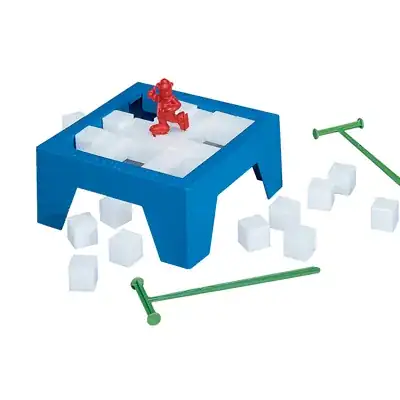
Given physics, it would seem like blocks wouldn't be sticky - but you can still predict when they will fall. Blocks will stay if they are in between (with a line of unbroken blocks) two blocks that are already confirmed to stay up (counting the edge)
For example, take this board.
----
--x-
---x
----
The two other "corner" blocks by the Xs would also fall, since they are not supported.
----
--xx
--xx
----
The rest of the blocks would stay, though. The rest of the board would stay up because of compression with the board edges.
----
--xx
--xx
x---
This block has been broken, now. However, nothing else will fall. I am going to mark stable blocks with an "s". These blocks are stable because they are held together by edges:
ssss
-sxx
-sxx
xs--
The rest of the blocks are also going to stay because they are held between edges and other stable blocks.
However, there is still a pretty simple winning strategy. Always break the ice block 180 degrees from what the first player played. The board will always remain symmetrical, and eventually you will get to some scenario like this.
xx-xxx
xx-xxx
xxBBxx
xxBBxx
xxx-xx
xxx-xx
Your opponent will be forced to break one of these chains, thus making the center fall.
You can never lose when doing this because of the symmetry. The central tile will only fall if it is not supported neither vertically nor horizontally. If you are breaking one of the tiles holding the center up (here shown as S tiles)
--SS--
--SS--
SSBBSS
SSBBSS
--SS--
--SS--
you would always break a side on the same axis that your opponent broke. You won't break stability in any axis because your opponent will first.
xxxSxx
xxxSxx
--BB--
--BB--
xxSxxx
xxSxxx
If your opponent breaks any of the S tiles, there will be no helpful force vertically.
xxxxxx
xxxxxx
--BB--
--BB--
xx-xxx
xx-xxx
The bottom two tiles are not providing any stability for the center because this stability only comes from compression, and the other side of that compression is broken. This means that when you remove the bottom two, you are not making the center less stable.
Knowing this strategy, however, doesn't mean you'll always win. You have to always be able to knock off only the block/blocks you want (which is skill, not strategy). I also haven't figured out what to do if you are going first and your opponent makes a mistake.