I've heard a lot (of good things) about this game and I'm interested in exploring it; however, I'm slightly worried about the initial cash investment involved.
About how much would it cost to get started with Magic: The Gathering?
I've heard a lot (of good things) about this game and I'm interested in exploring it; however, I'm slightly worried about the initial cash investment involved.
About how much would it cost to get started with Magic: The Gathering?

There have been many answers to this question, as there are many different ways to handle getting started in magic. Really, the best thing to do is to explore carefully and decide how you are going to play that's the only way to get a feel for how much your initial investment will be.
First and foremost, as others have suggested. Regardless of how you want to play, as a new player, Duels of the Planeswalkers is a fabulous way to get a feel for how the game is played. It's available on many different systems, most consoles and PC, as well as some tablets. It gives you an excellent way to get an idea of what different colours do, how they interact, the beginnings of how to use your resources correctly and the best strategies to employ in given situations. If you want to know whether you will like the game at all, this is the best way to find out.
If you like the game enough to continue from that point to the next step. There are 2 options, Paper magic, and Magic Online (often referred to as MODO). both of these are open to casual and competitive players alike, and the decision comes down to whether you are going to want to play with friends in your local area, with a hard collection to show for your money, or be able to jump in to a game of magic any time of the day or night. Whichever you choose, you will be making a similar level of initial investment, so your choice here really counts!
If you choose to take the online route, then jump onto the internet and make yourself an account, there are plenty of resources out there to help players get started on MODO, and there are bots who will give new players a handful of free digital cards to help grow their collections initially, besides that, you can buy boosters and enter tournaments just like with paper magic. you can even cash out your digital cards from recent expansions into paper copies if you complete a full set. If you go down the route of MODO, your initial minimum investment will be in the region of $10 for an account, from there you can jump straight in to playing some games.
if you choose the paper Magic route, then you need to make a decision about what kind of Magic you are looking to play. This is a very subjective choice, and depends massively on the player, realistically, without doing a bit of experimenting, you will struggle to figure out exactly what you want to do with magic. I will expand on this below:
There are many players (in fact, the vast majority) who will happily buy a few boosters here or there, and then build whatever decks they fancy out of what cards they have, and battle with their friends. These players get a lot out of every single card they own, and generally open a few boosters here and there a few times a week. Players like this will be playing at home with their friends, round a kitchen or dining table, with whatever decks they put together for that evening, maybe building a deck in a different colour for each of their friends that come to battle.
If that is the kind of magic you are looking to play, then your initial investment will not be sky high, there are many good answers already covering this, so I wont paraphrase them. I will say that sealed product (boosters/starter decks etc) would be your best choice. You would be able to spend as much as you feel you want to to get a collection big enough to build what decks you need to have fun with your friends, this could be as little as $20 as others have suggested, or I would say up to $100 would give you a very good basis to work from for a larger pool of cards to play with.
Like Competitive Play described below some casual players choose to follow certain deck construction rules (called a format) when building their decks. One of the most popular formats is called Commander, which involves creating a deck around a specific Legendary Creature, called your Commander. These decks are 100 cards (99 + the Commander), you can only have one a given card in a deck (other than basic lands), and all cards in the deck must have a color identity that is included in the commanders color identity. There is a Commander special release every November with 5 new decks that are around $35 a piece and are usually fairly competitive (for a casual audience, they aren't Competitive in the sense they would do well in a tournament).
If casual play at home with friends doesn't sound like your thing, (either because your friends aren't interested, or you are looking to meet loads of new people to play against, or you want to play to win) and you are looking to play in tournaments, then things go a lot differently, both in how to get started, and how much your initial investment will be.
There are many different types of tournaments, Limited formats, which require no prior investment whatsoever, are a good way of entering tournament play without having to spend any money prior to the tournament. You get the same chance everyone else gets, and it all comes down to learning how to play that format (be it draft or sealed) better than everyone else. Entry to these tournaments is often more expensive than traditional "build a deck beforehand" constructed tournaments, but you get to keep the cards you use in the tournament, so its a good way of picking up cards to expand your collection, whilst playing competitively. The cost of draft or sealed tournaments varies, so your local store is the best place to find out more information about this style of play.
If you want to know more about the types of tournaments, and advice about them, continue below, however, there is a LOT of information to process, and if you already feel like casual play is more for you, then this information is of little use to you. have fun YOUR way, and at YOUR pace!
As previously mentioned Limited formats require no prior cards, you play with the cards you are given by the Tournament Organizer. For limited events you have a 40 card minimum deck size rather than the 60 cards needed for all the constructed formats.
Booster Draft this is the most popular form of limited play. The way it works is you are seated at a table with several other people (8 players per table is considered ideal, however numbers can differ based on tournament attendance). Each person is then given 3 booster packs, they each open one of their packs and keeps a card from it passing the rest to the player on their left. They then take the pack passed to them from their right pick a card from it and repeat this process until there are no more cards to pass. This process is then repeated for the second and third packs, alternating direction with each pack. Each player then makes a deck from the cards they chose.
Sealed Deck is the other main form of limited play. In this format each player is given 6 booster packs and has to make their deck from the cards in those packs. This format generally has a lot more luck than Booster Draft since you only get to see 6 booster packs vs 24 boosters you get to see in draft so if you are unlucky and get bad cards there isn't really anything you can do to mitigate it.
Constructed competitive play is a whole different ballgame. This is where things get different, as in terms of "bang for your buck", you are best off buying individual cards from a reseller, rather than opening boosters and hoping to get the cards for your deck.
First and foremost, Event Decks have been made especially for you. they are more expensive than starter decks, but with very good reason. They contain more rare and powerful cards, and are generally built so that you can have a hope to compete in a tournament with them right out of the box. They even have instructional inserts to explain how the deck is meant to be played, and giving you some tips on how to use the cards that are included to best effect! These decks serve as an excellent starting point to build on. Note: Event Decks were discontinued with the release of Battle for Zendikar.
Playing at this competitive level, especially as someone starting out, it is very important that you start by paying attention to what kind of decks are winning tournaments week after week. There are plenty of websites that will give you a list of the decks (and every card they played) that came in the top 8-16 or so of the tournament. This gives you a very good idea of what kind of decks can do well reliably, and hence what you should be looking to invest your money into building. You can of course disregard this and build whatever you want, but if we are talking about investing $200+ in something, it's probably best to go with a tried and true formula, at least until you have some experience.
You may want to pick one of the cheaper decks that performs well, so you don't have to spend quite so much so soon, and that's fine, cheaper does not mean worse, and you can build something quite playable with under $100 if you pick carefully. You can also replace some of the most expensive cards with something more affordable if you wish, but bear in mind those cards are expensive for a reason, they're good!
There is some key information to remember however with constructed play, and that is the concept of rotation. Standard is the most popular constructed format, by a very large margin. If someone is playing non-casual magic with their own pre-built decks, chances are they are playing standard. One of the key things about standard is that every six months, usually around late September and early April, several sets of cards are "rotated out" of the format, meaning they are no longer legal for play. this means if you choose badly how you invest, you may well find that in a few months you are no longer allowed to play your expensive cards and have to spend that money all over again. Cards stay in Standard for approximately 15-18 months. On the positive side, this keeps the format feeling new and fresh, however, conversely, it does mean you have to continue to invest in new cards to play.
This puts a lot of people off these formats. Fortunately, there are other constructed formats that do not rotate, however these come with a trade off, as the initial investment is much higher. Eternal formats also tend to have a smaller player base, which means local tournaments are harder to come by, if they happen in your area at all.
Modern - this is the newest and cheapest non-rotating format. This obviously provides a massive advantage, in that cards you buy for this format will not ever rotate out of the format. This means that once you buy a deck - with some caveats - you wont have to make a big investment again. The exceptions to this are bannings, and newly printed cards. If the key elements of your deck are banned (such as Splinter Twin) then you may find you have to invest in an entirely new deck. Similarly, new cards may be printed which become key elements of your deck (such as the new Beck // Call which may well become a core element of modern Elves), however, overall this investment tends to be much more manageable than the continued investment in rotating formats.
Some players dislike modern, and a lot of the complaints raised against it centre around the fact that your investment into the format is not necessarily stable, as if key elements of your deck are banned, you need to reinvest into a new deck. Modern's banlist is relatively young, and as such is still undergoing more change than in other formats. Modern has seen cards banned or unbanned in many of the announcements since the format was officially released. This turbulence puts a lot of players off the format.
Legacy - This is a much more expensive, but also much more stable eternal format, which means that cards from all sets can be played unless they are explicitly banned. The highest value cards in this format are for the most part pretty safe from bannings, as they have been in the format for a long time, and would have been banned a long time ago if they were causing a problem. The main issue with Legacy is that the investment into a deck can easily reach into the region of $1000s. The main advantage is that your investment is unlikely to be invalidated by future card releases or bannings, and for the most part, wont require much (if any) continued investment as additional cards are released.
Legacy has its own problems however, and the prohibitively large cost of the key cards in the format takes its toll, While there are areas with a thriving legacy scene, and even some with higher legacy tournament attendance than any other format, in other areas, the player base is much smaller, and in some areas practically non-existent. Considering the cost of the format, it definitely requires some consideration of your local area to ensure you will be able to play.
Vintage - the most expensive and intense eternal format. This format has a very small ban list (banning only cards such as Contract from Below which reference the "Ante" mechanic which was removed from the game early on, "Dexterity" cards which require you to physically flip cards from a foot above the table such as Chaos Orb, cards with the Conspiracy type like Hymn of the Wilds, and Shahrazad) and a "Restricted" list, of cards which you may only include a single copy in your deck. Some of these cards cost hundreds or thousands of dollars each, and their power level makes them essentially required in your deck. As a result, Vintage tournaments are very hard to come by. I would not recommend going into vintage to someone just starting out.
So, having looked at all your options, here is an overview of what you can expect
Casual play - Comparitively cheap, you can happily play with an investment from anywhere between $20 and $100, depending on how many players you want to support. You can continue to invest to add variety, or play with what you have.
Limited - No initial "hump" of investment to be able to play other than tournament entry, but quite high continued investment.
Constructed
Standard (Rotating) - Reasonable initial investment (approx $50-$500), with similar investment to be made at least every 1-2 years.
Modern (Non-rotating) - Medium to high initial investment (approx $300-$2000), good chance of investment being stable, but good chance you may have to continually invest to keep current.
Legacy (Eternal) - High to very high investment (approx $500-$4000), quite stable investment, continual investment requirements small or non existent.
Vintage (Eternal) - Extremely high investment (approx $4000-$25000) very stable investment, continual investment requirements highly unlikely.
The problem is not the inital investment, it's the never-ending investment...
Here are two options I'm offering you:
Forget about that, try something else like Dominion or Thunderstone. Gosu was made by former Magicians who realized how many hundreds of bucks they spent on buying cards. These games are deck building games. They work like Magic, but you only pay them once.
Buy Magic: the Gathering. It's only a few whatever your local currency is. You can buy this year's edition, make a friend of yours buy one too and play against each-other, sometimes. But if you want to go and battle against old players, you must know that: you're not rich enough. Because once you are in the Magic circle, you can only get out by not playing at all. Don't imagine you can buy some cards and play. You must keep on getting new cards!
My point is: if your first question about Magic is, "How much will it cost?", you probably don't want this game.
Don't get me wrong, it's a great game! Just a very expensive one.


Getting started: $20 or so for a pair of starter decks. You need one starter per person, and an opponent, so to have a playable start for home use, you need two starters.
Note that starter decks are usually not terribly competitive with collected decks.
A decent collection will be around $50-$500 worth of boosters (depending on your values for decent and which editions you'll get, and your luck). You can probably get 2 or 3 decent decks out of an investment of $300+.
You can save a little by buying people's old cards; often they won't be pretty, but they're playable. That said...
The problem is, cards are constantly being changed as to tournament legality. Many people only play current tournament rules, even for friendly games, so you might have some older cards that are no longer tourney legal, and have upset opponents.
If you play ONLY with your own collection, and only with friends, you can save a bunch by getting unlimited editions of some of the older stuff that is no longer tourney legal.
If you play tourney, expect to spend $30 to $100 per month on assorted stuff... Keeping in mind a common tourney format is a "sealed deck tourney"... you buy a new-in-box sealed deck, and a booster or two (number by tournament rules), then make do with whatever you have there in just those 2-3 items. Typically, it's less expensive to buy them in the tourney ($3-$5 less than MSRP), but still, tournament play can rapidly build a huge collection and spend a LOT of money.

Also ask around to see if anyone is getting out of the Magic game and see if their willing to give you their old cards for cheap or free! FYI, foil lands make excellent trade fodder.
And check out trading platforms like Cardsphere, and scanner apps like Delver Lens to help you keep track of everything!
– Ben May 30 '18 at 15:29I'm a recovering M:TG addict, so I haven't played in a while. But assuming the game hasn't changed too much, you might want to look into actually stopping into a card shop and building your own "common" deck for cheap.
The rarity on M:TG cards is a large part of the price. Super-rare combo cards with the gold stamp are sold out of glass cases for high $$$, but usually next to them is a big box marked "commons," which I've seen go for as little as $.03 a card. Stick to one color and you'll only need "basic" lands, which I've actually seen given away at certain card shops.
The most common "common" builds when I played were:
White or Green "Weenie" - Focus on cheap creatures that you can play for 1-2 mana at max and try to overwhelm the opponent early.
Red Burn - Use a mix of cheap red creatures and direct damage to win as quickly as possible.
Suicide Black - At the time I was playing, there were several commons that hurt both you and the opponent, but hurt them more, which again lead to decks that worked to win as quickly as possible.
Green "Stompy" - Focus on surviving long enough to get huge but expensive creatures out.
Mono-Blue Control - A handful of damage-dealing cards mixed in with a ton of counterspells, ala Randy Beuhler's "Draw, Go" http://www.wizards.com/magic/Magazine/Article.aspx?x=mtgcom/daily/rb63
That was the deck that made me love magic, as he took it to 12th place at World's despite the fact that at the time you could build the whole deck for under $15. And it's fun to make your friends cuss.
Anyway, assuming you do build entirely out of the 3-cents-a-common box, you'll spend about $1.80, $2.25 if you include a basic sideboard as well. Following one of those builds, even loosely, should give you a playable-enough deck. But even better, you'll find they're very easily upgrade-able when the opportunity to buy better cards comes up, and often it only takes swapping out a few cards to change the face of the deck entirely. My much-beloved blue control deck was basically just a "base" that I could swap differing sets of spells into to make 5-6 different decks, which saved on card purchases quite a bit.
tl;dr: You can get started for very cheap, but the more you spend, the better your deck will get. Good luck and have fun.

Here's my suggestion: before you plunge headfirst into the dizzying money pit that is paper Magic (at least it can be, for those of us without enoug self-control!), try getting hold of Duels of the Planeswalkers on PC, XBox or PS3. It's not "real Magic", in a few ways that I'll mention, but it's an inexpensive way of getting close enough to it that you'll be able to tell if you like it. DotP 2012 has just come out, contains lots of cards from up-to-the-minute and even yet-to-be-published sets, and will let you get to grips with the rules of the game against a reasonably good AI, or even play against other humans if that's your preference.
How is DotP not like the actual game? Most importantly, you don't have full freedom to build your own decks. You start off with one of a dozen or so decks that are in the game, and by winning duels you unlock more cards that you can swap in for old cards, giving you the power to personalize your game, and get rid of cards you hate. But you CAN'T take the red deck and the blue deck and mash them together into a crazy combination of both. You're pretty much stuck with what you're given.
And that's the great thing about real Magic. There is no other game with such infinite potential. I mean, this game has tens of thousands of "pieces" stretching back over 20 years of history, and quite a few hundred more cards being printed every year. You can play it in about a dozen different officially sanctioned or semi-sanctioned ways, and there's something here for everyone. But all of this comes with a price, and that price is money. If you want to just get two precons and play them with a friend, that's $20. But that's just a tiny sliver of the fun you can have with Magic. Play Sealed Deck and Draft tournaments! Take part in six-player multiplayer extravaganzas! Try out Two-Headed Giant, or Commander, or Archenemy! Make the huge financial investment required to compete effectively in Standard tournaments, or sell your house and car to scrape together the "Power Nine" cards required for a Vintage tournament! The sky really is the limit.
You may get to that point, you may not. However, if you want to get a taster of the game for less than about ten bucks, Duels of the Planeswalkers is almost certainly your best option currently :D

I've recently been in this situation, I haven't played in almost 20 years and my girlfriend was interested in playing because one of her friends played.
If you want to learn the rules get the Magic the Gathering Game Duels of the Planeswalkers for the iPad/XBox/PS4/whatever the free demo should give you a pretty good basis in the rules.
Once you are sure you want to continue buy a set of "Dual Decks", they are cheap well balanced decks and they usually have some good cards for you to pilfer once you start actually playing. Sorin Vs Tibalt is particularly fun to play.
I was told to get the event decks and I bought a bunch of these to get the cards, I wasn't that impressed to be honest, the card selection for the duel decks was much better.
I've also bought a couple of the 2013 "Starter Decks"
You might want to invest in the "Deck Builders Toolkit", it provides you with a lot of cards, some boosters, and crucially land.
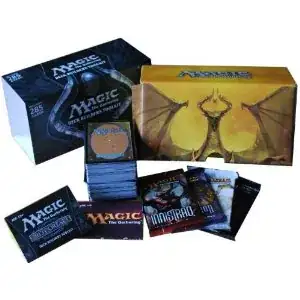
If you go to your local gaming shop's Friday Night Magic evening you might find some people are willing to give you some commons chat with people, I had a friend turn up at my house with two shoe boxes of commons with the instruction to take whatever I wanted.
It's also worth picking a format, I've grown to really like EDH/Commander and Legacy because I have a lot of old cards. But if you are just starting Modern might be a good idea.
If you are going to deck build look at decks on Tapped out for inspiration and the Reddit Magic Community are surprisingly helpful.

It's hard put a price on getting started, as many have said, it's never ending; even for those who think they have self control. It is however possible one of the best games of all times. If you want a similar feel, but something with more of a definite price and future expense amount, I would recommend looking at Fantasy Flights line of "living card games."
Current lines which are of similar theme to magic are warhammer invasion, a game of thrones, and lord of the rings. Pretty much the best part is you don't get in the trap of magic where you can't help but want to buy the high $ cards. With living card games, if you buy the expansion you get all the cards in the set rather than having to mine booster packs.

Surprised it hasn't been mentioned: ever since Magic Arena was released, the answer is "nothing". But be ready to grind a lot to build up a good collection of cards (unless you put in money, of course).
On the bright side, if you have a bad deck made of bad cards, there's some wrinkle in the matchmaking algorithm such that (in unranked games at least) you'll only play against other players with bad decks. You can also play limited, where you'll be on equal footing with everyone else, although you'll need to save gold/gems to enter them.

"Get started"? Nothing.
Around the release of every core set local stores receive 30 card "Sample" decks to hand out for FREE. This are basically only good for trying out the game playing against each other (as a normal structure requires 60 card decks), but they're fun to play with, restricted to cards that are easy to understand, and can provide a base for you to build a stronger deck around.
Beyond that, if you have friends who've been playing for more than a year, they will fall over themselves to give you cards. I need to free up some space, take my commons, please! You won't get the strongest deck out of this, but you can certainly get something you can play with.
Duels of the Planeswalkers is generally considered to be the best intro to learning the game, and you can get it off Steam for very little (£7 UK atm). It'll allow you to practice, learn and get a feel for the game, without being screwed up by the relatively complicated rule system that every player gets slightly wrong. (Magic is a game with a phonebook for a rulebook, and nearly every potential teacher has at least one thing they think they understand and totally don't).
As somebody else has said, you can pick up 2 actual starter decks for roughly $20-$30, and the new Clash Packs allow you to spend $30 for 2 casual decks that can be combined to form a tournament viable (if not dominant) deck.
If you find you enjoy deckbuilding, I recommend Limited formats for picking up cards, beginning with the set pre-releases, where you pay for 6 boosters, build the best 40 card deck you can out of them, and play 5 rounds of Magic. They're great fun, and generally advertised on Wizard's site ahead of time, along with a Store Locator.
As others have said, once started, you may find yourself eBaying your stuff to pay for that last mythic rare to complete your Modern Deck, but that's an intervention your friends and loved ones can have at a later time.

I really like the answers from Patters and Hurley but think that the logical intersection of these two answers is not spelled out. It leads to a way I have personally kept this an inexpensive hobby, despite accumulating over 6000 cards in the past 6 months. My family has spent less than $50 on these 6000 cards if you exclude birthday and holiday gifts of fat packs or other card packages. If you include the value of gifts then it is just under $250.
As other answers have already mentioned, initial cost can be quite low if you are satisfied to buy dueling decks and nothing more, or perhaps a Core Set Deck Builders' Took Kit.
This answers your question literally but as Patter's answer explains, you will likely not stop there. A really large part of the fun of Magic is building new decks and then testing them out. Costs will mount if you start to build a wide variety of decks or if you choose to play in competitions. With proper planning and early decisions in the right direction, you can keep these costs low.
I'm going to skip explaining Duels of the Planeswalkers and the various forms of intro decks which are explained in other answers - but do understand that to keep costs low and still get a rewarding experience, you'll need to understand the rules of the game and have a little experience. Try to get that experience before starting your buying.
What I recommend for those who want to keep costs low not just initially, but also on and ongoing basis, is to focus on a low cost format:
Peasant isn't all that popular and is not the least expensive so I'll focus on Pauper. Pauper is a format that allows you to use only commons to build your decks. Any common from any set can be used except for a very small number of cards that were banned due to being so powerful that they limited diversity.
There are four levels of rarity:
What makes MTG so expensive in the long run is rare and mythic rare cards. Some uncommons can be expensive too.
Commons and uncommons can be obtained very inexpensively, sometimes for as little as 1 penny per card. As I explain in much more detail in a separate question, it is possible to build a wide variety of decks at low cost if you keep to commons and uncommons, strictly avoiding purchasing rare or mythic rare cards.
Avoid rare and mythic are cards and you will keep your costs low. If you somehow obtain rare or mythic rare cards, trade them away or sell them to further reduce your net costs. The only downside to focusing on commons and uncommons is that you won't stand much of a chance going up against decks with many rares in them. So you'll end up avoiding playing such decks.


To get started, is about 30 bucks - that'll get you two theme decks. If you get them from the same set, they'll be generally balanced against each other (they're not guaranteed to be balanced against decks from older sets).
If you're looking to play competitively, it depends at what level - Magic runs several constructed formats, differentiated by how old the cards can be. The two most common formats are Standard (roughly the last two years worth of cards) and Extended (the last seven years worth of cards). Costs will vary accordingly.

In addition to the already-cited Intro Packs, the manufacturers have started releasing Event Decks for each block. These are pre-constructed decks built for the level of competition you'll face at the typical low-level tournament. They retail for $25, and are a pretty good investment as a starting player.

I've never bought any Magic the Gathering cards but I have experience with plenty other CCG's. If you're not willing to sink a couple 100 $ into new cards every year don't even start!
Every year there is a new Core Set with 250-450 cards as well as about three expansions totaling around 500 cards. The game I played the most did not have anywhere near that amount of cards coming out but I still bought about 300$ worth in each set (over a longer period though).
If you like the idea of card games like MtG but don't like the business model you should look into Games with more fixed card sets like Blue Moon or Summoner Wars.

it might not cost much. Maybe, you could buy 3 booster packs for 45 cards. Then, go to a random comic store, and buy a bunch of basic lands. then, you could have a ok 45-75 card deck. then go to a few fnm(friday night magic)s, and trade. once you have a decent deck, I might buy a pack depending on what colors your deck focuses on. In total it would cost...
                               3x$3+ $9 for boosters
                                     $1 dollor on basic lands (about)
                                     $10 for the pack
                               = $20 for everything

You can look on the internet for top tier deck lists to get ideas of what cards you will want and need and what works. Then, when you have a decklist, buy the singles from sites such as manashack.com It saves you a lot of money in the long run as you wont have to keep buying booster packs to get the cards you want.
I don't get why many answers focus on the (pointless) booster buying, so I'm going to rectify that.
In MTG there are many formats, which mostly fall in one of those two categories:
Playing in a Limited tournament costs 10-20€, depending on the format, and that cost is the cost of the boosters to play it, plus an extremely small fee. These should be the only boosters that you buy.
In Constructed you get to build your deck: to do that you should selectively buy just the cards you need, and once you have them you can keep using them as long as the format you're playing allows them (forever in Vintage or Legacy).
TL;DR: buying boosters is usually just plain stupid: you either get them anyway in the Limited tournaments, or you'd better buy specific cards for the Constructed.
That said:


