I don't know of a scenario that is an example: if either number can be played but not both, the player must play the larger one. Can someone please explain when this rule should be used.
Asked
Active
Viewed 414 times

2 Answers
3
Just to make it an easy and fast rule, a player MUST play the larger part of the roll, if he can play ONLY one part of his dice.
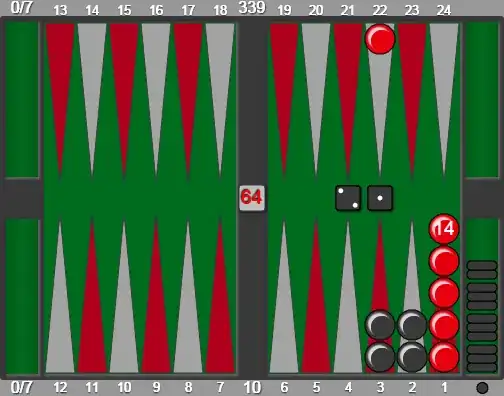
In the above example, if red rolls 21, he MUST play 3/1, and is not permitted to play 3/2, this is not a choice, its a mandatory move.

Skytten
- 141
- 1
- 3
0
Player A has 14 stones on Player B's one-point, and a fifteenth stone on his 3-point.
Player B has a wall at least two points long running back from his two-point.
If player A rolls 1-2 he can move his fifteenth stone either one or two points (respectively to either the two-point or one-point), but cannot move it three (ie remove it) because not al his stones are in his Home board yet.

freekvd
- 4,575
- 1
- 20
- 47

Forget I was ever here
- 11,932
- 20
- 40
-
Also, there could just be another wall 3 spaces away from the lone stone. – GendoIkari Feb 18 '15 at 17:37
-
Position is right (although pretty unusual), but description is misleading. – dwo Nov 02 '15 at 12:59