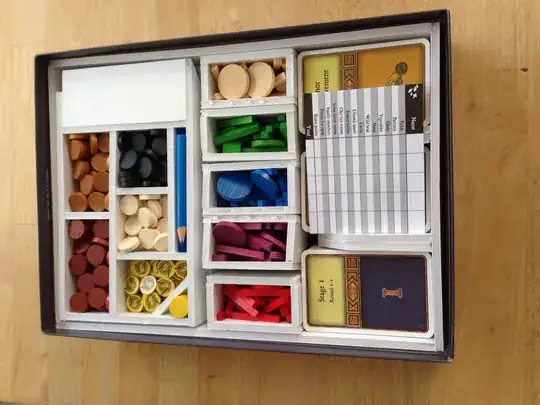
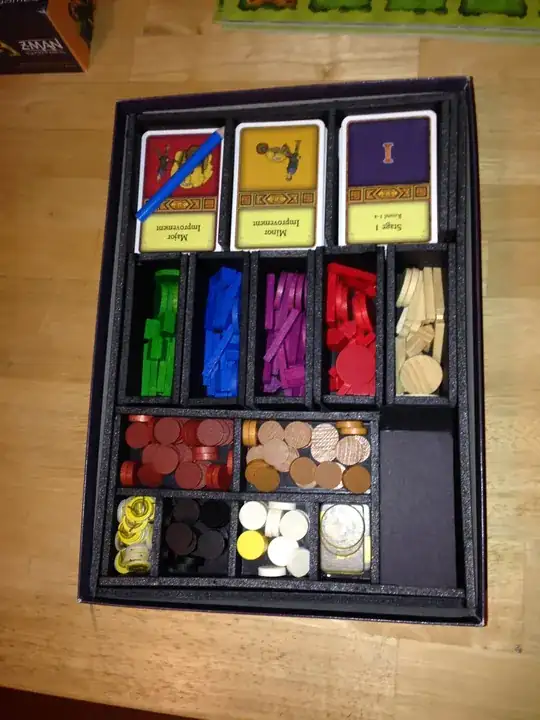
The trade-off is between setup time and maintenance (restocking at the beginning of each turn). We've chosen to split the difference as follows:
Each set of player pieces goes into its own ziplock bag. Hand each player a bag at the beginning of the game and let him manage it from there.
All the goods (wood, clay, reeds, stone, grain) go into a single large ziplock bag. We just dump this out onto the table (or, if you prefer, into a shallow bowl). Yes, you have to do a little digging when restocking the board, but it's spread out enough that you can generally just pick up three wood (etc).
All the livestock go into a single bag. Treat like the goods.
All the food tokens and the "5x" chits go into a single bag. Again, just dump it out somewhere; most of the time you're just grabbing food and the other chits are larger, so we haven't found it to be a problem.
Separate the cards into minor improvements, occupations, and everything else. For "everything else", that's the major improvements (in order, so you can just deal them out), the 14 turn cards (we just shuffle them all together and then populate the board), the extra "board" cards for higher numbers of players (we just pick what we need there), begging cards (we ignore them unless needed), and the "cheat sheet" cards (deal out). You could put a "cheat sheet" card in with each bag of player pieces if you prefer; we've never bothered.
This distribution of stuff allows easy parallel processing during game setup. One person can deal out the board, turn, and major-improvement cards while somebody else (or multiple somebodies) dump out the three bags of tokens and somebody else (could be two somebodies) shuffles and deals occupation and minor-improvement cards.
We don't bother to sort out the occupations by number of players; after dealing, people check for invalid cards, return them, and get dealt replacements. Iterate until done.
When we play we use all of the series together; if you want to play with, e.g., only the K-cards, I suggest the same approach as for occupations.
I haven't timed our setup, but it's never triggered the "ugh, this is taking too long" reaction. I think our Agricola setup is comparable to our Puerto Rico setup, for what that's worth.