3

What is the minimum eye which confers some evolutionary advantage?

By minimum I mean anything less than this has no advantage whatsoever and therefore is not favored by natural selection.

By eye, I mean not just a light sensor but also infrastructure which converts the light stimulus into an advantageous response.

Ideally would like a clear unambiguous before/after case especially on the infrastructure between the mutated protein and the cell's response mechanism which translates this into a survival advantage.

(I assume Opsin proteins floating around the cytoplasm by themselves confers no advantage without some kind of other infrastructure)

please also provide an estimate of the number of coordinated DNA base pairs which needed to change to confer this advantage so that a proper probability estimate can be done.

Berne
  • 331
  • 1
  • 5
  • 17
r2d2
  • 186
  • 6
  • An opsin protein attached at the membrane of cells exposed to light with a standard biochemical cascade allowing for example to regulate the expression of a gene will potentially be beneficial. Would this answer your question? – Remi.b Mar 07 '15 at 18:43
  • @Remi.b wouldn't this need a custom cocktail of chemical cascade to convert the light impulse to something useful (we are after all talking about a cell without an eye). The details of this cascade is really my question. which includesalso the details of how the impulse would be converted to something advantageous – r2d2 Mar 07 '15 at 20:16
  • @Remi.b will check out these links. thanks. looks complicated. wish there was something which addresses this specific question. – r2d2 Mar 07 '15 at 20:43
  • 1
    I moved my comments into an answer. I think that all the links directly address your specific question. Or I may not understand your question. Maybe the last link on the structure and function of the opsin gene is the information that you're specifically seeking for. I am not sure. – Remi.b Mar 07 '15 at 20:45
  • I think "eye" needs to be quite strictly defined before answering is possible. – AliceD Mar 07 '15 at 21:03
  • 1
    @ChrisStronks I agree. Not knowing what the OP is meaning by "eye" made the answer difficult to write and make it quite generalist and approximative. But I am not sure what the question is anyway. I think the OP struggles with how an opsin protein works. – Remi.b Mar 07 '15 at 21:09
  • 1
    @Remi.b yes agreed totally. I upvoted your answer as I agree that your description is the simplest light sensor , however, an opsin system alone may not be categorized as an eye. – AliceD Mar 07 '15 at 22:36
  • 2
    @ChrisStronks right. you'd need other infrastructure converting it to an sight sensation/reaction which is really what this question is about – r2d2 Mar 08 '15 at 05:51
  • Is this question inspired by that Darwin quote that creationists seem to love? Because if so that was totally taken out of context, see here. – augurar Mar 11 '15 at 05:14
  • @augurar no it was my own thought. can be applied to the emergence of all new information. not just the eye – r2d2 Mar 11 '15 at 06:59

2 Answers2

6

I think that you are expecting for some complicated system while such things are not necessarily involved. You basically just need a protein that is light-sensitive and some cascade of signal transduction. A light-sensitive protein is just a protein which conformation is changed in the presence of photons of a given wavelength. This cascade of signal transduction can be very standard. It doesn't need to be anything extraordinary.

Consider a mutation that turns a given protein into a light-sensitive protein. Such mutant protein could easily still activate the same cascade (and eventually regulate the expression of the same gene) and may eventually be beneficial. A visual signal (presence/absence of photons of a given wavelength) directly affect the conformation of the protein which in result can activate a whole cascade. The cascade doesn't need to have evolved after the protein had acquired the ability to response to photons. You may want to dive into the details of how the structure and function of the opsin proteins.

This article describes how an ancestral non-light sensitive protein (coded in GPCR gene. The proteins are also called serpentine) evolved into a light-sensitive protein (opsin). The article also link to other articles that discuss this transition.

There are several types of light-senstive proteins in different kingdom, including plants and bacteria that don't have nerves.

You can learn more about the cascade of transduction on wikipedia (here or here for example). You may want to learn more about opsin proteins and learn more about light-sensitive proteins.

Wikipedia page: Evolution of eyes > Early Eyes will probably interest you as well. Depending on the definition you use for "eye" (note, "eyes" have evolved independently 50 to 100 times), Planarian might be a good example of a species that have a primitive eye.

Remi.b
  • 68,088
  • 11
  • 141
  • 234
  • thank you but I am looking for an actual working example. either way, thanks for the links – r2d2 Mar 07 '15 at 20:53
  • 1
    Are you looking for a species that has a very primitive form of "eye" (eye taken in the strict sense of animal eye I suppose)? – Remi.b Mar 07 '15 at 20:59
  • no i am looking to understand what is involved in jumping from no eye to minimum eye – r2d2 Mar 07 '15 at 21:01
  • Do the sentences (in my answer) not answer your question? Consider a mutation that turns a given protein into a light-sensitive protein. Such mutant protein could easily still activate the same cascade (and eventually regulate the expression of the same gene) and may eventually be beneficial. – Remi.b Mar 07 '15 at 21:05
  • There is now a small paragraph (the second paragraph) about how a single mutation that offers the ability to sense light might be beneficial. Let me know if it still doesn't answer the question. – Remi.b Mar 07 '15 at 21:13
  • if you could provide a detailed example yes. but merely stating this does not. need something unambiguous. something scientific which can be put to the test – r2d2 Mar 07 '15 at 21:14
  • I linked an article that describe a specific example (see edited answer). Does it answer your question? – Remi.b Mar 07 '15 at 21:26
  • will need to research all these links. thanks. ideally would like a clear unambiguous before/after case – r2d2 Mar 07 '15 at 21:34
  • 2
    If I may say something that has nothing to do with the subject of the discussion; it sounds like you don't need this info for research purpose or whatever (otherwise the question would have been much clearer from the beginning) but that you arrived on this site almost ready to refuse any explanation one could give you. People who does that often end up protecting their first opinions toward any explanation by digging always further a possible way to refute the evidences even going to the philosophy of knowledge (or of logic). I'd advice not to make the mistake to be "primarily opinion based". – Remi.b Mar 07 '15 at 21:45
  • Enjoy the readings! – Remi.b Mar 07 '15 at 21:45
  • I have a hard time to understand what you would call a "clear before/after scenario". I think you either expect a an observation with a methodology that one with very little knowledge in biology can understand (in which case, we could sum up this point of view to "I don't trust your answer because I am not able to understand your answer") or an observation where the mutation would naturally occur behind our eyes, which is of course extremely unlikely to ever happen. But in the second case, I don't really understand what difference that would make. – Remi.b Mar 08 '15 at 01:12
  • 1
    I don't see how this answers the question. I agree that it is possible for one protein to mutate into another. What I am asking is about the other infrastructure which translates the light's effect on the protein into a minimal sight response. regarding what you wrote that the existing cascade could be reused, can you provide details or better yet empirical evidence for this? ex an experiment where a microorganism without any kind of sight had opsin proteins injected or mutated in its cell menbrane and this offered minimal sight. without this your answer is useless to me. but thank you anyways – r2d2 Mar 08 '15 at 05:49
  • i also dont see how this answers the question. the OP is asking for a minimum eye with the minimum accompanying infrastructure. maybe this should be a comment. – user813801 Mar 09 '15 at 12:59
  • @user813801 On one hand the OP is asking for the minimal number of changes for an "eye" to be beneficial. I showed that very few changes can lead to sensitive abilities. Now if the OP were not to consider the thing I described as being an eye (but he seems to not complain about that), the thing I described would still makes sense in order to describe the adaptive valley that the OP assumed to exist between having no eyes and having an eye. I would agree though that the absence of definition of what is an eye make the question confusing – Remi.b Mar 09 '15 at 13:20
  • if you dont understand the question, then clarify before giving a bunch of links to peripheral issues – user813801 Mar 09 '15 at 13:25
  • @user813801 Criticisms about the sense of the questions have been made below the question and there are currently 4 lose votes. I prefer avoid editing the post myself to clarify it as I am afraid the OP would feel like I change the sense of its post. I just thought I would do my best and give an answer to a somehow unclear question. – Remi.b Mar 09 '15 at 17:14
  • the OP made changes to the question to address all those points – user813801 Mar 09 '15 at 17:23
  • 2
    A mutation that lets a non-light-sensitve protein be light-sensitive would already have all the necessary infrastructure, since it would still have whatever cascade the original, non-light-sensitive protein used. Generally speaking, no additional infrastructure would be needed. – TheBlackCat Mar 09 '15 at 17:32
  • the article you reference says: "the origin of phototransduction in animals MAY have involved the alteration of only a single component...Taken together, these data support a view that the origination of animal phototransduction, and by extension of animal vision itself, involved the evolution of an existing CNG-based cascade into a functionally new cascade, founded by a novel opsin lineage of light-sensitive G-protein-coupled receptors." how much change is this? please give as much details as possible. thanks – r2d2 Mar 09 '15 at 21:39
  • Please continue this discussion in chat. – kmm Mar 09 '15 at 23:00
  • Comments are not for extended discussion; this conversation has been moved to chat. – kmm Mar 09 '15 at 23:00
2

A relatively simple proto-eye is the pineal gland. It has been considered to be the third eye and it is involved in circadian rhythms in man, it is involved in thermo regulation, and in reptiles and amfibians it is in fact directly light-sensitive.

However, it is not an eye as such, because the pineal does not convey topographical information about the environment to the brain. It is more of a light sensor in reptiles and amfibians. However, it is a sensor embedded in the central nervous system of higher organisms including humans. As such, it is not just a light sensor, but an endocrinic organ involved in the light-based entrain of endogenous circadian clocks present in various organs. It has been implicated to be an integral part of the visual system in early life:
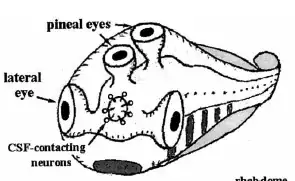
pineal

hypothetic four-eyed protovertebrate. Source: Vigh et al., 2002

The hypothetical system in the picture is not so much different from the lancet fish today, a 'living fossil'. In early life, and reptiles and amfibians today, the pineal is directly light-sensitive and thereby entrains the circadian clock directly via endocrinic functions. Synchronizing the circadian clock helps organisms to adapt to the environmental light periods, in other words prepare diurnal creatures to wake up in the morning and get ready to hunt etc. Hence it aids survival of various species in different biotopes (Vigh et al., 2002). In humans and other mammals with a dense, solid skull light-sensng is taken over by the retina, as the skull prevents admission of light. Here the pineal has only an endocrinic function receiving afferent input from the eye.

Reference
Vigh et al., Histol Histopathol 2002;17:555-90

AliceD
  • 52,402
  • 19
  • 174
  • 238
  • thank you. can this structure be useful if it were simpler? if yes, then it is not a minimum eye. – r2d2 Mar 09 '15 at 18:16
  • It is useful in organisms living today, such as for synchronizing day/night cycles or for either moving towards areas that are likely to have food or moving away from areas that are likely to have predators. – TheBlackCat Mar 10 '15 at 11:28
  • @RayS. - the pineal gland is the most simple structure I know that has been called an eye, but is far more rudimentary than the eyes that re-construct the visual environment. To me, it is more than a molecular light sensor (it is an organ), but its light-sensing capabilities are not such that it generates conscious perceptions of the environment. – AliceD Mar 10 '15 at 12:32