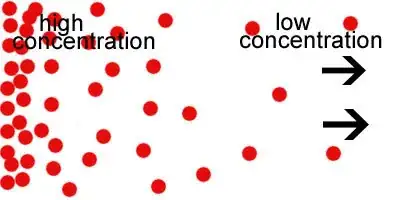
Lets start with a general definition: A gradient is the difference in the concentration of a substance (this can be a solutant in liquids, a gas or whatever) between two places. The image below shows the general definition. If nothing else happens what keeps the gradient stable, over time diffusion will cause an equilibrium between both places. The flow of substance always goes from the high concentration to the low (indicated by the arrows).
In biological systems the two parts of the gradient are usually divided by a membrane and are more stable. Gradients can be generated by active transport which requires the input of energy to work against the gradient. Examples would be the concentration gradient along a membrane like protons (positively charged hydrogen-ions), as this can be seen in the mitochondria. Here three complexes of the respiratory chain (I, III and IV) pump protons from the matrix in the intermembrane space, which requires energy. The fourth complex (V) pumps the protons back and uses the released energy from this process to make ATP. See the figure below which shows this process schematically (from here):


