Flicker Fusion Threshold:
The wikipedia definition:
It is defined as the frequency at which an intermittent light stimulus appears to be completely steady to the average human observer.
Background
In 1824, Peter Mark Roget (who also wrote the famous Thesaurus) first presented the concept of "persistence of vision" to the Royal Society of London, as the ability of the retina to retain an image of an object for $\frac{1}{20}$ to $\frac{1}{5}$ second after its removal from the field of vision.
A second principle - the $\phi\ phenomenon$ or stroboscopic effect is closely related to flicker fusion. It was first studied by Max Wertheimer and Hugo Munsterberg between 1912-16. Wertheimer and Munsterberg found that subjects can perceptually bridge the temporal gap between two consecutive displays, so that a series of static images appear as continuous movement. The discovery of flicker fusion became the perceptual basis for moving pictures, television, and all media based on stroboscopic presentation of stimuli.
The minimal frequency at which flickering stimuli appear continuous is called the critical flicker frequency.
Perceptual factors affecting the critical flicker fusion threshold
This critical flicker fusion threshold depends on the stimulus’
- Luminance (the Ferry-Porter law),
- Size (the Granit-Harper law),
- Color,
- Retinal eccentricity,
- Background Luminance, and other factors.
Biology Behind it:
Physiological evidence in humans and monkeys shows that flicker rates
above the perceptual critical flicker frequency threshold can
nevertheless generate cortical and subcortical visual responses. Thus
the temporal integration underlying flicker fusion does not occur at
the level of the retina, but must take place later in the visual
hierarchy. Single-unit recordings in the primary visual cortex of
primates suggests that, for two brief-duration targets presented in
close succession, the after-discharge to the first target interferes
with the onset-response to the second target (Macknik, 2006) (see
Figure 5). The onset-response to the second flash is absent for
inter-stimuli intervals of 30 msec or shorter (equivalent to 17 Hz
periodic). If the flashes are separated by more than 30 ms, the
after-discharge to the first flash and the onset-response to the
second flash begin to recover (i.e. equivalent to <17 Hz flicker).
These intervals roughly coincide with the critical flicker fusion
threshold in humans for 100% contrast stimuli in the fovea .
This suggests that perceptual flicker fusion may be due to the lack of
robust transient responses to the flickering stimulus.
http://images.scholarpedia.org/w/images/thumb/8/8b/Flicker_fusion_fig5.png/360px-Flicker_fusion_fig5.png
Source:
- Bartley (1939). Some effects of intermittent photic stimulation. Journal of Experimental Psychology 25, 462-480.
- Bloch, A. M. (1885). Experience sur la vision. Comptes Rendus de Seances de la Societe de Biologie, Paris 37, 493-495.
- Brücke, E. (1864). Über den Nutzeffect intermittierender Netzhautreizungen. Sitzungsber k Akad Wissensch Math-naturw Cl, Wien 49, 128-153.
- Di Lollo, V., and Bischof, W. F. (1995). Inverse-intensity effect in duration of visible persistence. Psychol Bull 118, 223-237.
- Ferry, E. (1892). Persistence of vision. Amer J Sci 44, 192-207.
- Fukuda, T. (1979). Relation between flicker fusion threshold and retinal positions. Percept Mot Skills 49, 3-17.
- Flicker Fusion
What is the Different speeds of Visual Perception?

First-order motion
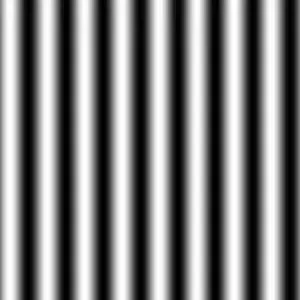
Experiment: A moving sinusoidal grating with bright peaks and dark troughs is seen through a window.
Result: Even when its velocity is so high that 30 of its bright peaks pass each location per second (30 Hz), observers still perceive its direction of
motion.
Depth from binocular disparity
Experiment: Two identical gratings, one in each eye, are viewed through identical windows.
Result: One is spatially shifted relative to the other, introducing a binocular disparity that is perceived as depth.
Even when they move at a 30 Hz rate, the depth is still perceived.
If the input to depth mechanisms were blurred at a >30 ms timescale, detecting the depth would be impossible at this rate.
Edges and texture boundaries
Experiment: Against a gray background, a field of white dots is adjacent to a field of black dots.
Result: Both fields are set in rapid alternation between white and black, but out of phase – when
one is white, the other is black. The conspicuous boundary between them is perceived even at fast
rates of 30 Hz, whereas at faster rates the black and white are averaged by the brain into the same color as the background.
http://ak.picdn.net/shutterstock/videos/3139525/preview/stock-footage-retro-geometric-dot-background-in-black-gray-and-white.jpg
Binding of color and orientation sharing a spatial location
Experiment & Result: If a red, right-tilted patch is alternated with a green, left tilted patch,
it is easy to distinguish from the complementary pairing of red left alternating with green right, even at
fast 20 Hz rates.
Binding of form and color across space
Alternating color-shape pairings can only be reported at rates below ~3 Hz.

source: http://www.psych.usyd.edu.au/staff/colinc/HTML/dynamics.htm
Binding of global form with color
Two specially constructed dot patterns that form distinct shapes alternate, with all the dots of one red and all the
dots of the other green.
At alternation rates faster than several a second it is very difficult to determine the shape color pairing even though the shapes and colors themselves
are easily identified.
Direction change and acceleration perception
A moving stimulus alternates between two speeds (acceleration) or two directions. When the alternation occurs
faster than several per second, these changes are unperceivable.
Its limit is 8-10 Hz.
Word perception
Certain pairs of words (such as ‘jump’ and ‘pink’), when alternated in the same location, cannot be distinguished
from another matched pair at rapid rates as one perceives only the sum, which is the same for both pairs.
They can be distinguished only at rates slower than several items per second.

Source: http://www.psych.usyd.edu.au/staff/alexh/research/words/
Source:
- Holcombe AO (2009) Seeing slow and seeing fast: two limits on perception. Trends Cogn Sci 13:216 –221.
- http://www.psych.usyd.edu.au/staff/colinc/HTML/dynamics.htm


You can check this post. You may find it useful.
– WYSIWYG Jul 24 '14 at 04:54