14

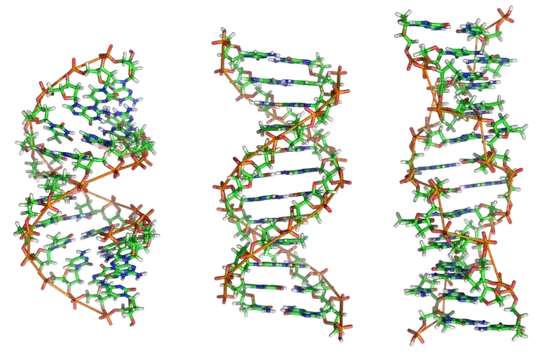
RNA is known to form an A-form helix, while DNA generally forms a B-form helix under physiological conditions.
enter image description here

From left to right: A-form DNA, B-form DNA, Z-form DNA. Image created by Richard Wheeler

The preference of RNA for the different conformation is supposed to be caused by the 2'-OH, my question is now how exactly this favors the A-helix? Which interactions are important and cause RNA to adopt an A-form helix?

Daniel Standage
  • 5,741
  • 3
  • 29
  • 62
Mad Scientist
  • 9,184
  • 10
  • 46
  • 73
  • 1
    There are many factors that produce effect in that interaction. You could have a first look in detail at http://www.sciencedirect.com/science/article/pii/S0022283605014439 – Open the way Feb 26 '12 at 08:33

1 Answers1

14

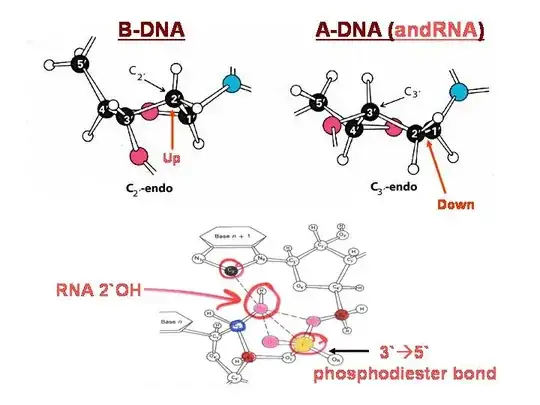
The beta-form of DNA and the alpha-form of DNA are based on the pucker on the sugar ribose. As DNA doesn't have a 2'-OH, it can obtain both conformations.

schematic of Beta vs Alpha from riboses

RNA does not have this luxury. The steric clash of the 2-OH with the 3'-OH makes the B-form to be very unfavorable thus constraining the RNA to adopt the A-form. Incidentally this steric limitation is also why RNA structures are more stable (see https://biology.stackexchange.com/a/769/389)

bobthejoe
  • 7,867
  • 7
  • 43
  • 73