1

Here is exactly the same question with an accepted answer. However, that answer looks wrong (I can’t find the “alert moderators” button). Firstly, it refers to a dubious source. Secondly, it contradicts this answer, which states that L cones do not have increased sensitivity in the violet area. This is also evident from the pictures on Wikipedia [1] [2].

The question is further complicated by this source. In it, the relative sensitivities of the M and L cones are exactly the same for violet.

enter image description here

How do we distinguish the color violet from blue? If a source of monochromatic deep red color is added to a source of monochromatic far blue color, will the effect be equivalent to the violet color?

Imyaf
  • 19
  • 2
  • Does the answer at https://biology.stackexchange.com/questions/51870/can-red-cone-cells-actually-see-much-red-light help? – Bryan Krause Mar 12 '24 at 16:37
  • Or https://biology.stackexchange.com/questions/26216/advantage-of-opponent-color – Bryan Krause Mar 12 '24 at 16:38
  • 1
    Or note that while "the relative sensitivities of the M and L cones are exactly the same for violet" may be true, this is not true for blue, and that's how you tell them apart. – Bryan Krause Mar 12 '24 at 16:41
  • Links are useful and I agree with the assumption. But here https://biology.stackexchange.com/a/85105/80210 the adopted answer with a positive rating contradicts this. – Imyaf Mar 12 '24 at 16:52
  • Okay; this isn't a very good place to complain about that. 4 users including the question asker found it useful, that's what the "rating" means. Other commenters have also pointed out an issue with it. Note that various plots of "cone sensitivity" come with different assumptions: with the eye or in a dish, for example, so you wouldn't expect them to all look the same. – Bryan Krause Mar 12 '24 at 16:55
  • Another related question: https://biology.stackexchange.com/questions/56385/how-are-colors-outside-the-standard-rgb-color-scheme-perceived – Bryan Krause Mar 12 '24 at 17:01
  • The fact that an accepted answer is incorrect does not justify reposting the same question. Acceptance is in the gift of the original poster — it doesn’t mean the answer is correct. Upvotes for an incorrect answer are annoying, but a limitation of the SE model. All you can do is downvote the accepted answer and explain why it is incorrect. To bring it to the list attention, provide an answer yourself, or perform a minor edit on the question (add or remove a tag, if you have the privilege or ask one of us). – David Mar 13 '24 at 19:59
  • Does this answer your question? What is violet color? – David Mar 13 '24 at 20:00
  • That answer looks wrong. It refers to a dubious source beause L cones do not have increased sensitivity in the violet area. – Imyaf Mar 14 '24 at 15:45

2 Answers2

2

Color perception: There are several competing/complementary theories of color perception: the most popular, trichromatic theory, being complemented by the opponent process theory. There is also Land’s Retinex theory and Goethe’s (yes, that Goethe) Theory of Colors.
According to Peter Vishton: (Teaching Company, Secrets of Human Perception)

Overall, the opponent process theory of color complements the trichromatic theory of color. The trichromatic theory explains the retinal receptor level, whereas the opponent process theory explains processing in the lateral geniculate nucleus and the visual cortex

The perception of color by the human brain is an extremely complex interplay of many functions of which the frequency and intensity of light entering the eye is only one. (Do you remember The Dress) Color is an artifact manufactured by the brain. How the brain interprets color depends on, amongst other things, the ambient light, surroundings, shadow and contrast. A white table cloth appears white when illuminated by daylight, but also when illuminated by a yellow light for example a candle.

Edwin Land (of Polaroid fame) performed many experiments: Land

In one set of experiments, the illumination was adjusted so that, for example, a white area of one Mondrian sent to the eye exactly the same triplet of radiant energies as a green area of another Mondrian. The two areas continued to appear white and green. Retinex Theory

However, to answer your question from trichromatic theory:

The receptors send a series of impulse to the brain proportional to their response to the frequency and intensity of the light striking them. The brain interprets the color it sees by comparing the levels of response from the various receptors. Different relative levels are interpreted as different colors. So, from your diagram S=10%, M=0.5%, L=0.5% activation is interpreted as violet. Rods will give a measure of the total intensity of light for comparison.
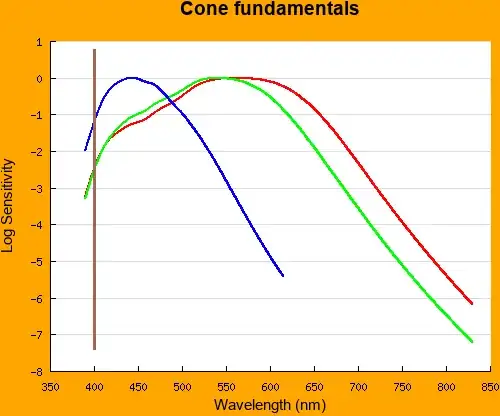
Response to violet light

If you consider the sensitivity of the different receptors to violet light, the output from these is a unique combination that is sent to the visual cortex. There is no other possible light source that will produce this array. The brain has no trouble labeling this as violet.
Blue light would send S=100%, M=10%, L=5% (This assuming log10 scale)

Adding blue light to red will give magenta - for which there is no single monochromatic color.

Rich
  • 283
  • 1
  • 8
-2

I refer to the comment of Bryan Krause and the data you provided:

If the M and L cones respond similarly for violet, and dissimilarly for blue, then that is a simple explanation for how you tell them apart.

Ryan
  • 1,311
  • 10
  • 16
  • 1
    Ryan Unfortunately that statement is also true for green (550nanometers) although the blue S is much less intense. – Rich Mar 15 '24 at 10:20
  • Your answer is excellent, Rich, especially in explicitly naming trichromatic theory. Besides upvoting it myself I don't have much more to do here; this answer was never developed properly, and was just drawing attention to a comment – Ryan Mar 15 '24 at 15:17