I want to put disc brakes on my bike but I do not know which type to put on


Asked
Active
Viewed 3,896 times
6

-
1What kind of fork do you have? – Vladimir F Героям слава May 11 '20 at 18:37
-
2Can you [edit] in a photo? – Swifty May 11 '20 at 18:37
-
1I edited it but it added more photos than I thought it would – Ferretboi May 11 '20 at 19:53
-
1@Ferretboi I deleted the duplicate photos – Swifty May 11 '20 at 20:08
1 Answers
14
In order to fit a disc brake, you need a compatible fork and a compatible wheel, plus a compatible brake lever.
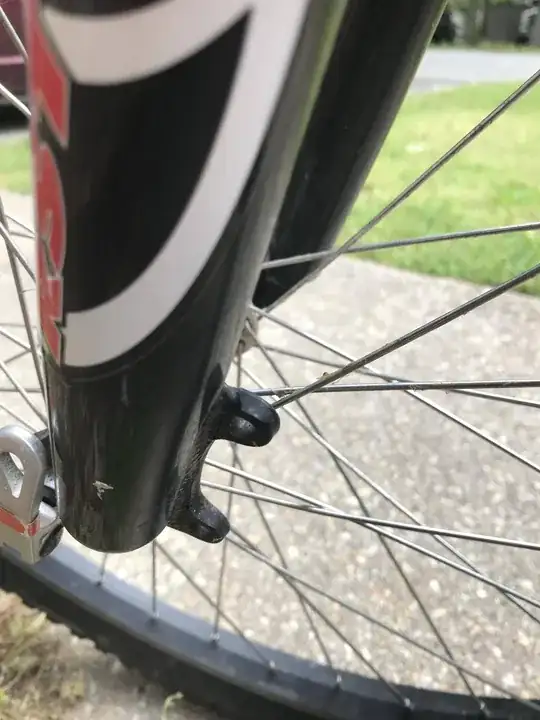
Your fork does have a disc brake mounting already designed in, it is an International Standard (I.S.) mount. Most mtb brakes now are Post Mount fittings so are fitted using a simple adapter. You can see the differences here or search around images.
To fit a disc brake you need a disc compatible wheel of the correct diameter (check the current size), the caliper and maybe a lever. If you have V-brakes now, you could add a mtb specific, cable-operated caliper to the existing lever with a new cable and housing. Alternatively you can get pre-bled hydraulic disc brakes, comprising the lever, caliper and disc, ready to use out of the box. N.B. there are two standards of disc mounting, 'six-bolt' and 'centre lock', match this to the new wheel hub.
Bear in mind that because you need a wheel change, changing to a disc brake could be expensive relative to the value of the bike (which is of course not always monetary). It's up to you to decide the best use of the money; that might mean upgrading this bike, or it might mean saving up towards a disc brake specific bike, new or used.
An interim upgrade could be a high quality brake of the same type you have; if it is a V-brake, good models are quite affordable and do make a noticeable difference over basic models. Also, with rim brakes particularly, high quality brake pads noticeably increase performance for not a lot of money.

Swifty
- 12,807
- 3
- 33
- 71
-
515-20 years is too much. My 2010 Merida Matts has those on the fork and on the frame. They were selling both the -V and -D version. It was not expensive, but no BSO. It is Deore, the RD is Deore XT. – Vladimir F Героям слава May 11 '20 at 21:01
-
-
1
-
@VladimirF I think around 2010 it was fairly common for bikes to come in disk- and V-brake versions. My GT hybrid from around then has V-brakes but the frame could take disc brakes. They shipped a different fork on the disc version – Chris H May 12 '20 at 14:00
-
For V-brakes, is more modern compressionless housing going to help? Because Shimano don't offer cable discs, and standard housing is fine for road caliper brakes, they may just not have gone and developed a good compressionless housing. I know this helps with cable discs. That said, I'm not sure if it's helpful for V-brakes. I definitely endorse looking for good brake pads, e.g. Kool Stop. – Weiwen Ng May 12 '20 at 14:20
-
1@WeiwenNg I'd say what really counts for V-brakes is the stiffness in the caliper arms, they can vary greatly. The cable run is generally very short, so not that consequential. I wouldn't prioritise compressionless housing here or use it to make up for a bad brake. Cable discs however normally have a full run of housing, front is double the length of a v-brake housing and rear is like twice as long again, hence the benefit of compressionless housing. – Swifty May 12 '20 at 14:49
-
I would disagree on the point of changing one brake won't radically alter the bike, especially on the front. It can turn a 'dangerous' bike into something that is good enough to take a few kilometers to the train station and back. I would agree though that a quality v-brake can be comparable to a disc brake in the dry. – el_oso May 12 '20 at 15:47