15

I have a fixie and I'm finding the rear wheel slips forward when riding (horizontal dropouts), causing the chain to loosen and thus a sub-optimal riding experience. It's not enough to be critical, just annoying.

I have the bolts extremely tight on the frame with the chain taut, but it still slips a little when riding. I'm wondering if there are any tricks out there to solve this problem, or if I'm doing something wrong?

mhamrah
  • 251
  • 1
  • 2
  • 4

7 Answers7

13

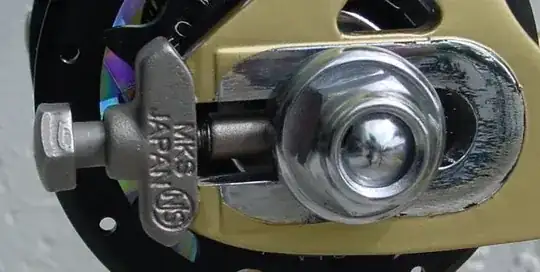
Search for chain tugs rather than a chain tensioner.

Chain tug

You want something to hold the wheel in place rather than to push the chain up or pull it down (Chain tensioner).

On a fixed gear, the latter will just break with the first back pressure on the pedals.

Adam Leadbetter
  • 131
  • 1
  • 5
6

Some things to try:

  1. Make sure there isn't any grease on dropouts, axle, or bolts.
  2. Make sure the nuts for the rear axle have some bite to them.
  3. Make sure the rear hub has some bite to it where it touches the rear dropouts.
  4. More spinning the pedals, less hammering on them.
  5. Increase the size of the rear cog, and if you need to, the front chain ring. If you don't see how this can help, do a free body diagram, Hint, it's a lever problem.*
  6. Get chain tugs**

*: Imagine you're going up a really steep hill and you're almost at a stop. Regardless of anything else, the force applied to the bottom of your wheel must be constant to keep you from going in reverse. Now do a free body diagram on the wheel. In statics, we can sum the moments about any point, so choose the point which the chain connects with the rear cog. If A is the force applied to the wheel by the axle, G is the force applied to the wheel by the ground, r is the rear cog radius, and D is the rear wheel diameter: Then summing the moments, we have that A*r-G*(r+D) = 0. Solving for A, we have that A = G + G*D/r, so as r is increased, the force at the axle is decreased. These results won't deviate much if a fully dynamic system were to be considered.

**: Make sure the chain tugs that you get are beefy. Small spindly chain tugs are only designed to take the forces needed to properly position the tire in the drop outs. They will bend or break if they need to take pedaling loads due to slippage of the rear axle.

Michael come lately
  • 1,182
  • 1
  • 8
  • 22
user160917
  • 971
  • 6
  • 13
  • Increasing the size of the front ring will result in less pull/tension on the chain: it's like being in a higher gear. But I don't see how increasing the size of the rear cog will help: it will decrease the torque on the axle, but not decrease the straight-forward pull. – ChrisW Feb 23 '11 at 21:43
  • @ChrisW: to keep the same gear with a larger chainring you need a larger rear cog. It's that simple. I think you're over-thinking this. (and a larger rear cog increases torque, not decreases it). –  Feb 23 '11 at 22:04
  • 1
    So the larger front ring causes decreased tension in the chain, and the correspondingly larger back ring ensure the same effective gearing even with the reduced chain tension. The net effect is the same gearing with reduced chain tension. The reduced chain tension means less pull on the axle. – ChrisW Feb 23 '11 at 22:10
  • 1
    @moz "I think you're over-thinking this." - Yes, perhaps. It has become second-nature to you; I'm still working it out for the first time. – ChrisW Feb 23 '11 at 22:15
  • @ChrisW: "So the larger front ring causes decreased tension in the chain, and the correspondingly larger back ring ensure the same effective gearing even with the reduced chain tension." is exactly right. As an exercise, express the sentence using torque instead of tension... which explains my bracketted comment too. I've spent too much time watching riders trying to get gears with 5cm more development because an extra 4.5cm is obviously not enough. Except they work in pi inches and call them inches. And can't do maths. So yes, it has become second nature :) –  Feb 23 '11 at 22:29
  • I'm still not sure that increasing only the size of the rear cog would help; if you were to only increase one, maybe it should be the front one. – ChrisW Feb 24 '11 at 03:40
  • There's some confusion here about tension. At rest, we're trying to minimize chain slack; bigger rings/cogs will help to reduce this. But under power, if you increase the ring+cog but keep the gear ratio the same, the axle will still experience the same amount of pull regardless; only reducing the gear ratio will reduce the pull. – darkcanuck Feb 24 '11 at 07:18
  • @darkcanuck I think that increasing the size will cause decreased 'pull' (on the axle) for a given torque. – ChrisW Feb 24 '11 at 16:04
  • 1
    @ChrisW: only if the front ring remains the same size (with the same force on the pedals). If the gearing remains constant or you still keep mashing the pedals just as hard then the chain tension will be the same. This answer would be perfect if point 5 was removed. – darkcanuck Feb 25 '11 at 00:48
  • @Ben: you can't solve this using moments. You need to find the force applied at the axle in the forward direction of the bike (causing the axle to move relative to the frame). Once this force exceeds the clamping force of the axle nut(s), the axle will shift forward. – darkcanuck Feb 25 '11 at 06:01
  • @darkcanuck. You can absolutly solve this problem with moments, In fact, I just did. I'ts a trivial lever problem where the axial forms the fulcrum and the point of contact with the chain and the ground form the applied forces. – user160917 Feb 25 '11 at 18:38
  • @Ben, my apologies, I thought you were taking moments using the axle as the center (so it wouldn't even enter the equation). I get your formula now and it makes sense, interesting how the chain tension is factored out so easily. Can you really model a chain as a single tangential force at the top of the cog? In practice, the chain tension is spread across every tooth that contacts the chain... – darkcanuck Feb 26 '11 at 17:56
3

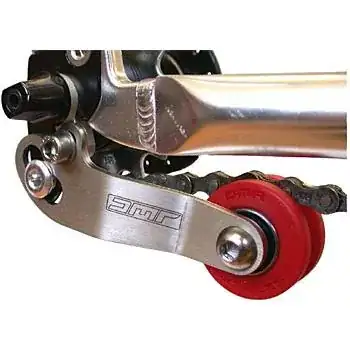
You could look into getting some chain tugs which basically create a link between the axle and frame. Here is an example:

Surly Tuggnut

sillyyak
  • 1,348
  • 6
  • 4
3

In a little late on this forum question, but I’ve experienced this problem on a few aluminum frames that have stainless steel dropout sleeves. Your frame is likely using a stainless steel dropout. The stainless is as hard or harder than the axle nuts which prevents them from biting into the metal. The only solution is to abrade the dropout surface with sandpaper to allow more bite by the axle nut washer. Also check that the nut washer is still serrated to do the biting.

One pro-tip (per Sheldon Brown and fixed gear street riders and track racers alike): your chain tension should never be described as “taut”. You want at least one inch minimum of vertical up-down slack. Ideally, have the chain tension as lose as possible without chain jump. Your crank arms should register some play before the chain becomes taut. Also, When you stand the bike vertical on its rear wheel, you should see the chain has some side-to-side swing as well.

Swifty
  • 12,807
  • 3
  • 33
  • 71
Yogi
  • 31
  • 1
2

First make sure there's no grease lubricating the nut/dropout area. Also make sure you're using washers, not just bare nuts (or nuts with washers built in). If slippage is still a problem you have three choices:

  1. change your gearing so you're spinning rather than grinding (get a lower gear)
  2. tighten the nuts so you're denting the dropouts and things stay where they are (may not work, will damage the bike)
  3. buy a chain tug The are devices that slip over the axle and brace against the end of the dropouts. They're more common on BMX's. I use those on my QR hub gear bicycles because you can't crank a QR up tight enough to hold. BMX ones will cost ~$20, fixie ones twice that but are much more fashionable.
1

For anyone reading: If you use rim brakes, THIS IS A SERIOUS ISSUE!

If the rear wheel slid forward after you set it up, then the tyre will be closer to your brake pads. Then (in my case) if you use 80-90% of your rear brakes, then the rim brakes will flex a bit, touch into the tyre and tear a hole in the sidewall.

This is exactly how i blew up one of my continental grand sport race (28) tyres, luckly I slowed down by the time it blew up but it could have ended badly.

Maybe not someting that is very likely to happen, but I think it's definetly worth considering.

Track nuts are definetly the way to go, I wasn't using them when this happened.

(Non-fixie)

George
  • 11
  • 1
  • 1
    Hi, welcome to bicycles. While this is an interesting anecdote about the problems of slippage, it doesn't address the question of how to prevent it. Please make sure you're answering the question; when you earn some reputation you'll be able to leave comments. You might want to take the [tour]. – DavidW Feb 10 '24 at 13:42
0

You can also take a few links out of your chain and move your wheel all the way forward so it has nowhere left to slide forward. This is probably the least desirable solution, I highly suggest getting a chain tensioner.

Victor
  • 401
  • 4
  • 3