22

The penny-farthing was the standard until the diamond-frame "safety bike" was "invented" and revolutionalized the world of bikes.

It seems to me strange to have to "invent" to put the same size of wheels on a bike, composed of two triangles (the idea of triangles is meny hundreds of years old in civil engineering).

Why did those awkward and dangerous bikes exist?

James Bradbury
  • 6,615
  • 3
  • 30
  • 54
Vorac
  • 13,698
  • 19
  • 82
  • 153
  • 5
    Created a new tag "history". Edit away,if you wish. – Vorac Aug 07 '13 at 09:18
  • Why did those awkward and dangerous bikes exist? Because they were super-awesome, I suppose. – MrBoJangles Aug 07 '13 at 15:12
  • 1
    You could ask: Why was the bike, in any form, not really invented until the 1800s? Certainly the raw technology was there (keeping in mind that "safety bicycle" frames and wheels were initially made with wood). – Daniel R Hicks Aug 07 '13 at 18:01
  • 2
    @DanielRHicks: the raw technology was not there. – whatsisname Aug 08 '13 at 17:14
  • 2
    @whatsisname - How so? Wheeled wagons had been around for at least a thousand years. Metal was available for bearings, and even if not, wood made good bearings if you used a hard wood and charred the bushings. Belts of leather were well within the ability of even the average tinkerer to make. – Daniel R Hicks Aug 08 '13 at 19:27
  • 2
    @DanielRHicks: technology is not materials, it is knowledge and skill. It's really easy to think up ways to implement modern machines using ancient tools, because we already have the knowledge. Going the other way is quite a bit different. Your question is basically identical to, for example "why didn't the Romans have steam engines?" (and the Aeolipile doesn't really count). They had the abilities to produce all the raw materials for modern steam engines, but they didn't have the knowledge, that wasn't learned until the late 1700s. – whatsisname Aug 08 '13 at 19:45
  • You don't think that Leonardo could have built a passable bicycle if he was motivated to? – Daniel R Hicks Aug 08 '13 at 21:19
  • Wouldn't it be easier just to look it up on Wikipedia? – JohnS Aug 09 '13 at 16:24

5 Answers5

31

I think the simple reason is that the drivechain hadn't been invented.

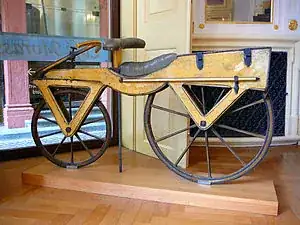
In 1818 the dandy-horse or draisine was invented. This was similar in shape to a modern bicycle, but without pedals. Riders would scoot along with their feet.

Wooden draisine (from wikipedia)

If you want to go a bit faster, especially on any kind of incline, then you need a better way of putting power in. Without a drivechain the only option is pedals connected directly to a wheel. The larger the wheel, the bigger the gearing. The circumference of these wheels was measured in inches and is why you may still hear gear ratios described in gear-inches.

Of course the large wheels were unwieldy and limited by the length of the rider's inside leg.

James Bradbury
  • 6,615
  • 3
  • 30
  • 54
  • 6
    As much as cyclists are supposed to dislike cars, I actually think that the car a major reason that the bicycle is decent mode of transportation at all. The safety bike didn't come into existence until 1879. Karl Benz built his first engine for a car in 1878, and patented it the year later. The advances in creating precision machined parts and the need for smooth roads brought about by the popularity of the car, made the bicycle in to a much more suitable form of transportation. Without the advances brought about by the automobile industry, the bike would have been a toy for many more years. – Kibbee Aug 07 '13 at 12:31
  • 6
    ...and without the roads campaigned for by cyclists, cars wouldn't have taken off, at least if Robert Penn is to be believed. – James Bradbury Aug 07 '13 at 13:06
  • 4
    I just find it really amazing that something as complex as the car, and something as simple (or at least that's how most people see it) as the bicycle were basically invented at the same time. The steam powered motorcycle was made a decade before the safety bike, but nobody thought of adopting the system so you could propel it with your legs rather than an engine. It actually didn't use a chain drive, but actually used leather belts. Now belt drives are back in style, although no longer made of leather. – Kibbee Aug 07 '13 at 13:26
  • 3
    Yep, the penny-farthing "evolved" from attempts to add pedals to the above design. It's worthwhile to remember that in order to have the "safety bicycle" you needed a chain or belt, and those weren't invented (and available as manufactured units) until they were needed for industrial purposes, mostly related to power transmission from some sort of combustion engine. So the (internal/external) combustion engine led to the invention of the safety bike. – Daniel R Hicks Aug 07 '13 at 16:16
  • @jamesBradbury You could probably expand your argument to encompass all sorts or precision machined parts. You could have made a modern bicycle equivalent, but it would have been impossibly unwieldy (e.g. leather belt drive). Once you could get miniature (by the standards of the day) sprockets, chains, bearings, etc you could all of a sudden make the technology "leap" to build the modern bicycle. – Byron Ross Aug 13 '13 at 23:58
  • 1
    "Without a drivechain the only option is pedals connected directly to a wheel" - what about gears without a chain? (I guess it'd be hard to make a practical structure rigid enough to not skip under load?) – dbr Jul 04 '14 at 13:58
  • I think James Bradbury meant decline rather than decline. As far as wheel size consider that when I was a young club racer most of us used a 42x21 as our lowest gear, I typically only used the 21T cog when I went up to the mountains to train. My lowest gear that I seldom used works out to be a 27 * (42 / 21) or a 54" (4.5 foot diameter) wheel. – Eric Jan 06 '15 at 17:24
25

It only seems strange to you because you've had the benefit of never having to learn the lessons of the penny farthing and the technological achievements of the safety bicycle firsthand (aka 'standing on the shoulders of giants syndrome').

The penny farthing is only awkward and dangerous because you are comparing it against a technological leap forward. That technology you are taking for granted, and are not realizing just how difficult it was to develop those technology without having the advantage of already knowing about it. Two of the key pieces of technology in a bicycle you are taking for granted:

JamesBradbury's answer shows the dandy horse.

  • Pneumatic tire: rubber tires didn't exist until 1887, when John Boyd Dunlop invented them. Without pneumatic tires, the ride from a smaller wheeled vehicle would be awful compared to a penny farthing.
  • The chain - The humble, tiny roller chain requires a significant amount of manufacturing sophistication to be made affordable. A bicycle chain has around 500 individual parts that all have to be precisely fit together. Mass production was a fairly new concept, and really only began in the 1850's and first being effectively used during the US civil war in the 1860's. Importantly, the chain wasn't invented until 1880.

The safety bicycle had some initial problems of its own too, it began with a treadle bicycle, prior to the inclusion of the chain drive.

Additionally, the idea of "triangles" and their use as structural members isn't as old as you might think. Sure, people have known for a long time that triangles are 'strong', but our analytical and mathematical knowledge of them is only since the middle 17th century.

So the bottom line: people rode penny farthings because the modern bicycle wasn't invented yet.

Criggie
  • 124,066
  • 14
  • 180
  • 423
whatsisname
  • 12,122
  • 37
  • 51
  • 2
    +1 for mentioning the pneumatic tire, which was an angle I hadn't considered. – James Bradbury Aug 08 '13 at 07:45
  • Please explain why belt drives were not a feasible replacement for a chain. I think belts were used in Rome. – Vorac Aug 15 '13 at 08:37
  • 2
    @Vorac: I'm sure someone could make a working leather belt drive for a bicycle, but you are missing the point that doing so only makes sense because we already know how to make a bicycle. A lot of inventions that are plainly obvious to us know were hundreds of years in the making. Just look how long it took the invention of the flush toilet. The humble S-trap, a fixture of all modern drains, wasn't invented until 1775! – whatsisname Jul 05 '14 at 03:12
13

Don't forget, when the penny farthing was invented, horses were still a major mode of transport - when you see people on horseback regularly, the idea of sitting that high up doesn't seem unreasonable.

Chris H
  • 58,694
  • 2
  • 88
  • 254
4

A recent view is that technology was less of a factor vs. sociological factors. The main sociological difference between the Penny-farthing and today's bicycle frame is the perspective of safety: the rider wants to feel safe or not.

In the times of Penny-farthing mastering a difficult to ride horse/vehicle was a major feat, and riders wanted to show of their skills. Riding a more difficult vehicle was a wish by riders.

Today's bicycle with the diamond frame mostly offers safety for the driver, by having a good view around the traffic, and a good chance to stop when needed (vs. efficiency, aerodynamics, speed, acceleration, etc., while recumbent and other designs do better in those aspects). Today riders want a bike that offers higher safety, vs. feeling unsafe.


The modern view of history of technology says about technology development that:

  1. Instead of the "linear model", there are many other models about how technology develops (starting with Thomas Kuhn's book "The structure of scientific revolutions").
  2. Technology development is considered to be CONSERVATIVE, ie. it has to be compatible with the network of existing surrounding (ex. the power plug of every machine needs to fit what is available in households), and only small iterations go ahead. Too big steps of innovations usually fade away, as they are not compatible with current needs/technologies. They might came back later, in a different form. For example attempts for mimicking birds using their winds for flying were considered a dead-end for a hundred years, while today micro robots use the same principle. (See the chapter Thomas P. Hughes: The evolution of large technological systems).

There's a lot of research done about bicycle development in History of Technology, mainly because researchers who pioneered these theories came from the Netherlands. The paper published by Bijker ("King of the road: the social construction of the safety bicycle.") is a major work that introduced the theory of social construction of technological systems.

You can find a short summary of Bijker's book at the bicycle research project. A Google search can give you a pdf of the paper. Note that Bijker's book is not considered "new" anymore, but rather "classic", and many new research goes beyond.

olee22
  • 1,358
  • 2
  • 9
  • 17
  • 2
    +1 for the "major feat" idea. I think Mark Twain said something like "Try a [penny-farthing] bicycle, you won't regret it if you live". – James Bradbury Jul 04 '14 at 08:10
  • 2
    I imagine the modern equivalent of that is riding brakeless fixies or unicycles. People want to show off their prowess by doing something that's inherently difficult to set themselves apart from the crowd. In the days of penny-farthings, I don't think many used them as a main form of transportation, but rather for recreating and racing. – Kibbee Jul 04 '14 at 12:36
3

Speed. Without the complexity of gearing.

They were racing machines, pure and simple. There's one in the Glasgow transport museum with aerodynamic rim profile and flattened fork blades! I think it's about 20-21lbs, still quite respectable today.

The smooth ride of large wheels on rough roads was a plus, but the larger the wheel you could turn given your inside leg measurement, the faster you went.

In the UK, gearing is still expressed as the diameter of the equivalent ungeared wheel - you'll turn a 100 inch gear going downhill...

Gears would add weight, noise, complexity. Belts, friction, slip, lost energy. Chains ... OK, when the Reynolds chain was invented, it took over.

But chain wasn't that revolutionary. All Reynolds added was a gap between rows of links, which could ride on sprockets (different sized sprockets, for speed multiplication).

That basic style of chain was centuries old by then, and in a form that blows the mind if you think about the implications of making it... that silver thread in the first photo is a chain, probably 0.2mm thick, with links about 0.5 by 1mm, assembled by hand. And repaired by hand too. (Yes, that huge planetary object is a 1c piece)

As a watch spring ran down, the chain transferred its pull to a larger diameter on the fusee cone, to keep the pull and the watches rate constant. If you think our engineering skills are that much better today, read it and weep.

user_1818839
  • 357
  • 1
  • 7