26

I commute and want to draft another bike, but still have room to stop when someone opens a car door in front of the rider in front of me. At what distance does drafting significantly reduce drag? Are there factors other than following distance that influence drafting efficacy (wind direction, etc)?

This is not a question about whether the drafting while riding through urban environments is a good or bad idea. I know that it is probably a bad idea.

Goodbye Stack Exchange
  • 17,928
  • 19
  • 99
  • 174
Precipitous
  • 1,233
  • 1
  • 11
  • 11
  • 2
    Are you talking about drafting another bike, or a car? If a bike, you have little choice; you'll have the be directly behind them. If you're talking about drafting a car, I'm closing this question as blatantly unsafe and illegal behavior. – Goodbye Stack Exchange Oct 14 '10 at 21:00
  • 12
    Clearly, I am referring to bicycles. See first sentence. – Precipitous Oct 14 '10 at 21:10
  • It may be that the conclusion from the answer "Effective drafting stops a x feet." is that effective drafting is not possible with a following distance. I don't think that this is a legal question in my area: Laws for bicyclists behavior in my area don't go farther than wearing a helmet and using a light at night. – Precipitous Oct 14 '10 at 21:14
  • 1
    That's fine. I found your opening sentence to be unclear, though; I added "another bike". I suppose the "the rider in front of me" should have tipped me off! As odd as it seems, there are many, many cyclists who do draft cars, trucks, and buses. (Also see Ben's answer.) – Goodbye Stack Exchange Oct 15 '10 at 00:44
  • 1
    It depends on how good he/she looks in lycra – mgb Jan 25 '11 at 23:22
  • 4
    You should not ride within a car door's distance of a parked car, regardless. – Daniel R Hicks Sep 26 '15 at 17:43
  • How fast are you commuting that drafting will be effective? – FreeMan Mar 09 '22 at 18:55
  • 1
    The author of this question was last seen 6 years ago, and I do not think this question is answerable without clarification of what "effective" means. I've been able to measure a self-drafting effect of a single rider alone on a 250 m velodrome during hour record attempts, demonstrating that even a straw can stir a bathtub. In cases where a record is beaten by a tiny amount, that effect, while small, can be effective; however, I suspect the author did not have this kind of effectiveness in mind. – R. Chung Mar 11 '22 at 23:17

7 Answers7

41

My opinion:

I don't believe you can effectively draft and have enough time to stop. I don't know the exact aerodynamics (and I suspect it's affected by speed and wind), but if you watch any paceline or peleton, they're never more than a couple feet (about half a meter) behind the rider in front, often only a few inches (centimeters) behind. With a crosswind or larger groupings, they're even likely to have wheel overlap (where the front part of the front wheel of the following cyclist is next to the rear part of the rear wheel of the lead cyclist).

You can really only draft safely with the cooperation of the lead cyclist, who needs to signal back to you before starting to stop.

Do the math:

Let's put it another way:

  1. If you're going 15 miles/hour (25 km/hour)
  2. That's also 22 feet/second (6.9 m/second)
  3. And if you're following 3 feet behind (1 meter) (a bit far for drafting)
  4. You have 0.136 seconds (0.145 if you take the metric rounding version) to react to something that causes the lead bike to need to brake suddenly to avoid colliding.
  5. If you're 2 feet (2/3rds of a meter), you have less than a tenth of a second. If you're 2 feet and 20mph (32 km/hour) you have about 1/14th of a second to react.

Less than a sixth of a second to figure out that the lead bike is braking and to start braking, and that's assuming your brakes are as good or better than the lead bike's brakes. If the lead bike has slightly better brakes (or wider tires, or grippier tires, or even just pulls the brake levers a bit harder than you do), you may simply have no reaction time available and a collision will be unavoidable.

In other words: you definitely can only safely draft with the full cooperation of an experienced lead cyclist who won't brake unless they've warned you or being rear-ended by you is better than whatever they're about to run into. If you were going to go by hazards, they'd need to warn you about upcoming hazards and you'd need to pull back to 10 feet (3 meters) or more.

Avoid the door zone

Additionally, you should simply stay entirely out of the door zone so that opening car doors aren't much of an issue. It's not unheard of for car doors to open very fast with no warning, so that nobody has enough time to avoid hitting the suddenly opened car door. I haven't checked the laws of every single state in the US (and definitely not outside the US), but in general the area that parked car doors can open into (the door zone) constitutes a hazard that you're not required to ride through. When a bike lane is in the door zone I'll either ride the line on the left of the lane (if that's outside the door zone), or simply ride in the right wheel track of the car lane next to the bike lane.

freiheit
  • 18,957
  • 4
  • 86
  • 117
  • 12
    Excellent write-up. The emphasis on full cooperation is important. The rule is basically: Before drafting someone, make sure they know you are there. – bikesandcode Oct 15 '10 at 23:19
  • 5
    I'll add that if you're drafting someone at an effective distance (1-3 feet), you will hit them if they brake hard without warning. This is why braking in a paceline is a big no-no. So if the rider in front of you gets doored (no warning) then you are going to join in the fun! – darkcanuck Oct 17 '10 at 01:37
  • Nice comment about avoiding the door zone - if only that was possible round here. One of the roads on my commute is so narrow that the door zones from the 2 sides of the road are only about a handlebar's width apart, and where the bike lane runs in the door zone deliberate dangerously close passing to try to force bikes into the lane that shouldn't be there becomes commonplace. – Chris H Mar 03 '14 at 10:08
  • 5
    The don't ride in the bike lane on that stretch. Take the lane since it's obviously not safe to be in the door zone, and if the door zones are that close together there is no room for a car to pass you either. – Chris Cleeland Sep 27 '15 at 18:07
  • @ChrisCleeland that was my approach when I rode that route, but dangerously close passing was common (often combined with pulling in with no room for me to do anything other than swerve into the bike lane, after which there are too many cars to pull out again). The really narrow stretch didn't have a bike lane - it was urban but effectively a single track road (conversation at 1 year intervals!) – Chris H Sep 02 '16 at 12:50
  • @ChrisH let's close the gap in conversation! :) Seriously, though, it's easy for me to sit in front of my keyboard and say something like "move farther to the left so that drivers are forced into a full lane change in order to pass you", while that is definitely a way, I've found over the years that the Right Thing To Do is often contextual on the space in which we ride and what's happening while we are riding. It does sound like that stretch should be reconfigured so as not to delude people into thinking there is room that isn't there. What are the odds of that happening? – Chris Cleeland Sep 19 '16 at 23:06
  • I'll also add to the original comment that the amount of space you need in order to react is minimally about a bike length, and only if you've have great reflexes. This is based on racing and being both the guy who collided with the sudden-stop and being the guy who was the first to avoid the sudden-stop. – Chris Cleeland Sep 19 '16 at 23:08
14

Depends on the size of the thing you are trying to draft.

The distances listed below are distance between objects at normal road biking speeds. Bigger distance for higher speeds. I may (or may not have) drafted a lot of things when I was younger and dumber. This is what has been observed.

  • A Bike: 1-2 Feet
  • Small Car: 2-4 Feet
  • SUV: 3-5 Feet
  • Truck: 3-5 Feet
  • 18 Wheeler: 4-8 Feet
  • Bus (my favorite): 8-12 Feet

The rudimentary calculations that others have done here are all conservative because the object you are drafting is also moving and cannot instantaneously stop, they also have to decelerate. In the case of an 18 wheeler or a bus their deceleration is likely to be slower than the cyclist. In order to truly calculate the time you have to react you would need to know the speed of both objects and the deceleration that each can achieve.

Nevertheless at these distances it is EXTREAMLY DANGEROUS to draft anything that doesn't know you are there. You will not be able to react to a rock, stick, crack in the road, or pothole, and any of these common occurrences will likely end you.

user160917
  • 971
  • 6
  • 13
  • 6
    I'll note that there is a significant benefit to chasing another cyclist (even a safe 10+ feet): if not physics and aerodynamics, motivation. – Precipitous Nov 14 '10 at 00:18
  • Yikes, be careful. If following car/bus/truck try to follow in line with wheels, try to keep a good view of road ahead so you can predict what will happen. Very dangerous if behind car/bus/truck and a HUGE pothole appears underneath you! Following in line with wheels helps with this a little. – gaoithe Aug 29 '19 at 14:25
  • 1
    That's just reckless. Athletes get away with this kind of ignorance of safety distances because they are in a cooperating group, but you won't in commuter traffic. And you cannot tell me that you can react to a cyclist doing an unexpected emergency stop when you are following at 0.5m distance (that's only about 1/15 of a second). You are endangering yourself and others if you do this. – cmaster - reinstate monica Jun 26 '20 at 21:25
  • 2
    I find small cars too aerodynamic - we're generally taller than them and so my head is out in the airflow, not in the drag area behind the car. – Criggie Jun 26 '20 at 23:30
  • A cyclist (especially roadie on drops with rim brakes), won't have a hope of stopping faster than an empty bus or 18 wheeler. It won't matter if the driver knows your there or not - if something happens up front, they will try to stop. Worse, brake and swerve - the same way you went when you were unable to stop and swerved so you are now beside them. – mattnz Mar 14 '22 at 02:08
  • I'm awarding you a bounty for coming back 11.5 years later to improve the answer. That's dedication, thank you. – Criggie Mar 15 '22 at 09:23
9

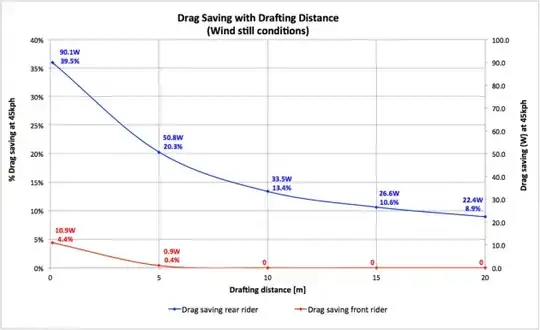
According to this research quoted by Cycling Weekly you get pretty good drafting effects at 5 metres, as does the person you are sitting behind. And you still get a significant drafting effect up to 20 metres.

https://www.cyclingweekly.com/news/product-news/close-need-benefit-drafting-349941
enter image description here

Criggie
  • 124,066
  • 14
  • 180
  • 423
  • 1
    Those graphs are at 45 kph. That's almost 30 mph. What is the drafting effect at realistic commuting speeds? – Andrew Henle Jun 26 '20 at 20:58
  • 2
    @Andrew I don't know for slower speeds, but posted the answer because it shows that drafting effect is potentially a lot further than some of the other answers here. – Wiggo the Wookie Jun 26 '20 at 21:05
  • 2
    Finally an answer with some science behind it :-) – cmaster - reinstate monica Jun 26 '20 at 21:30
  • 2
    @cmaster-reinstatemonica - If you''re drafting wouldn't you want the science in front?? – Daniel R Hicks Jun 26 '20 at 21:47
  • @cmaster I chanced upon the article and this question when I was googling to see I I could get any benefit from riding with a buddy while maintaining 2 metre social distance. – Wiggo the Wookie Jun 26 '20 at 21:48
  • 2
    @Daniel R Hicks as long as the science is within 5 metres behind it the answer will still benefit. – Wiggo the Wookie Jun 26 '20 at 21:50
  • 2
    @WiggotheWookie - Yeah, but I'm always leery of getting ahead of the science! – Daniel R Hicks Jun 26 '20 at 21:52
  • 1
    Lol, and there I was not even thinking about that pun XD Anyways, if you are drafting a bike, you are most certainly not holding enough distance to stop SARS-COV2 from spreading: The leading cyclist is producing virus aerosol at top speed, and the slip wind washes it over to you. I remember hearing about a study that concluded that you need at least 10m distance for social distance when you are following a cyclist. TL;DR: When you are in a cyclists' wake, you are also in their aerosol cloud. – cmaster - reinstate monica Jun 26 '20 at 22:19
  • 1
    @cmaster-reinstatemonica the press mixed up air passing around the both riders with aerosols or droplets expelled by the front rider. These would be dilluted and spread to become negligible. What is more, there is already plenty of empiric evidence in the fact that there's no massive virus outbreak in central Europe. Bike commutes, where keeping ridiculously large gaps is impossible, are and were undertaken by a sizable part of the population. – gschenk Jun 27 '20 at 00:36
  • @gschenk That was not just a press mix up but a preliminary press release from the same professor that published the draft data similar to those linked ones (but in a scientific journal) and that did some preliminary dispersion studies of the aerosol in this setup. – Vladimir F Героям слава Jun 27 '20 at 06:35
  • 1
    @gschenk It doesn't need much virus to get infected with COVID-19. That's what the super-spreader events tell us. What's common at the really large superspreaders is, as far as I can see, that they had air-recycling air conditioning. That's the only prerequisite you need to allow a single patient to infect literally hundreds of others, tens of infections per hour. And such air conditioning is also diluting the virus aerosol quite effectively. So, I'd rather be careful not to ride in the wake of another cyclist for any extended time frame. Better safe than sorry. – cmaster - reinstate monica Jun 27 '20 at 09:08
8

First, at around 10-12 MPH and below you are fighting rolling/frictional resistance enough that the drafting benefit is negligible in still air. If the you have a headwind of 10+ MPH or are traveling at 15+ MPH then there is some benefit to be had.

Assuming that there is no wind or a direct on head wind, the extension of the 'drafting bubble' is about 5 - 6 feet beyond the front rider. Any further back than that and neither rider experiences any benefit. Obviously the closer you get the better, but that requires the lead riders cooperation and that the two of you communicate.

Since wind is rarely straight on, many times you will be drafting slightly to one side or the other. The impact again is a little less, but you may be safer, as long as you are careful not to overlap wheels.

Gary.Ray
  • 16,359
  • 5
  • 58
  • 97
3

To answer this part of your question specifically:

At what distance does drafting significantly reduce drag?

I think a well accepted rule of thumb is that riding right on someone's wheel (within a couple feet) can save you about 40% drag. It depends on your speed, wind speed, wind direction, how aero the cyclist ahead of you is, etc.

I compete in triathlon, where there is (usually) a "no-draft" zone of 7 meters behind the cyclist in front of you. You can sit 7 meters behind (about 3 bike lengths from their back wheel) and still get a non-trivial draft. I think it can be about 10% depending on wind direction, speed, how aero the guy you're drafting is. The folks at Specialized measured this in their wind tunnel and said it could be as much as 20%. 10-20% may not be noticable to many people, but if you're in an Ironman race going 112 miles on the bike, I'll take a 10% energy savings any day, even if I don't feel it. On the other hand 10-20% may not be enough of a savings for you to risk getting in an accident on your daily commute.

lecrank
  • 131
  • 3
1

Drafting is very well possible depending on the environment. In The Netherlands it is not untypical to have significant parts of your commute on stretches of cycle paths that are straight, free from car dooring risks and without side roads (or at least ones over which you have priority).

I find that at speeds of 25 km/h and above, when you stay less than 1 meter away from the draftee, there is a significant benefit. On the other hand, by riding slightly staggered behind the other person, you can watch the road ahead and anticipate any abrupt maneuvers.

Jaap Eldering
  • 288
  • 1
  • 7
  • I frequently have people draft behind me and do it from time to time myself. This is not unusual around here in southern Bavaria. Especially for regular commuters. On popular and faster routes it is unavoidable anyway, since bunches of faster riders form automatically since the first rider of a bunch is slowed down much more by slower riders than those following in their wake. At speed about a bicycle's lenght seems to be typical. – gschenk Jun 26 '20 at 21:33
  • 2
    "and anticipate any abrupt maneuvers" - that's not correct. It should read "and anticipate some/most abrupt maneuvers. You won't be able to anticipate everything. And if you are riding so close that you cannot react to any maneuvers you did not anticipate, you are endangering the rider you are following (as well as yourself, of course). Don't do this to someone who's not cooperating! – cmaster - reinstate monica Jun 26 '20 at 21:34
-4

One wheel-length behind is what you're taught when learning to paceline.

And it is definitely a bad idea. If I caught someone doing that to me I would intentionally slam my brakes - I can easily correct from a rear wheel losing traction, but you would go down.


I didn't think it needs to be said, but I would not intentionally harm someone on the road.

Criggie
  • 124,066
  • 14
  • 180
  • 423
Nathaniel Hoyt
  • 1,071
  • 6
  • 6
  • With the present increase in cycling wheel length is about what one may hope for commutes here in my city. However the speed is low, between 16 km/h and 25 km/h. I did brake for the wrong set of red lights the other day and had a bunch of riders zip past me on either side. Also the noise of at least three back-tires scratching on tarmac. – gschenk Jun 26 '20 at 21:28
  • 4
    I don't condone the aggressive part of this answer, but I'm thankful for you calling drafting in traffic a bad idea. – cmaster - reinstate monica Jun 26 '20 at 21:36
  • 1
    Instead of instigating a crash, start by talking. Simply yell "Oi - get off ! " (substitute as you see fit). Then just take away what they want, by slowing down. There's nothing to be gained draughting at 20 km/h. If they still won't get off, then get along side and ask "what do you think you're doing ? " and have a dialogue. A later option is to check your strava flybys and see if they're listed, for a public shaming ("wheelsucker" doesn't sit nicely with many riders) – Criggie Jun 26 '20 at 22:48
  • Or turn it around, and yell at the follower "hey its YOUR turn on the front!" and get some assist from the situation. – Criggie Jun 26 '20 at 22:49
  • i didn't think it needed to be said, but i would not intentionally harm someone on the road lol – Nathaniel Hoyt Jun 27 '20 at 23:14
  • @NathanielHoyt Perhaps this answer needs a revisit and rewrite with [edit] ? Your comment about not intentionally causing harm is at odds with "you would go down". – Criggie Mar 09 '22 at 00:49
  • @Criggie no i'm not going to edit. y'all take this stuff way too seriously lol – Nathaniel Hoyt Mar 09 '22 at 03:29
  • @NathanielHoyt I'll edit it for you. This is in response to a flag. – Criggie Mar 09 '22 at 09:07
  • A very gentle way to discourage someone from following too close if you know they're there is to stop pedalling and call "slowing" (but don't brake), fiddle with your gloves/GPS or something, then get back up to speed. You lose little time but the following rider will get fed up of having to brake and soon pass. It's up to you whether you get on their wheel or not. Now I'm more used to group riding I don't mind a fairly close follow if it comes with a greeting, and will indicate hazards as if we started in a group. – Chris H Mar 09 '22 at 09:20
  • 1
    Good effort @Criggie but the assertion from Nathaniel's comment doesn't really make up for the first paragraph even though it contradicts it. Time to let the downvotes do the talking. Oh, and it's also dumb because the follower is likely to hit Nathaniel from behind and they'll both go down – Chris H Mar 09 '22 at 09:23
  • oh my god why are you guys taking this so literally – Nathaniel Hoyt Mar 09 '22 at 19:40
  • @NathanielHoyt because this is a Q&A and not a chat or forum. Someone, somewhere will miss the humour and take it literally. The audience is global, so cultural differences come into it too. I know it sounds pedantic; it is. – Criggie Mar 15 '22 at 09:22