24

In her 1970 song "This Flight Tonight", Joni Mitchell sings

I'm drinking sweet champagne
Got the headphones up high
Can't numb you out
Can't drum you out of my mind
They're playing Goodbye baby, Baby Goodbye
Ooh ooh love is blind

The Sony Walkman first came out near the end of that decade. So what was Joni listening to on that fateful flight?


I will award a 100 point bonus to anyone who can identify the plane she was on in the song based on the lyrics.

SQB
  • 2,265
  • 1
  • 21
  • 49
  • 5
    Seventies mid-flight entertainment consisted in no small part of this. Yes, the song only strengthens that argument. – dotancohen Oct 18 '14 at 09:25
  • What airplane you are referring to? – Farhan Nov 04 '14 at 14:53
  • @Farhan The plane she was on. – SQB Nov 07 '14 at 18:28
  • @SQB Do you have a picture or video of that song? I couldn't find any. – Farhan Nov 07 '14 at 19:30
  • @Farhan You can follow the link in the question for the lyrics. I don't think there is an official video, but you can hear her sing it here: http://www.youtube.com/watch?v=iTfB8Q6DpZ0 – SQB Nov 07 '14 at 19:44
  • @SQB Actually what I meant to ask is where how do you see the airplane in that song? I already found the song audio on YouTube but that doesn't have a picture of the airplane. Or did I miss it? – Farhan Nov 07 '14 at 20:44
  • 2
    @Farhan It was kind of a joke actually, but I thought that perhaps someone would know a crazy little detail like there only being one airline serving champagne on their domestic flights to Las Vegas at that time, only flying one type of airliner. – SQB Nov 07 '14 at 21:01
  • I thought the air traffic with the pilots was more interesting than any music. – blacksmith37 Jun 04 '21 at 21:00

5 Answers5

25

During that time, the in-flight entertainment mostly available on flights was radio1 and/or TVs. Although it was not on all flights. Oops, that is true even today.

The radios may or may not have channels. If they had, there was a knob on the armrest, next to headset jacks, to switch channels. The headsets were pneumatic units like this:

headset

The in-flight movies were shown using one or more common CRT TVs mounted on ceilings or walls and audio could be heard using the headsets. The first time a movie was shown on an international flight was in 1962 by PIA. It was more like the picture below but instead of LCD monitors, there were CRTs.
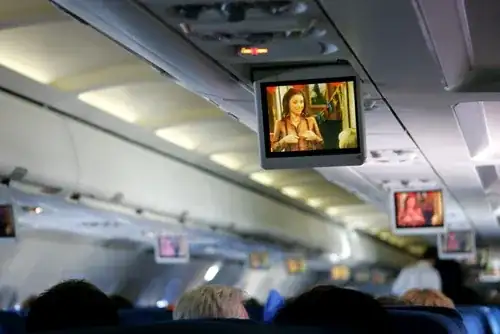
tv

In mid-seventies, Braniff Airways was the first airline to offer video games in-flight.

By 1979, electronic headsets replaced their pneumatic counterparts, which improved audio quality.


Wikipedia has a detailed article about the history of in-flight entertainment:

In 1971, TRANSCOM developed the 8mm film cassette. Flight attendants could now change movies in-flight and add short subject programming.

In the late 1970s and early 1980s, CRT-based projectors began to appear on newer widebody aircraft, such as the Boeing 767.

This website has nice slideshow about the history.


1: Not actually a radio, but recorded audio

Farhan
  • 29,390
  • 14
  • 112
  • 183
  • 1
    Whoa! You could get radio at cruising altitude? I imagine radios work kind of like modern cell phone towers, which you can't really get 7 miles in the air. – raptortech97 Oct 17 '14 at 21:20
  • Actually, getting cell signal 7 miles in the air isn't the problem (it's not a problem 7 miles away from a station on the ground), it's that you're screaming past them at 350-500 miles per hour. Your phone pretty much can't lock on to an antenna, or gets too many, and you get 'no service' – egid Oct 17 '14 at 21:34
  • 1
    Surely you don't literally mean "radio". I wouldn't think a plane would stay in range of a commercial FM station for long enough, and I'd think longer-range transmissions would be of unsatisfactorily low quality. Wouldn't it have been recorded music? Certainly various kinds of audio tape players were available by then. – Nate Eldredge Oct 17 '14 at 22:09
  • 7
    And as your quote says, there wouldn't have been CRT TVs, like in your picture, by the early 1970s. A white screen and film projector seems much more likely. – Nate Eldredge Oct 17 '14 at 22:10
  • 1
    @raptortech97: Radio antennas have to be tuned down at night because the range is just too big. It's entirely the opposite of cell towers. Curvature of the earth starts to matter, which isn't that problematic at 10.000 eeft up. And as it's not the finicky highly-packed digital stuff, zooming around at Mach .8 doesn't affect radio much. – MSalters Oct 17 '14 at 22:41
  • Why do you say it was "radio" and "TV" instead of pre-recorded music (and pre-recorded video)? – ChrisW Oct 17 '14 at 23:12
  • 4
    it wasn't broadcast radio or tv on the 70s planes, but I have listened to the radio (using a small portable radio) on a plane and it's trivially easy. I live 100 miles from a transmitter I listen to at home. Adding 5 vertical miles does little. You have to change channels as you fly, but I could chase the CBC across Canada easily enough. – Kate Gregory Oct 18 '14 at 05:52
  • @KateGregory Yes but, when crossing the Atlantic... IIRC it was pre-recorded: on a loop (each channel would loop/repeat after a while), and there were no advertisements. – ChrisW Oct 18 '14 at 07:45
  • no argument on the transatlantic trip, but @raptortech97 expressed an opinion that altitude alone was an issue – Kate Gregory Oct 18 '14 at 08:02
  • 1
    @NateEldredge: In early 1970 they would have been CRT (the picture is LCD) and possibly black-and-white, but projector and white screen would be totally impractical. And probably even not permitted due to the very hot light bulb projectors contain. – Jan Hudec Oct 18 '14 at 10:21
  • 7
    Projector and screen were NOT impractical. About as soon as CRT projectors were cheap enough for the home, they started showing up in airplanes. The projector was mounted in the ceiling and the screen on the bulkhead. I've been on a number of widebody a/c that had that arrangement. (And they did not use a "bulb".) – Jamie Hanrahan Oct 18 '14 at 11:44
  • @JanHudec: I don't know whether planes used 8mm or 16mm prints of movies, but either way a projector, screen, and films would weigh less than a CRT that could be viewed by all the passengers. I would not expect a projector bulb to pose any more of a threat than any other light bulb, especially since nitrate has never used for 8mm or 16mm filmstock. – supercat Oct 18 '14 at 18:13
  • 2
    @raptortech97 Cell phone towers are deliberately made quite low power to keep their range down so they don't stomp on the next cell. That is nowhere near the issue with broadcast radio, FM transmitters normally use enough power to push it to the horizon, AM transmitters can go farther still. At night you can sometimes pull in AM stations from hundreds of miles away. – Loren Pechtel Oct 19 '14 at 03:40
  • 1
    @supercat: When CRTs started to replace film projectors on airplanes, they were not giant CRTs, they were CRT projectors. These are tiny CRTs (3 of them -- red, green, and blue) that produce lots of light and project onto the same type of screen that film would project onto. When direct-view CRTs started to be used, it was many small ones, not a single large one. – Gabe Oct 19 '14 at 07:07
  • @Gabe: Indeed, though a suitable number of small CRTs and the associated electronics would still weigh more than Super 8 film and projection equipment. The electronics necessary to drive small CRTs have gotten smaller and lighter over the years, but I suspect the shift to video was driven more by media production cost. Although Super 8 films were mass-produced for children's toys, I would expect that reproducing an small number of optical-soundtrack films was probably a lot more expensive [btw, I wonder why they used optical; the biggest problem I know with magnetic soundtracks... – supercat Oct 19 '14 at 17:41
  • ...is that the iron oxide coating hastens the deterioration of the filmstock to which it is applied, but I don't think airlines had any concern about whether their film prints would decay after 20 years. – supercat Oct 19 '14 at 17:42
  • The picture is of fold-down LCD panels (the kind that are used today,) not the CRTs that were around back in the day. – reirab Dec 29 '14 at 22:20
  • 1
    I do not remember the small TVs till much later. It was all projected in the early days. Personally, I think they went back a step with the introduction of the smaller screens. A whole aircraft full of people laughing at that one spot in the movie is something folks no longer get to experience. – Trevor_G Dec 12 '17 at 16:36
  • 2
    @JanHudec wrong, in the 1970s (and I've seen them even in the 1990s on older aircraft) they would use pull down movie screens and projectors. The screens would come down from the ceiling in front of the center bulkheads, projectors in the ceiling some distance behind. – jwenting Jun 02 '21 at 07:27
13

I remember flying on planes in the late 70's/early 80's, where there were headphone jacks built into the armrests. But they weren't electronic jacks; the headphones were connected by rubber tubing, and the speakers were actually in the armrest, so the sound was conducted up the rubber tubing to the earpiece.

It made the headphones extremely cheap: they were just molded plastic and rubber tubing.

abelenky
  • 30,696
  • 9
  • 92
  • 143
  • 11
    You could listen by just putting the arm rest up, max the volume and put your ear next to the plug in port. Not very comfortable at all, and both channels in one ear. They had continuous loop cassette tapes that the flight attendants started and stopped. – Eric Oct 17 '14 at 21:59
  • 3
    Three of the reasons the headphones were pneumatic were. 1) Cheap, 2) No point stealing them, 3) They could be boiled (sterilized) and re-used. – Trevor_G Dec 12 '17 at 16:32
13

There would be a number of channels of pre-recorded 'radio'-type shows, typically 5 or 6 if I recall correctly, such as current affairs, comedy, classical music, easy-listening & pop/rock, plus the movie channel or channels.

Some airlines charged a nominal rental for the headsets, while others provided them in the plastic-wrapped 'travel pack' of blanket and pillow/cushion. Either way, they were gathered up before landing.

The earliest headsets were pneumatic, but later there were electronic ones, albeit with connectors that were pretty much exclusive to airline travel, to discourage them going astray.

Gwyn Evans
  • 269
  • 1
  • 5
  • 1
    The programming was on fairly short loops as well, It was funny, the music channels had "DJs". The comedy was pretty lame. I flew in the early 70's. Looking back, it was pretty crude, but it was what we had. – Tim Nevins Jul 08 '19 at 16:15
6

This is slightly off-topic because it is more about video than sound, however In Flight Entertainment, a Quick Look at its History says,

The popularity of in-flight entertainment didn’t really take off until 1960 with the invention of a smaller, more portable film playing system that would play smaller 16 mm reels. Soon after, the invention of the pneumatic headset would finally resolve the problem of being able to hear over the loud cabin noises. TWA became the first major airline to use the new system boosting them to become the world’s premiere airline to travel on.

The addition of the 8 mm cassette in 1971 made in-flight entertainment a more efficient process, mainly for the flight attendants who could simply change the film during the flight. The video cassette would dominate the way passengers viewed in-flight films until the invention of the DVD which would later become the primary source of all in-flight movies.

Throughout the late 1970s and into the early 1980s, the CRT based projectors began appearing on some wide body airliners. The CRT projector used electric beams of colored light that would beam films onto a fluorescent screen. The CRT was able to display a larger, clearer picture using both video cassettes and laser discs.

ChrisW
  • 3,094
  • 1
  • 23
  • 28
  • I wonder how long each 8mm cassette was? I would expect super 8 sound film to run 20 feet/minute (compared with 36 feet/minute for 16mm), but the super 8 cartridges I've seen have generally been 50 feet long (which would be rather short). – supercat Oct 18 '14 at 20:59
  • This says that the Super 8 film was "spooled into proprietary cassettes that often held a whole 2-hour movie". – ChrisW Oct 18 '14 at 23:43
3

Some parts of the comments above in this article are incorrect. Before approximately 1978 there was an industrial Super 8 film projector that dropped down from the ceiling, much like an overhead video projector. The projector was loaded with a cartridge that contained the abbreviated cut of a major motion picture film. The film was Super 8 film and on one continuous loop. The movie film was projected on a flippable screen on a front bulkhead. When no movie was being shown it had a logo or some artwork on the flip side of the screen. No CRT or LCD until the 80's since there was no tape system small enough to fit on a plane before VHS or Beta's introduction in the late '70s. Later the airlines got special industrial video tape machines that worked with a specialized cartridge system developed for use in aircraft. Of course later came more advanced systems.

Ron Hamill
  • 31
  • 1