I recently came across the FAA's press release regarding the diffracting laser lights which appear every Christmas:
You might not realize this, but a well-meaning attempt to spread holiday cheer has the potential to create a serious safety risk to pilots and passengers on airplanes that fly overhead. So please make sure all laser lights are directed at your house and not pointing towards the sky. The extremely concentrated beams of laser lights reach much farther than you might realize.
The FAA makes it clear that there is a substantial concern regarding laser-blindeness among pilots. And its clear the FAA will do something about it. But what can they truly do to help, within the limits of their authority?
Doing some research (okay... fine... having Google link me to Wikipedia), I find the following limits:
- 0.05 µW/cm² - Laser Free Zone
- 5.00 µW/cm² - Critical Flight Zone (10 nmi around airports)
- 100.0 µW/cm² - Sensitive Flight Zone
- 2500 µW/cm² - Normal Flight
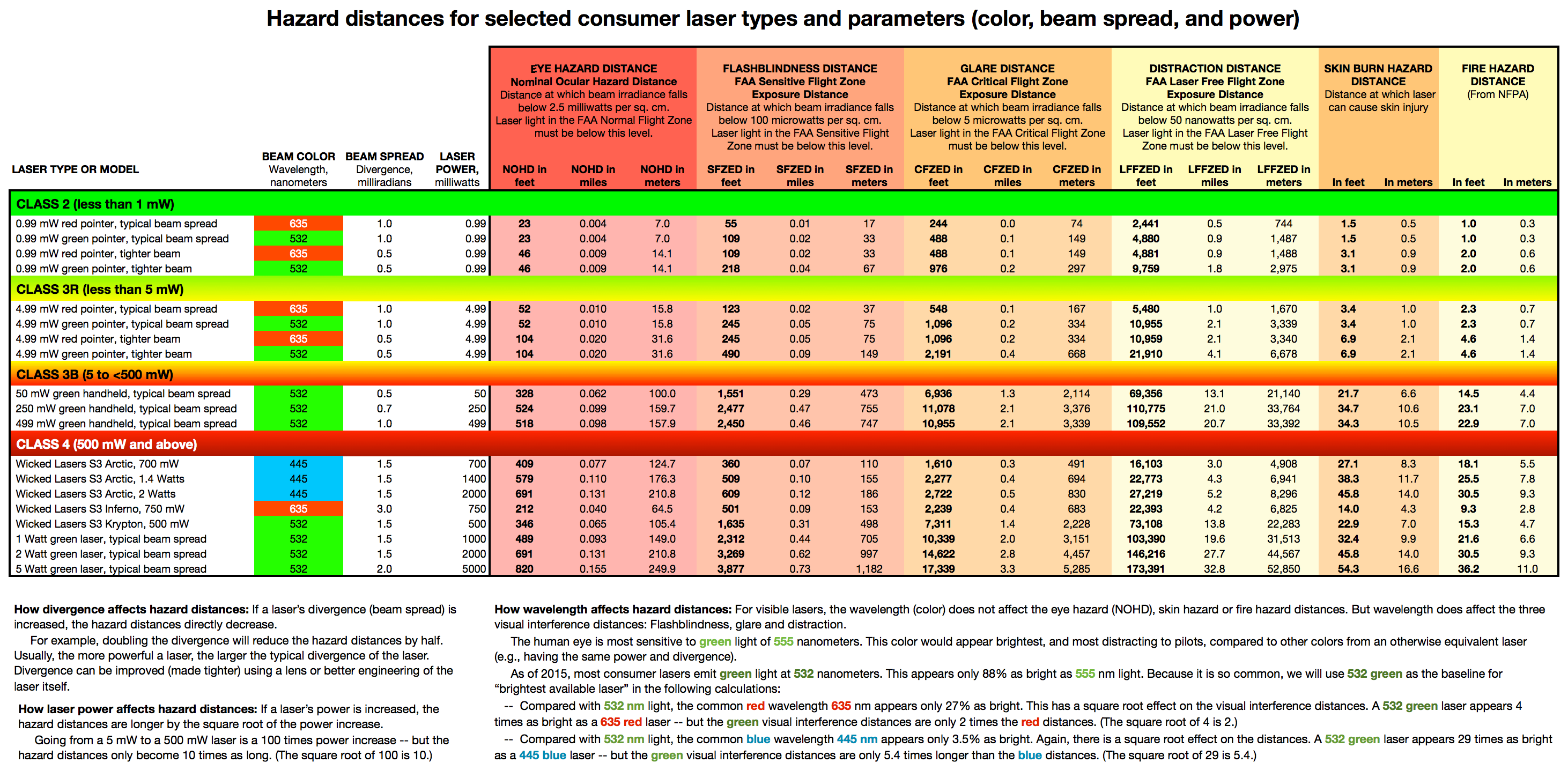
I did some calculations on a class 3R laser pointer with a safety factor of 3 built into them, and got results which were quite in line with this infographic from Laser Safety Facts. I'll report the professional numbers, rather than my own, just to avoid uncertainty. These are the distances at which point the laser pointer crosses the threshold and it becomes illegal to point them at an aircraft (according to laboratory conditions. Obviously one should never intentionally point a laser pointer at an aircraft, regardless of power):
- 10,995 ft - Laser Free Zone
- 1,096 ft - Critical Flight Zone
- 245 ft - Sensitive Flight Zone
- 104 ft - Normal Flight Zone
(Note: these numbers are consistent with those linked in this answer to a related question, and come from the same site)
With a minimum altitude for flight over urban terrain set at 1000ft, it appears it is not possible for a standard green 3R laser pointer to cross the threshold chosen by the FAA for critical flight zones, much less normal flight zones. Over rural areas, the lower 500ft minimum altitude could play a part, but would still never reach the normal flight range. Naturally, there is the possibility of violating requirements near or within a critical flight zone, where landing aircraft may be much lower than 1000ft, but it shows the level of concern that the FAA has for that given brightness threshold.
This seems quite inconsistent with the FAA press release. The holiday laser light shows have a substantially higher dispersion than a typical laser pointer (indeed, they start by fracturing it into dozens of smaller points with cheap optics).
It's possible the FAA is intentionally overstating the risk, but its also possible that the thresholds chosen are simply much higher than is truly comfortable for pilots. With thousands of laser strikes reported per year, pilots' comfort level is clearly surpassed by laser strikes on a regular basis.
Does the data suggest the FAA limits are too high to sufficiently protect pilots? (I'd ask whether they should be changed, but that would turn into a quagmire of opinion based regulation changes quite quickly)