20

Do tanker aircraft, (such as the KC-135, KC-10, S-3B, etc), distribute fuel from their own fuel tanks, or is it strictly from a separate cargo tank?

Obviously, some cargo tanks are going to be involved, as an aircraft carrying only the fuel in it's wing tanks isn't going to be a whole lot, and some of these aircraft are known to fuel some very thirsty birds, such as B-52's, etc.

Sub question: What proportion volume of the aircraft's fuselage is taken up by the addidional fuel. Do they just pack it as full as they can with fuel? Seems like this would very quickly add to weight, and you would struggle getting such a fuel laden bird off the ground.

Bassinator
  • 5,490
  • 7
  • 35
  • 56
  • 2
    Don't get too concerned about the fuel weight, as it is part of the aircraft design to accomodate that. Consider a KC-10 can carry 356k lbs with all of its tanks full, while a Boeing 747-8I can carry 315k lbs of fuel and takeoff at a total weight of 987 k lbs. – casey Oct 09 '14 at 00:34
  • 3
    @casey for a refueling mission a 747 wouldn't have other payload. Max fuel capacity is 239,000 L hence 239000L0.81kg/L2.2 gives 425,898 lbs. much heavier than MTOW minus MZFW – vasin1987 Dec 22 '14 at 20:47

1 Answers1

23

Both the KC-135 and KC-10 can burn the fuel it carries on board for refueling (the notable exception was the KC-135Q, which carried separate tanks of JP-7 for the SR-71 Blackbird).

enter image description here

Both indeed do have significant fuselage tanks - the KC-10 is notable for being 'dual-mission' capable, meaning it can carry both fuel and cargo, and the KC-10 is also air-refuelable (so a KC-135 can offload extra gas into a KC-10 when their crew rest is up, allowing the KC-10 to stay on station and refuel other planes longer). The maximum fuel load of a KC-10 is 356,000 pounds. This is over 7 full loads of gas for a B-52 (B-52G and H could carry 308,000lbs of fuel, so 365,000 capacity of KC-10 would potentially fully fuel a B-52 one time, with enough fuel left to get the KC-10 home. Of course the B-52 would never be completely empty in the air so the KC-10 would not need to offload the full 308,000lbs), or 30 full loads for an F-16 with external tanks, and the maximum fuel load of a KC-135 is 200,000 pounds, or over 4 full loads of gas for a B-52.

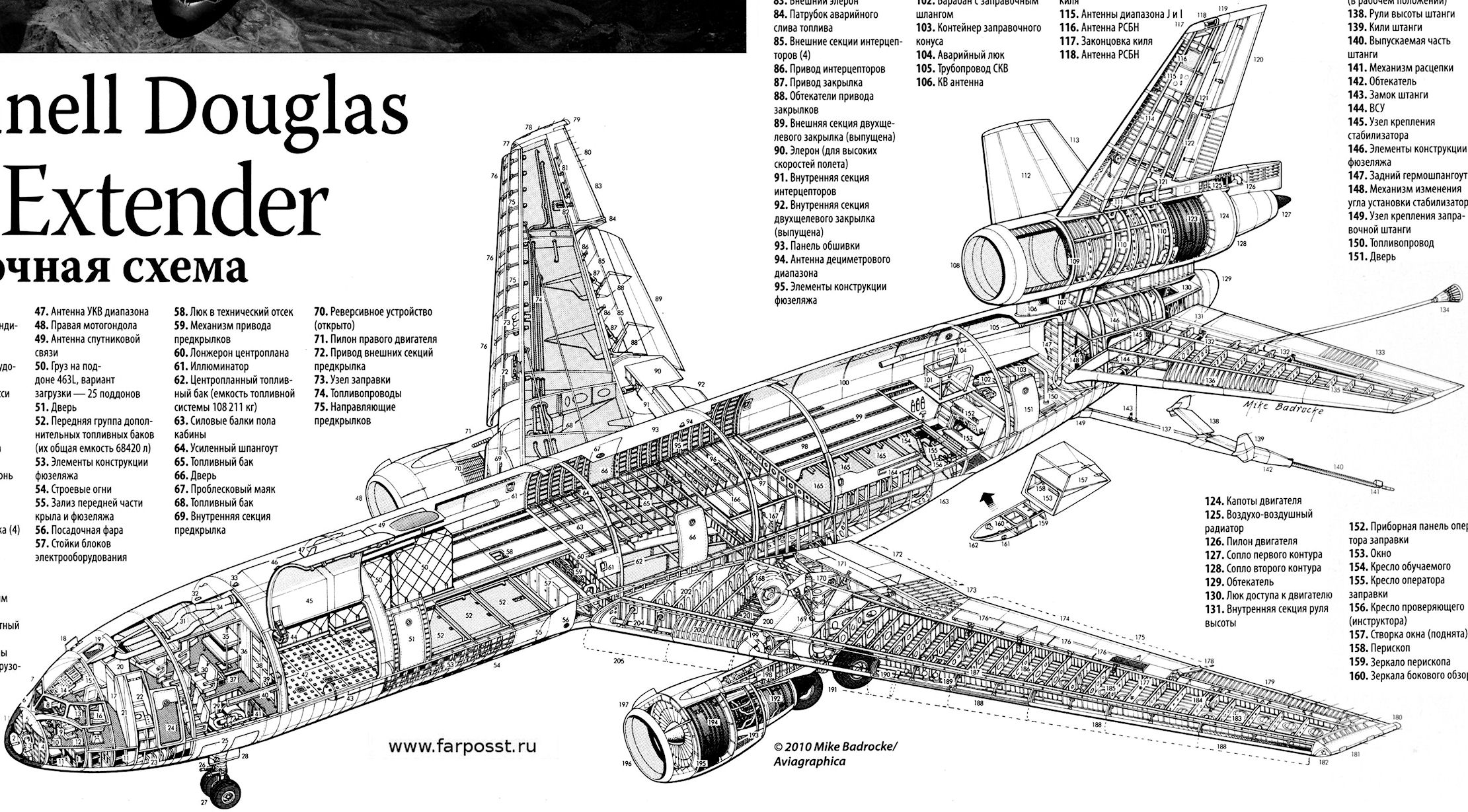
As for how much of the fuselage is taken up by fuel tanks, you can look at cutaways of the KC-135 and KC-10 (unfortunately the captions for the KC-10 are in a foreign language, as I could not find a high-enough resolution one in English). In both cases, the fuel tanks are in the lower half of the fuselage - the reason the KC-10 has a cargo mission as well is because it is a larger aircraft and has a much higher gross weight. The KC-135's cargo space is much smaller, and as such is not used for transporting large items. This technical document for the KC-10 also gives volume of each tank (called Fuel Cells):

  • Forward Fuselage - 8,250 gallons in 3 sections, 6' deep
  • Aft Fuselage - 9,870 gallons in 4 sections, 6' deep

You are correct that it is a struggle getting them airborne when fully loaded - several of the KC-135 pilots I have talked to have taken until the very end of 10,000 foot plus runways to get airborne, and one of the KC-10 pilots I know said they would occasionally take off with less than a full load then take on fuel from a KC-135 to make it easier.

Page 3-45 of this technical manual has a chart for calculating minimum runway for a particular speed - for example, a sea level takeoff at 30 degrees (Celsius) at Max takeoff weight would require about a 13,500 foot runway.

SSumner
  • 5,354
  • 1
  • 29
  • 43
  • 3
    Wow, this is exactly what I was looking for. I hadn't realized the KC-10 was actually larger than the KC-135! Must be some nice engines! – Bassinator Oct 09 '14 at 00:56
  • 9
    I would almost suggest JATO bottles for takeoff, but something about strapping a few rocket engines onto a plane carrying nothing but fuel seems like a bad idea... – Bassinator Oct 09 '14 at 00:58
  • 2
    @HCBPshenanigans - the KC-10 has 3 engines producing 52,500 pounds each while the KC-135R (currently flown model) has 4 engines producing 21,600 pounds each - the old E-model engines only produced 13,750 pounds each, so you can see why the old 135s especially were underpowered – SSumner Oct 09 '14 at 01:43
  • 2
    At McConnell AFB they have 8 KC-135s that can also take on fuel (we called them R/Ts). Also, the KC-135 can carry 80,000 lbs of cargo for various missions. (I was a boom operator during the enlisted portion of my AF career.) A fully loaded 135 with the CFM-56 engines can outclimb a KC-10 any day of the week! ;) – JasonR Oct 09 '14 at 17:04
  • 2
    I don't entirely get why air-refueling of tanker aircraft makes sense - can anyone explain? – Sanchises Apr 07 '15 at 14:14
  • 1
    @sanchises - if a jets crew has the end of their duty day, but still have gas, then they can offload it so the gas can stay on station but they dont have to – SSumner Apr 07 '15 at 18:15
  • @SSumner Thanks, I interpreted the sentence the other way round, which did not make sense. Got it now, though. – Sanchises Apr 07 '15 at 18:39
  • 3
    @Sanchises aircraft can be limited at take off by their Maximum Takeoff Weight, but actually fly with more weight (particularly so if the tanker is departing a base with a shorter runway) - so for particularly long tanker missions you can load the aircraft to the MTOW and then top it up to the mission load from another tanker once its in the air. – Moo Jan 19 '17 at 18:17
  • @Airhead: Probably still less bad than strapping them onto a plane packed to the gills with high explosives... – Vikki Jun 26 '18 at 02:42
  • 10
    "This is over 7 full loads of gas for a B-52 ... so 365,000 capacity of KC-10 would potentially fully fuel a B-52 one time". Quite the contradiction right there in just one sentence! :) – FreeMan Aug 26 '22 at 11:54
  • @Sanchises That would make an interesting Question! – StephenS Aug 28 '22 at 03:45