10

This answer explains how pilots when switching code on transponder should either carefully avoid temporarily squawking one of the emergency codes, or should temporarily put the transponder in stand-by.

Radios (both comm and nav) usually have an active frequency and a stand-by frequency and the pilot selects the stand-by frequency and then activates it with a button, which avoids temporarily selecting different frequency and limits the time when the radio is not receiving.

Why don't transponders have similar mechanism? It seems it would be much more useful for them than it is for the radio.

Jan Hudec
  • 56,247
  • 12
  • 155
  • 268
  • 4
    They do. Every transponder I've seen has a standby position. – Simon Oct 20 '15 at 09:31
  • @Simon, a stand-by position on the switch yes. But not a button that would activate the new value only after it has been fully set. – Jan Hudec Oct 20 '15 at 09:58
  • 1
    Not all radios have a secondary frequency which you set and then switch to, many older radios have only one frequency. – GdD Oct 20 '15 at 10:01
  • 1
    Just having a short delay (10 seconds) after a new code is set before the transponder uses it, may be enough. – Ian Ringrose Oct 20 '15 at 12:47
  • @IanRingrose well yes, the problem only exists on primitive transponders like the one with one knob per digit, precisely because they have relatively simple electronics inside. The knobs are probably wired directly into the sequencing hardware; they're too simple for an automatic 10 second delay. – Roman Oct 20 '15 at 17:15
  • @Simon That standby mode prevents the transponder from responding to interrogations entirely (your target becomes a primary target only, with no data block). You should generally not set your transponder to its standby mode unless ATC tells you to. – voretaq7 Oct 20 '15 at 17:29
  • The 10 second delay could be put into the radar software, also with a check that if the plane goes missing the last number is shown even if it was active for less then 10 seconds. – Ian Ringrose Oct 20 '15 at 17:31
  • @voretaq7 Well, that's what I was trained to do, and my habit, and ATC have not commented once. AFAIK, it's common practice so disappearing for 5 seconds is probably no big shakes to them. – Simon Oct 20 '15 at 17:42
  • @Simon I don't know about it being "common practice" (none of the folks I fly with do it). While I doubt it would be a serious issue in most cases, particularly in relatively empty airspace, it seems contrary to the guidance in the AIM. A sweep in "standby" mode means ATC loses your altitude (and possibly your whole target) until the system interrogates you again which could confuse their conflict alert software. I can't point to a FAR that says "don't do that", but it definitely seems strange to me. – voretaq7 Oct 20 '15 at 17:57

3 Answers3

11

For navigation and communication radios the feature of having a second readout that can be pre-set to the next frequency is useful since the next frequency is usually known in advance. Your next transponder code is a somewhat random number and the moment that you will get it is not as predictable as a frequency change. Therefore there is no need for a pre-set / standby squawk code in a transponder.

Also, in a communication radio, when you pre-set the wrong frequency and cannot establish communication after the switch over, a single button press will bring you back to the original frequency. This prevents prolonged communication loss. This is similar in navigation radios. For a transponder such a feature has no value, you won't switch back to the previous squawk code.

The problem of inadvertently selecting a special code can be addressed by other means. For example a digital interface that requires confirmation of the selected code before it is activated.

DeltaLima
  • 83,202
  • 11
  • 272
  • 366
3

The transponders that have the problem of inadvertently selecting/transmitting "incorrect" (or emergency) codes are old-tech designs. Much like the old-tech radio designs there was no concept of "standby frequency" or "code being entered" - whatever was on the face of the instrument is what it's doing.
Radios of the same vintage have the same interface (e.g. the KX-170b):
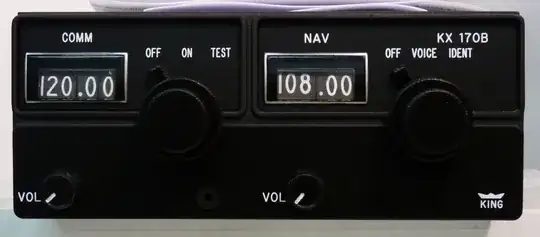
This radio has no "standby"

The usual solution for the old-tech transponders is to think before you spin the knob. If you were squawking 7701 and told to squawk VFR (1200 in the US or 7000 in most of Europe) you wouldn't turn the right-digit until you'd adjusted one of the other two so you wouldn't inadvertently squawk one of the emergency/alert codes.

(The radar system could still see you squawking the "wrong" code for one or two passes in this situation, but that's a self-resolving problem and it generally doesn't set off any alarms for ATC.)


Modern (push-button entry) transponders do have an "inactive" squawk code in that then new code isn't transmitted until after you're done entering it. Most also have a clear or one-touch VFR button in case you make an error entering the new code, so if ATC assigned you code 7001 and you inadvertently punched 77 in turbulence you don't need to keep entering a "wrong" code - just hit clear or VFR and try again.

voretaq7
  • 68,398
  • 8
  • 226
  • 337
-4

Transponders are more technologically conservative than radios and the old models have a lot of analog electronics in them. You could certainly add the electronics and additional buttons to have them do a switchover the way radios do, and I think newer models can, but the older models are more primitive, which is why you see those instructions to use standby.

Tyler Durden
  • 13,282
  • 4
  • 43
  • 67