Considering that building runways is expensive and that they take up a lot of space, could you land a large commercial airliner on a circular runway, braking as you go around the curves?
Asked
Active
Viewed 1.5k times
37


-
30"Breaking" is the most likely result, yes. :) – egid Feb 24 '14 at 18:49
-
2I was thinking of airports like Berlin-Tempelhof, which is in the middle of the city and therefore small, but which has circular taxi-ways on the perimeter around the runways. One reason this airport was closed was that the runways didn't support large aircraft. – yippy_yay Feb 24 '14 at 20:15
-
20Circular runways are called helipads but they work better for helicopters. – p1l0t Feb 24 '14 at 20:15
-
20Circular Runways: Because if there is one thing I want during my landing roll is to turn away from the headwind – Radu094 Feb 24 '14 at 21:07
-
5The short runway problem has already been solved: http://en.wikipedia.org/wiki/Aircraft_arresting_system. Brace! – Igby Largeman Feb 26 '14 at 04:57
-
1So that would be up/cross/down/cross/up-wind take-offs and landings all the time... @SebastianHenckel: Only if the circular runway would be all around Berlin, outside ring-bahn circle... – paulo.filip3 Feb 26 '14 at 12:06
-
1http://www.endlessrunway-project.eu/ you aren't the first to think of this – markasoftware Feb 27 '14 at 05:00
-
2Reminds me of the old joke (from the early Fifties, and inspired by underpowered aircraft like the F-84): If someone builds a runway all the way around the world, Republic will design an aircraft that needs every inch of it. – Peter Kämpf Nov 28 '14 at 21:47
-
To my surprise, no on has mentioned the fact that planes have different turning radii that would change based on each aircraft's airspeed and the current windspeed. Pretending that there is a "one size fits all" radius is a huge fallacy in this idea when they talk about "banking the runway" an therefore, also the aircraft. – Ryan Mortensen Mar 18 '17 at 17:45
-
@IgbyLargeman: Not for commercial airliners. – sampathsris Jun 02 '17 at 14:36
11 Answers
29
As a matter of physics, there's a certain amount of braking and steering force available to the aircraft after it lands.
Suppose the aircraft touches down moving due north, and continues clockwise around your circular runway. After a quarter-circle it travels due east -- but that means that enough braking force has been applied to reduce the northward component of its velocity to zero, while also giving it some eastward velocity.
If only that eastward force hadn't been applied, the aircraft would be at a halt now -- using less force than what's necessary for it to follow the circle.
So if the plane can keep itself on a circular runway, it will be even easier for it to come to a halt on a straight runway whose length is the radius of the circle.
(Also, the plan ignores that the critical factor in the length of runways is not landing but taking off -- there must be enough runway to brake down safely if the takeoff is aborted just before rotation. And taking off from a curved runway sounds even crazier than landing. If the runway is horizontal, the plane would become airborne in the middle of an uncoordinated turn...)

hmakholm left over Monica
- 6,648
- 4
- 26
- 44
-
8
-
5The logic seems reasonable, but is it actually true? That is, if a vehicle in general can make an unbanked turn with radius
r, then it can necessarily come to a halt in distancer? – Steve Jessop Feb 25 '14 at 09:04 -
8@SteveJessop: There are some differences being swept under the carpet here because a turning force does no work whereas a braking force has to dissipate some waste heat. But it looks like the limiting factor in actual fact is not energy dissipation but the available friction between the landing gear and the runway anyway, so yes, it ought to be true. – hmakholm left over Monica Feb 25 '14 at 09:35
-
@anarcat: What if a straight runway went uphill? Oh, you mean for takeoff? A banked curved runway would be right for only one specific Vr, which I imagine would be operationally cumbersome. :P – hmakholm left over Monica Feb 25 '14 at 09:39
-
@SteveJessop that might actually be a very interesting question to pose over on [physics.SE]. – David Z Feb 25 '14 at 23:18
-
2@HenningMakholm Well, you could have a runway with a U-shaped profile, so that every Vr can choose a slant angle right for them. Although I imagine the pilots will complain even more about this. – Superbest Feb 26 '14 at 13:00
-
4Also, the question assumes that braking and turning is done by the same force, but isn't an airplane better at turning than stopping because it can use the tail rudder which it wouldn't be able to use for braking? – Superbest Feb 26 '14 at 13:01
-
1@anarcat many runways are slanted, slightly and sometimes not so slightly. Makes takeoff or landing slightly shorter or longer depending on the angles involved, but rather hard to reverse if the wind shifts :) – jwenting Feb 26 '14 at 13:17
-
1@Superbest at the low speeds involved, the rudder is not very effective at turning, so you'd have to rely on differential braking and thrust instead (talking airliners here, not your C172). – jwenting Feb 26 '14 at 13:18
-
@jwenting: Differential braking/trust produces no sideways force -- it merely yaws the aircraft, and actually forcing it to move away from a straight line right depends on wheel/runway friction after the fact. And it's even worse for the rudder -- since the rudder is aft of the CoG, yawing the aircraft to the right depends on producing a net left force on the tail and vice versa. Again the actual centripetal force must be supplied by the wheel/runway interface. – hmakholm left over Monica Feb 26 '14 at 15:30
-
@HenningMakholm: Um, no, yawing the aircraft to the right does in fact help to turn it, by putting the aircraft into a sideslip and allowing its weathervane stability to shift its direction of flight. Otherwise, it would be impossible to make an unbanked turn in the air, when this is actually easily done (although somewhat dangerous due to the risk of causing a spin). – Vikki Apr 13 '19 at 04:21
26
One major complication would be the shift in relative wind as you work your way around this curved runway.
On approach, the wind would be coming from one direction (ideally straight head), then as you touch down and begin your curve while slowing down, the wind shifts direction to come more from one side. So now you're trying to stay on a centerline that is curving, at somewhat high speed, while the wind moves to one side of your plane.
That is just insane.
Another major issue would be the amount of "float". Although airplanes target touching down right at the end of the runway, that doesn't always happen. Sometimes due to excess speed, gusty winds, or a misjudged flare, the plane will float a distance down the runway before actually touching down. During this time, the plane's nose may be high, and visibility of the runway is limited. Because the runway is straight, it's no problem.
But suggesting that a pilot navigate a curved runway while floating further than anticipated is just nuts. If they don't turn enough, they end up outside the curve of the runway. If they turn too much, they end up inside the curve. Either way, if they overcorrect at low altitude and airspeed, the chance of a catastrophic crash is unacceptably high.


21
Since there are actual projects for things like this I guess it is possible at least in principle:
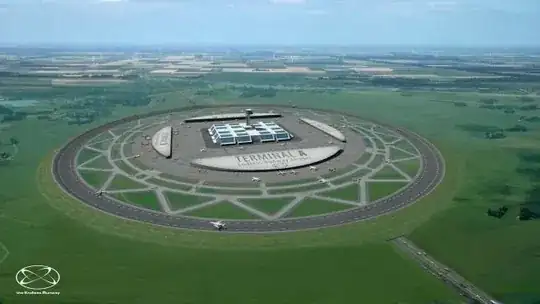
https://www.endlessrunway-project.eu/
From the site:
The main feature of the circular runway is that it will become possible to let an aircraft operate always at landing and take-off with headwind. Whatever its strength and direction, the Endless Runway becomes independent of the wind. When allowing limited crosswind, airspace users can shorten the global trajectory of the flights through optimized departure and arrival routes.
Apart from that they seem to hope that they can start/land more airplanes per time unit by shifting the start/landing point thus avoiding the problem that airplanes must not follow other airplanes to close along the same trajectory.

Jakuje
- 103
- 5

Jens Schauder
- 343
- 1
- 8
-
3yes, this thing would have a runway be a very large circle, with a radius large enough that you can always run along it (nearly) straight and thus always have optimal wind. In reality of course that'd be so large as to be impractical. But it's essentially possible using a circular platform that's 10x10km in size, not dissimilar to the meadows used for WW1 and early WW2 airfields where aircraft could take off and land on a roughly circular patch of grass around the periphery of which was constructed the airfield. – jwenting Feb 26 '14 at 13:21
-
10They envisage a circular runway 3000 m in diameter. By my back-of-the-envelope calculations, the lateral acceleration necessary for following that circle at a takeoff speed of 140 knots would correspond to a bank angle of about 20 degrees. Getting airborne will be exciting ... – hmakholm left over Monica Feb 27 '14 at 12:21
-
-
3
-
2Not to mention that, at a 3,000 m diameter and 140 kt takeoff speed, the wind would be changing direction relative to your aircraft very quickly. Where there really becomes a problem is as you're turning through the area of the runway where you have a headwind. As you turn into that area, your airspeed increases, potentially to the point that you leave the ground. As you turn out of that area, you're airspeed drops again, potentially stalling the wings. Bad news. – reirab Mar 28 '14 at 15:40
-
6
-
2@JensSchauder, 'Lift off' is not something that happens instantly. When you're taking off, you start pulling back at the rotation airspeed and the nose starts to rise into the air then. However, the main gear doesn't rise off the ground for a few seconds after that. On a circular runway with a 1,500 m diameter near V2 of an airliner, you would do some significant turning during that time. Also, even once you're fully off the ground, it takes a finite amount of time to roll out of the turn. You can't stop turning immediately. – reirab Mar 29 '14 at 15:12
-
2I downvoted this because compared to other answers, this answer fails to address in detail the ins and outs of the proposed runway. Crazy engineering designs are proposed every year, but that doesn't mean they're practical. I'd like to see more discussion of advantages, whether those advantages could actually be realized in practice, and disadvantages of the proposed design. – Cody P Dec 02 '16 at 17:27
-
1The last time the endless runway site was updated was March of 2015, so it looks pretty dead as a project. – zeta-band Dec 30 '16 at 18:37
-
1@zeta-band every few month some news flunky looking for something "sciency" for the evening news comes across the site and interviews the people involved about their "revolutionary idea" that they're going to implement "real soon now" (never mind that it was tried and rejected over 50 years ago). – jwenting Apr 11 '17 at 10:11
10
A circular runway maybe works but this circle can't be small as the turn must be really smooth, talking about just a few degrees per 1000 feet. So this runway would actually be very "long" and need a lot of space.
Let's stop thinking about that! You would probably not be able to maintain 'directional' control if the outboard engine fails (e.g. left turning runway, right engine fails). How would you set up an ILS approach? Aircraft aren't build for this. It would be dangerous or even impossible and would never be approved.


-
3This would also be disastrous with anything less than great braking action. It would also destroy our ability to do reduced vis (300 or 600 RVR) takeoffs. Where would the approach lights go? Would there be an extension like a running track? – casey Feb 24 '14 at 18:47
-
Adapting ILS would certainly be a challenge, but even now certain airports have complex approaches. Curved path approaches have been demonstrated before, and with GPS there are now even more possibilities. – fooot Apr 14 '15 at 14:29
8
The problem with some of these proposed ideas (like a treadmill) is that they don't account for the inertia of the plane. You can't take a 500,000 lb 747 travelling at 160Mph and simply place it on a treadmill or spinning runway. There is still forward velocity to account for. Even if you could find a way to make the aircraft stop "very fast" without ripping the landing gears off (ie. the arresting gear suggested by Dan), think of the effect it would have on passengers. Consider going from 160Mph to 15Mph in only a few seconds. It's not comfortable, and for many people (think infants and elderly), it's not even safe.
In regards to the aircraft turning, commercial airplanes are quite top-heavy, at least when compared to cars. Cars can turn very fast, even at high speeds (think NASCAR), because they are low to the ground. They have huge surface area on their tires in relation to the size and weight of the vehicle. Airplanes are the opposite. Compared to their size and weight, landing gears are very small, and not very useful for much else than rolling in a straight line.

StevoInco
- 181
- 2
5
The cost of building a "circular runway" (probably with banked sides like a Velodrome) would probably be more difficult and expensive to build than a big long flat bit of concrete.
Another way to solve the same problem would be to use arresting gear and catapults like they do on aircraft carriers (which have the same problem - too expensive to build a big enough runway).
I'd pay extra to land and take off on such a runway, but I may be in the minority :-)

Dan Pichelman
- 6,979
- 2
- 38
- 43
5
As a pilot, it sounds terrible. Even landing or taking off on a strip with a hump in the middle, so you cannot see the other end, dramatically increases the workload, and the degree of risk. Not to say that it cant be done, when everything goes right, but if anything fails, then you raise the risk of a crash enormously.
And at the moment, the bottleneck is not getting to the airport, its waiting around to go through all the procedures when there that takes most of the time. So its not much advantage to put an airport nearer the city anyway. A better road, catering for airport traffic only, to further away, may well cut the transit time.
Personally I would rather land an aircraft somewhere where there are as few obstacles as possible. Gives a much better chance of success when things go wrong.

Adrian Janen
- 51
- 2
-
Yeah, most larger cities have tall enough buildings that you don't want the airport too close to the city center, anyway. – reirab Mar 29 '14 at 15:15
3
As many of these other answers speak to as well, the rate of turn for aircraft on the ground is very low, so the circle would have to be far larger than practical.
However, on a very related note, early airports all had circle landing areas. From wikipedia:
The earliest aircraft takeoff and landing sites were grassy fields. The plane could approach at any angle that provided a favorable wind direction. A slight improvement was the dirt-only field, which eliminated the drag from grass. However, these only functioned well in dry conditions. Later, concrete surfaces would allow landings, rain or shine, day or night. http://en.wikipedia.org/wiki/Airport

woody121
- 131
- 2
-
8The landing area might have been circular or oval shaped, but the actual landings and takeoffs were straight. – BeowulfNode42 Feb 25 '14 at 13:36
-
... yes, I am aware. Thats the rate of turn restriction I mention. As explained in the quote, the advantage of the circle is not to shorten the field but to give the pilot the ability to always land and takeoff into the wind. – woody121 Feb 25 '14 at 19:17
-1
Yes. The "long line loiter" method (see https://en.wikipedia.org/wiki/Pylon_turn ) could be used to lower a weighted line from the airliner to the ground. The line would be retrieved by ground crew and attached to a winch mounted on a turntable on top of a tower in the middle of the runway circle, tall enough for the line to clear all obstacles. The winch would be equipped with a system allowing it to apply constant tension to the line, which could be varied to equal any desired tension. As the airliner descends, the winch would start applying more and more tension to the line, so that the line would provide some of the centripetal turning force, allowing both the bank angle and the turn radius to be decreased, after the manner of a control-line model airplane. By the time the airliner reached the surface, the line would be providing all the centripetal force required for the airliner to stay over the circular track with zero bank angle. As the aircraft approaches the surface, a computerized control system linked to a GPS receiver onboard the aircraft could be used to ensure that the line tension was modulated in such a way as to keep the aircraft nearly over the centerline of the circular track, despite variations in wind speed and direction, and then at that point the winch spool could be locked to keep the line length fixed until touchdown. A similar method, but in reverse, could be used for takeoff, with the line being jettisoned (or simply released from the ground winch and reeled back up to the aircraft) after the aircraft is established in a "long line loiter" turn at the appropriate altitude and bank angle.

quiet flyer
- 22,598
- 5
- 45
- 129
-5
Different point of views can be derived of such a suggestion:
- Huge turntable-like runways which turn while the landing aircraft rolls out. Turning at the same speed as the aircraft decelerates, result in the aircraft always be facing the same wind conditions during stopping process.
- Development of the first item: a treadmill-like landing runway. At the time of touchdown the aircraft does not require any airstream along its wings. The following deceleration could be performed on a treadmill or assembly line.
But honestly, none of them would financially or even technically pay off the effort of just expanding existing runways in length.

-
2A treadmill wouldn't help. If you landed without using wheel brakes, it would obviously take the same distance (relative to a stationary point on the ground) to stop, whether the runway was moving or not. So the only way you could stop in a shorter distance would be if you could dissipate more kinetic energy per second in the wheel brakes, i.e., by having more powerful brakes and grippier tyres. But then you could use those brakes and tyres just as well to get a shorter stopping distance on a static runway! – David Richerby Feb 25 '14 at 23:01
-
Sure, without wheel brakes it takes all the same distance. But was thinking about using wheel braking + treadmill for a decreased need for landing space on an airport. – LRT Feb 26 '14 at 07:58
-
4The version without wheel braking was a thought experiment to set things up. With wheel braking, a treadmill wouldn't help because the plane would need more powerful brakes and stronger, grippier tyres or it would just skid against the moving pavement. To avoid that, you would need better brakes and tyres than existing planes have but, if you had that, you could stop shorter on existing runways, without needing the expense of the treadmill. – David Richerby Feb 26 '14 at 08:35
-6
This will work if the circular runway is rotating. The runway should be on a pedestal, and spin up to an to an angular velocity such that the tangent matches the aircrafts speed. then rise up and catch the aircraft, slowly reducing angular velocity and lowering to the tarmac.
Take off would proceed in the reverse manner. with the aircraft speeding up trying to stay on the rotating runway as it rises and increases angular velocity.
In the event of alien invasion we can use the rotating run ways to launch projectiles such as the airport busses.

user979
- 5
- 1
-
4I can't tell if this is a serious answer or not...technically it might work, but it's just so ridiculous it sounds sarcastic – SSumner Feb 25 '14 at 21:05
-
7Aircraft fly due to lift created from air moving over the wings, not because the ground moves quickly under the landing gear. Even if there was a rotating disc under the air craft, there'd be no lift created. – CJBS Feb 26 '14 at 07:39
-
1@CJBS, You're correct, of course, however, I assumed he meant that the aircraft would be stationary on the runway and let the runway accelerate it up to takeoff speed. Technically, that could work, but it would require far, far more energy input than just letting the aircraft take off under its own power (not to mention the obvious problems with trying not to get thrown off the side of the runway, changing wind direction, etc.) – reirab Mar 29 '14 at 15:22
-
@reirab - having a set of stationary fans blowing huge amounts of air at the craft is potentially more practical than having a spinning disc... – CJBS Mar 30 '14 at 04:41
-
2@CJBS, Well, that wouldn't really help anything, as it wouldn't actually accelerate the aircraft forwards. You could get some air flowing over the wings while it's behind the fans, but that's not going to help you once the aircraft rises out of the stream of air being blown at it by the fans. It would then immediately stall and plummet back down into the ground. Of course, the important thing to note here is that neither solution is practical. - lol – reirab Mar 30 '14 at 04:58
-
4Great. We could eliminate the aircraft altogether and simply fling the airport buses, complete with passengers, luggage and chickens, in the direction of the destination. – Mark Micallef Dec 02 '14 at 03:51