The part of the code on an ATmega core that does setup() and loop() is at follows:
#include <Arduino.h>

int main(void)
{
        init();

#if defined(USBCON)
        USBDevice.attach();
#endif

        setup();

        for (;;) {
                loop();
                if (serialEventRun) serialEventRun();
        }

        return 0;
}
Pretty simple, but there is the overhead of the serialEventRun(); in there.
Let's compare two simple sketches:
void setup()
{

}

volatile uint8_t x;

void loop()
{

    x = 1;

}
and
void setup()
{

}

volatile uint8_t x;

void loop()
{
    while(true)
    {
        x = 1;
    }
}
The x and volatile is just to ensure it isn't optimised out.
In the ASM produced, you get different results:
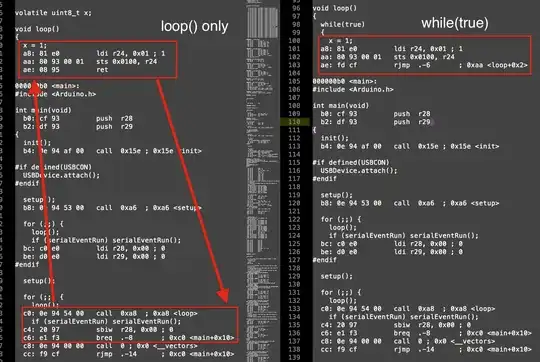
You can see the while(true) just performs a rjmp (relative jump) back a few instructions, whereas loop() performs a subtraction, comparison and call. This is 4 instructions vs 1 instruction.
To generate ASM as above, you need to use a tool called avr-objdump. This is included with avr-gcc. Location varies depending on OS so it is easiest to search for it by name.
avr-objdump can operate on .hex files, but these are missing the original source and comments. If you have just built code, you will have a .elf file that does contain this data. Again, the location of these files varies by OS - the easiest way to locate them is to turn on verbose compilation in preferences and see where the output files are being stored.
Run the command as follows:
avr-objdump -S output.elf > asm.txt
And examine the output in a text editor.


main.cused by Arduino IDE. However it does not mean that HardwareSerial library is included to your sketch; actually it is not included if you don't use it (that's why there isif (serialEventRun)inmain()function. If you don't use HardwareSerial library thenserialEventRunwill be null, hence no call. – jfpoilpret Feb 21 '14 at 20:04Serial.print(). In this situation, what can happen if yourloop()loops forever and thus never callsserialEventRun()? I'm afraid Serial may not work in this case. – jfpoilpret Feb 21 '14 at 20:07serialEventRun()callsserialEvent()for the various serial ports. By default, all of these are empty procedures, but they can be overridden by the user to do something useful if desired. If you're not overriding it, there's no need to call it. – microtherion Mar 03 '14 at 16:23