3

I've bought an additional second hand printer and I noticed that the lead screw has been bent. I did not have any issues so far with prints that are only a few cm tall.

I filmed it from the top, next to a ruler, as shown below and put a grid over it for reference. I think it should be replaced. How bad is this? When should it actually be replaced?

rotating bended leadscrew view from above

Criggie
  • 1,114
  • 7
  • 22
Bob Ortiz
  • 1,245
  • 1
  • 10
  • 42

2 Answers2

7

It's too bent when it starts to cause issues.

Really, it is that simple. If your prints looks good, you don't hear any screeching sounds, your motors are not losing steps, then you are good and just leave them be. Keep them clean, keep them lubed, and enjoy your hobby.

More specific to your situation, good set of lead screws, with guaranteed straightness and pitch consistency, can cost more than an used Ender 3. Decent "3D printing quality" set will cost less, but still a significant percentage of your machine worth. Enders are good bang for your buck, not because they have a lot of bang, but because how little is the buck. They are designed to be built with imprecise parts, and to still give acceptable quality. You can replace screws, replace V wheels with linear rails or rods and ball bearing, you can add input shaping by changing firmware to Klipper, upgrade hotend, add enclosure, replace extruder with something lighter, and so on. But why?

By the time you will find and "fix" all the quirks of your Ender, you will spend enough to build Voron or RatRig, or to buy one of the Bambu Labs printers or Prusa kits. And that's what I'd do, but if you prefer to tinker, if that's your hobby, go for it. Just remember, it doesn't make economical sense.

To reiterate, if it works acceptably, don't fix it. Unless it's for fun.

Mołot
  • 904
  • 5
  • 18
3

Cause and effect

Bent screws can cause an effect known as Z-wobble. But, to mitigate this, the non-driven side of the lead screw is left unconstrained. This is intentionally designed as such.

This means that as long as the linear guide (being V-slot with rollers, linear shafts or linear rails) are sufficiently guiding the carriage, a little bent screw would not cause too much problems in the print result.

Note that the animated gif shows the end displacement, this exaggerates the actual displacement experienced by the lead screw nut.

When is a leadscrew too bent and should be replaced?

If it causes quality issues in your prints.

E.g.: enter image description here

Mitigation

Buying new, straight leadscrews. Usually, the more straight the more expensive, the lead screws from the far East range from acceptable to unusable. Ball screws are much more precise, but also cost more, especially the ground screws.

Some people straighten the lead screws, there are videos to be found how you do that.

But, note that there is an option not to replace the screws!

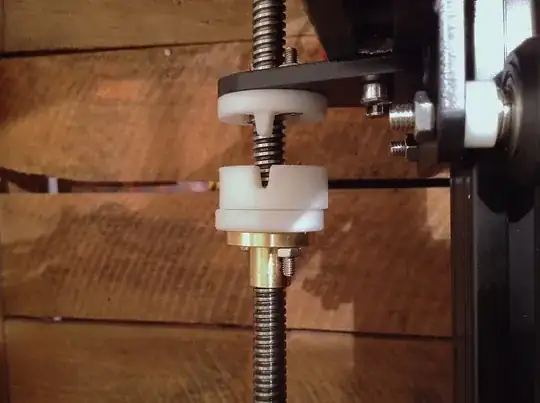
E.g., to completely remove any wobble of the lead screw, you can use something called an Oldham coupler to decouple the X-Y movement from the Z movement. For Creality Ender printers, there are specific couplers to order to install so that you will not need to buy new lead screws.

Custom printer designed Oldham couplers look similar to: enter image description here

There are also printable versions that work very well, in fact I designed and used my own, inspired by this design: enter image description here
0scar
  • 37,446
  • 12
  • 68
  • 156