Geoffrey Chaucer


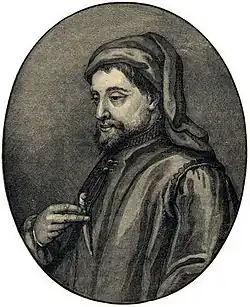
Geoffrey Chaucer (c. 1343 – October 25, 1400) was an English author, poet, philosopher, bureaucrat (courtier), and diplomat. Chaucer is most famous as the author of The Canterbury Tales. He is sometimes credited with being the first author to demonstrate the artistic legitimacy of the vernacular English language, rather than French or Latin.
- See also The Canterbury Tales
Quotes
Th' assay so hard, so sharp the conquerynge,
The dredful joye, alwey that slit so yerne;
Al this mene I be love.
- By writing have men mind of things passed, for writing is the key of all good remembrance.
- "The 25 Good Women", quoted in Edward, 2nd Duke of York, The Master of Game, Prologue
- The lyf so short, the craft so longe to lerne.
Th' assay so hard, so sharp the conquerynge,
The dredful joye, alwey that slit so yerne;
Al this mene I be love.- Parlement of Foules, ll. 1-4; comparable with Hippocrates, Aphorisms 1:1 (Ars longa, vita brevis)
- For out of olde feldes, as men seith,
Cometh al this new corn fro yeer to yere;
And out of olde bokes, in good feith,
Cometh al this newe science that men lere.- Parlement of Foules, l. 22-25
- Nature, the vicar of the Almightie Lord.
- Parlement of Foules, l. 379
- Soun is noght but air ybroken,
And every speche that is spoken,
Loud or privee, foul or fair,
In his substaunce is but air;
For as flaumbe is but lighted smoke,
Right so soun is air ybroke.- The House of Fame, bk. 2, l. 257-62
- For I am shave as neigh as any frere.
But yit I praye unto youre curteisye:
Beeth hevy again, or elles moot I die.- The Complaint of Chaucer to His Purse, l. 19–21
- Harde is his herte that loveth nought
In Mey, ...
Troilus and Criseyde (1380s)

That hadden prys, now wonder nyce and straunge
Us thinketh hem; and yet they spake hem so,
And spedde as wel in love as men now do
- Ye knowe eek, that in forme of speche is chaunge
Withinne a thousand yeer, and wordes tho
That hadden prys, now wonder nyce and straunge
Us thinketh hem; and yet they spake hem so,
And spedde as wel in love as men now do;
Eek for to winne love in sondry ages,
In sondry londes, sondry ben usages.- Book 2, line 22-28
- Of harmes two the lesse is for to cheese.
- Book ii, line 470
- For which he wex a litel red for shame,
Whan he the peple upon him herde cryen,
That to beholde it was a noble game,
How sobreliche he caste doun his yen.
Criseyda gan al his chere aspyen,
And let so softe it in her herte sinke
That to herself she seyde, "Who yaf me drinke?"- Book 2, line 645-651
- Or as an ook comth of a litel spir,
So thorugh this lettre, which that she hym sente,
Encressen gan desir, of which he brente.- Book 2, line 1335-37
- The earliest known near-usage in English of the proverb "Great oaks from little acorns grow."
- It is nought good a slepyng hound to wake.
- Book 3, line 764
- For of fortunes sharp adversitee
The worst kynde of infortune is this,
A man to han ben in prosperitee,
And it remembren, whan it passed is.- Book 3, line 1625-1628
- He helde about him alway, out of drede,
A world of folke.- Book 3, line 1721
- Oon ere it herde, at tothir out it wente
- One ear heard it, at the other out it went
- Book 4, line 434
- Eke wonder last but nine deies never in toun.
- Book 4, line 525
- For tyme y-lost may not recovered be.
- Book 4, line 1283
- I am right sorry for your heavinesse.
- Book 5, line 146
- And for ther is so gret diversite
In Englissh and in writyng of oure tonge,
So prey I God that non myswrite the,
Ne the mysmetre for defaute of tonge;
And red wherso thow be, or elles songe,
That thow be understonde, God I biseche!- Book 5, line 1793-1798
- Go, little booke! go, my little tragedie!
- Book 5, line 1798
- O yonge fresshe folkes, he or she,
In which that love up-groweth with your age,
Repeyreth hoom fro worldly vanitee,
And of your herte up-casteth the visage
To thilke God that after his image
Yow made, and thynketh al nis but a faire
This world, that passeth sone as floures faire.- Book 5, line 1835-1841
Bartlett's Familiar Quotations, 10th ed. (1919)
- Quotes reported in Bartlett's Familiar Quotations, 10th ed. (1919).
- Your duty is, as ferre as I can gesse.
- The Court of Love, line 178
- O little booke, thou art so unconning,
How darst thou put thy-self in prees for drede?- The Flower and the Leaf, line 59
- Of all the floures in the mede,
Than love I most these floures white and rede,
Soch that men callen daisies in our toun.- Prologue of the Legend of Good Women, line 41
- That well by reason men it call may
The daisie, or els the eye of the day,
The emprise, and floure of floures all.- Prologue of the Legend of Good Women, line 183
- For iii may keep a counsel if twain be away.
- The Ten Commandments of Love
Quotes about Chaucer

—John Dryden
- Chaucer, notwithstanding the praises bestowed on him, I think obscene and contemptible;—he owes his celebrity, merely to his antiquity, which he does not deserve so well as Pierce Plowman, or Thomas of Ercildoune.
- Lord Byron, from a memorandum book dated 30 November 1807, in Letters and Journals of Lord Byron, ed. T. Moore (1830), p. 36
- The worshipful father and first founder and embellisher of ornate eloquence in our English.
- William Caxton, Epilogue to Boethius' De Consolacione Philosophie (1478)
- Chaucer was one of the most original men who ever lived. There had never been anything like the lively realism of the ride to Canterbury done or dreamed of in our literature before. He is not only the father of all our poets, but the grandfather of all our hundred million novelists.
- G. K. Chesterton, Chaucer (1959), p. 34
- As he is the Father of English Poetry, so I hold him in the same Degree of Veneration as the Grecians held Homer, or the Romans Virgil: He is a perpetual Fountain of good Sense; learn'd in all Sciences; and, therefore speaks properly on all Subjects: As he knew what to say, so he knows also when to leave off; a Continence which is practis'd by few Writers, and scarcely by any of the Ancients, excepting Virgil and Horace. ... Chaucer follow'd Nature every where, but was never so bold to go beyond her.
- John Dryden, Preface to The Fables (1700)
- 'Tis sufficient to say according to the Proverb, that here is God's Plenty.
- John Dryden, Preface to The Fables (1700)
- That noble Chaucer, in those former times,
The first enriched our English with his rhymes,
And was the first of ours that ever broke
Into the Muses' treasures, and first spoke
In weighty numbers, delving in the mine
Of perfect knowledge.- Michael Drayton, Epistle to Henry Reynolds (1627)
- One of those rare authors whom, if we had met him under a porch in a shower, we should have preferred to the rain.
- James Russell Lowell, My Study Windows (1871), p. 229
- One... characteristic of medieval space must be noted: space and time form two relatively independent systems. First: the medieval artist introduced other times within his own spatial world, as when he projected the events of Christ's life within a contemporary Italian city, without the slightest feeling that the passage of time has made a difference, just as in Chaucer the classical legend of Troilus and Cressida is related as if it were a contemporary story. When a medieval chronicler mentions the King... it is sometimes difficult to find out whether he is talking about Caeser or Alexander the Great or his own monarch: each is equally near to him. ...the word anachronism is meaningless when applied to medieval art... in Botticelli's The Three Miracles of St. Zenobius, three different times are presented upon a single stage.
- Lewis Mumford, Technics and Civilization (1934)
- I read Chaucer still with as much pleasure as almost any of our poets. He is a master of manners, of description, and the first tale-teller in the true enlivened natural way.
- Alexander Pope, as quoted in Joseph Spence's Anecdotes, Observations, and Characters, of Books and Men, ed. S. W. Singer (1820), p. 19
- Dan Chaucer, well of English undefiled
On Fame's eternal beadroll worthy to be filed.- Edmund Spenser, The Faerie Queene (1596), Book IV, Canto II, stanza 32
- Dan Geffrey, in whose gentle spright
The pure well-head of poetry did dwell.- Edmund Spenser, The Faerie Queene, Book VII. Canto VII, stanza 9
- The morning star of song, who made
His music heard below;
Dan Chaucer, the first warbler, whose sweet breath
Preluded those melodious bursts that fill
The spacious times of great Elizabeth
With sounds that echo still.- Alfred, Lord Tennyson, "A Dream of Fair Women" (1832), lines 3–8
- It is pretty generally admitted that Geoffrey Chaucer, the eminent poet of the fourteenth century, though obsessed with an almost Rooseveltian passion for the new spelling, was there with the goods when it came to profundity of thought.
- P. G. Wodehouse, "Rough-Hew Them How We Will" (1914)
External links
- Geoffrey Chaucer articles at Harvard University
- Texts of Chaucer's works online
- Works by Geoffrey Chaucer at Project Gutenberg
- Poems by Geoffrey Chaucer at PoetryFoundation.org
- Chaucer's Life
- Chaucer's Official Life by James Root Hulbert
- "Geoffrey Chaucer" - In Our Time on BBC Radio 4 (9 February 2006)
- Chaucer's language: Glossary from the Canterbury Tales
- Chaucer at The Online Library of Liberty
- The Canterbury Tales: A Complete Translation into Modern English
- Caxton's Chaucer
- Caxton's Canterbury Tales: The British Library Copies
- Portraits of Chaucer
- Astronomy & Astrology in Chaucer's Work